


Last Updated on August 23, 2026 by John Patterson
Think about it.
Grabbing a tub of multi-purpose construction screws feels like the modern, premium move. Screws pull boards tight, make zero noise, and feel indestructible in your hand.
Then the building settles, the wind blows, and fastener heads pop right off the studs. That stings your wallet and ruins solid framing.
Let’s be direct. Screws are not universal fasteners.
Standard screws are exceptional in tension, but terrible in shear. They snap under dynamic movement, split dry lumber, and trigger instant building code violations.
METALLURGICAL FAILURE FORMULA
High Surface Hardness + Low Core Ductility = Sudden Brittle Shear Failure
Curious how screws behave in structural stud walls? Review our engineering breakdown on can you use screws for framing.
Quick Answer: What Are the Main Disadvantages of Using Screws?
Short version?
Standard screws suffer from brittle shear failure under side-to-side load, split wood grain without slow pre-drilling, increase labor time by 400%, and cost up to ten times more than collated nails.
Unless certified as structural timber fasteners, driving common screws into framing lumber violates residential building codes.
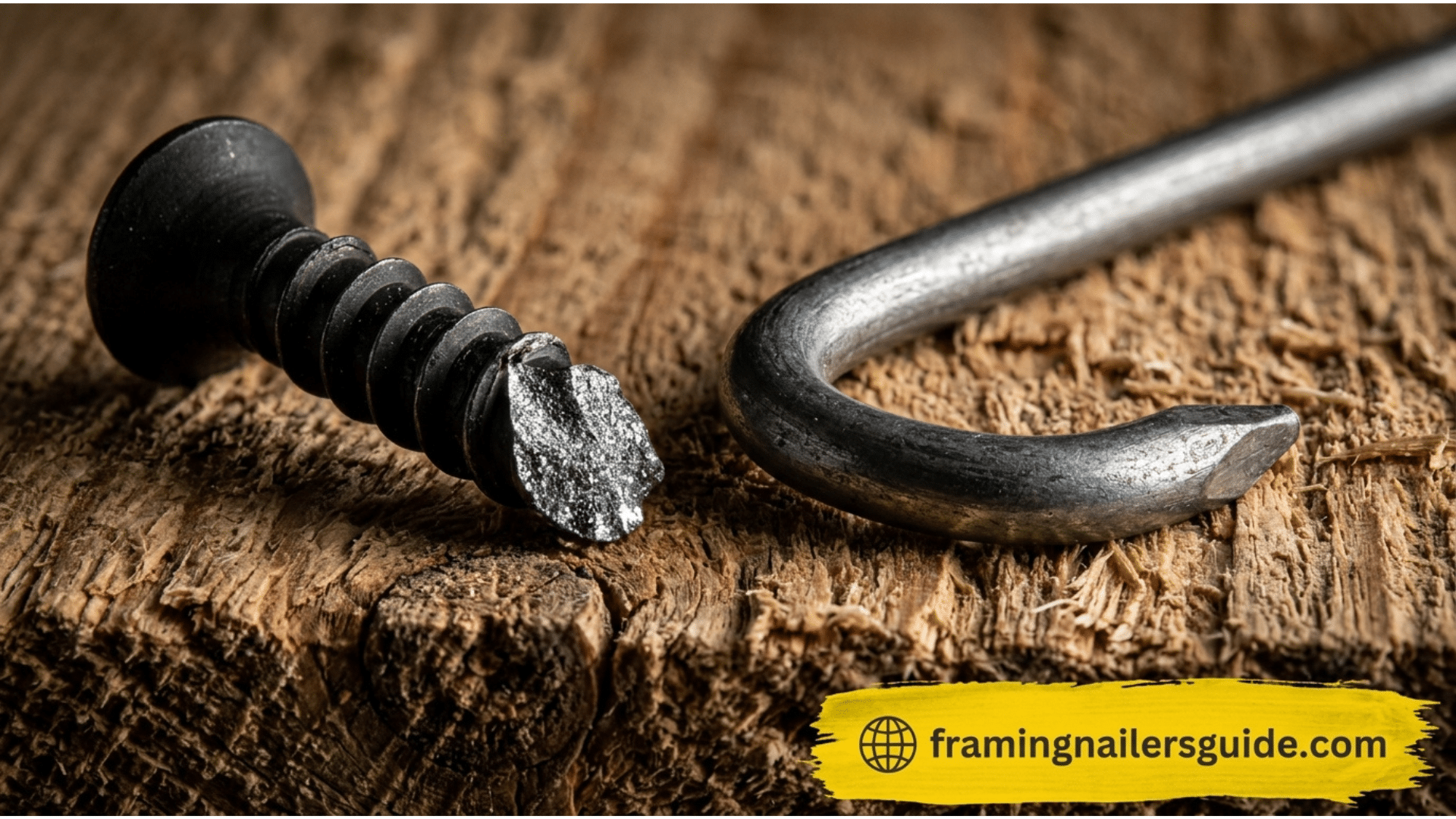
Brittle Shear Fracture: Case-hardened steel snaps cleanly in half when structures shift or settle.
Sluggish Production Speed: Driving screws with an impact driver takes 5 to 10 seconds per fastener compared to 0.5 seconds for pneumatic nails.
Lumber Splitting: Thick screw root shanks act like wedges, splitting board ends and edge grain.
Drive Head Cam-Out: Worn drive recesses cause driver bits to slip, permanently locking stripped fasteners.
Heavy Cost Penalty: Quality structural screws cost $0.35 to $1.25 each compared to $0.03 per framing nail.
Need exact nailing schedules for wall assemblies? Check out our complete guide on what size nails for framing.
Disadvantage 1: Brittle Shear Failure Under Lateral Loads
Physics never lies.
Fastener factories case-harden carbon steel screws with high heat. This creates high surface hardness so your driver bit does not strip the head.
That hardness destroys internal ductility.
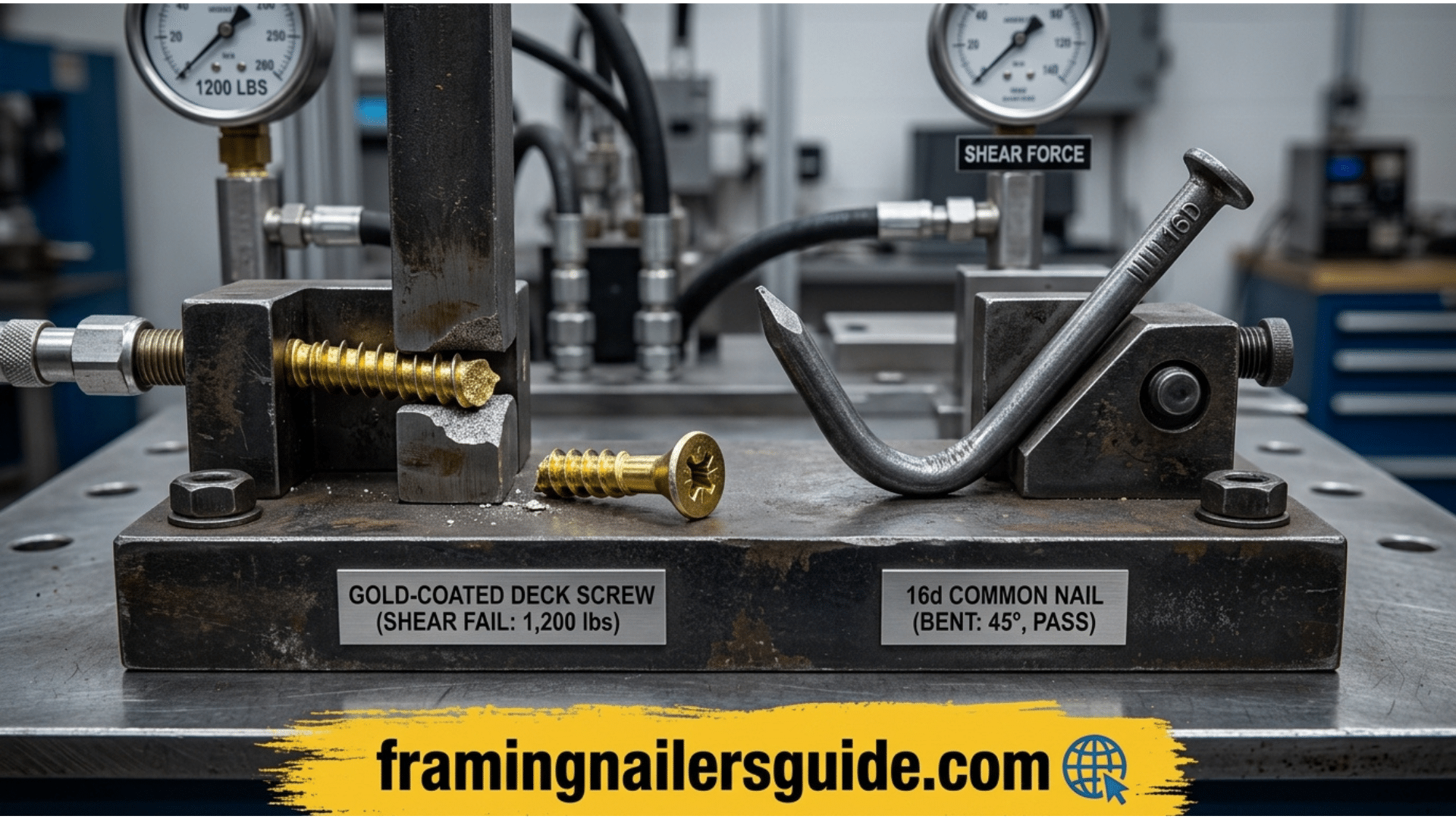
When wind gusts push against a wall or floors deflect under live furniture weight, wood framing exerts perpendicular shear force. A case-hardened screw cannot bend.
The shaft fractures instantly with zero warning.
SHEAR LOAD DYNAMICS
Case-Hardened Screw = Snaps Clean Under Lateral Shear
Mild Carbon Steel Nail = Flexes & Absorbs Structural Shift
Framing nails use ductile low-carbon steel. Under extreme lateral shear, nails bend, yield, and keep the joint locked together.
This is why the International Building Code (IBC Section 2304.10) mandates ductile wire nails for primary wood framing.
Disadvantage 2: Sluggish Installation Speed and Muscle Fatigue
Time is cash.
Framing a residential home requires thousands of fasteners. Driving screws one by one quickly destroys production efficiency.
Pneumatic / Cordless Framing Nailer: Fires 3 code-approved 16d nails in two seconds flat with a single bounce.
High-Torque Impact Driver: Demands 6 to 12 seconds per screw while applying constant forward pressure.
Physical Toll: Driving hundreds of high-torque screws causes severe forearm pump, wrist strain, and shoulder fatigue.
Tool Wear: Impact driving drains high-output 18V batteries rapidly and overheats brushless tool motors.
Looking to maximize production framing output? Compare tool platforms in our guide on 21 vs 30 degree framing nailer systems.
Disadvantage 3: Higher Cost and Economic Inefficiency
Count the pennies.
Fastener prices multiply quickly across large timber projects. Using screws for whole-house framing inflates budgets unnecessarily.
Collated 16d Framing Nails: Cost roughly $0.02 to $0.05 per nail in 2,000-count cartons.
Multi-Purpose Construction Screws: Cost roughly $0.15 to $0.40 per fastener.
Certified Structural Timber Screws: Cost roughly $0.50 to $1.25+ per fastener in retail buckets.
Framing an average 2,000-square-foot house consumes roughly 15,000 fasteners. Switching entirely to screws adds over $2,000 in pointless hardware costs.
Disadvantage 4: Wood Splitting and Edge Blowouts

Lumber fights back.
The thick solid root of a screw displaces wood fibers outward as it turns. Near board ends, this outward pressure acts like an axe wedge.
The grain splits instantly.
Nail Mechanics: Pointed diamond tips slice and compress wood grain fibers without spreading them apart.
Screw Mechanics: Deep threads and wide root shafts force wood fibers outward, causing severe end-grain checks.
Toe-Nailing Hazard: Driving screws into the 1-1/2-inch end grain of a 2×4 stud splits the board unless you pre-drill.
Learn how to nail stud plates without splitting lumber in our guide on wood framing techniques.
Disadvantage 5: Driver Bit Cam-Out and Stripped Recesses
We have all been there.
Under heavy torque, driver bits slip out of screw heads. Once a drive recess rounds off, the fastener is permanently trapped.
Cam-Out Friction: Phillips and low-grade Pozidriv recesses strip instantly under high cordless tool torque.
Trapped Hardware: A stripped screw buried 2 inches into dense Douglas fir cannot be pulled with a claw hammer or cat’s paw.
Destructive Extraction: Removing stripped or snapped screws requires vice-grips, screw extractors, or digging into finished wood with a chisel.
Disadvantage 6: Failed Inspections and Building Code Bans
Inspectors check stamps.
If a municipal building inspector spots drywall bugle heads or gold star-drive screws inside load-bearing stud walls, work stops immediately.
Mandatory Sistering: Adding sister studs directly alongside every screwed structural member.
Overlay Nailing: Driving code-compliant 16d nails into every joint while leaving dead screws in place.
Sheathing Teardowns: Tearing down OSB sheathing fastened with non-structural screws.
Costly Delays: Plumbing, electrical, and insulation rough-ins grind to an immediate halt.
Fastening delicate casing or baseboards next? Switch to our brad nailer vs framing nailer guide to prevent surface blowouts.
Always confirm fasteners carry active evaluation reports from the International Code Council Evaluation Service (ICC-ES) and meet standard ASTM F1667 structural fastener guidelines.
When Are Screws the Superior Fastener Choice?
Balance the facts.
Screws are not evil. When applied to tensile withdrawal connections, screws outperform smooth nails easily.
Subfloor Plywood Decking: Screws pull warped plywood tight against floor joists to permanently eliminate floor squeaks.
Cabinetry & Precision Joinery: Allows precise tensile clamping, fine alignment, and clean disassembly without timber destruction.
Deck Boards & Exterior Trim: Secures surface boards against weather cupping while keeping fastener heads accessible.
Engineered LVL Headers: Engineered lag-replacement fasteners like Simpson Strong-Tie SD Connector Screws sandwich laminated beams under certified structural loads.
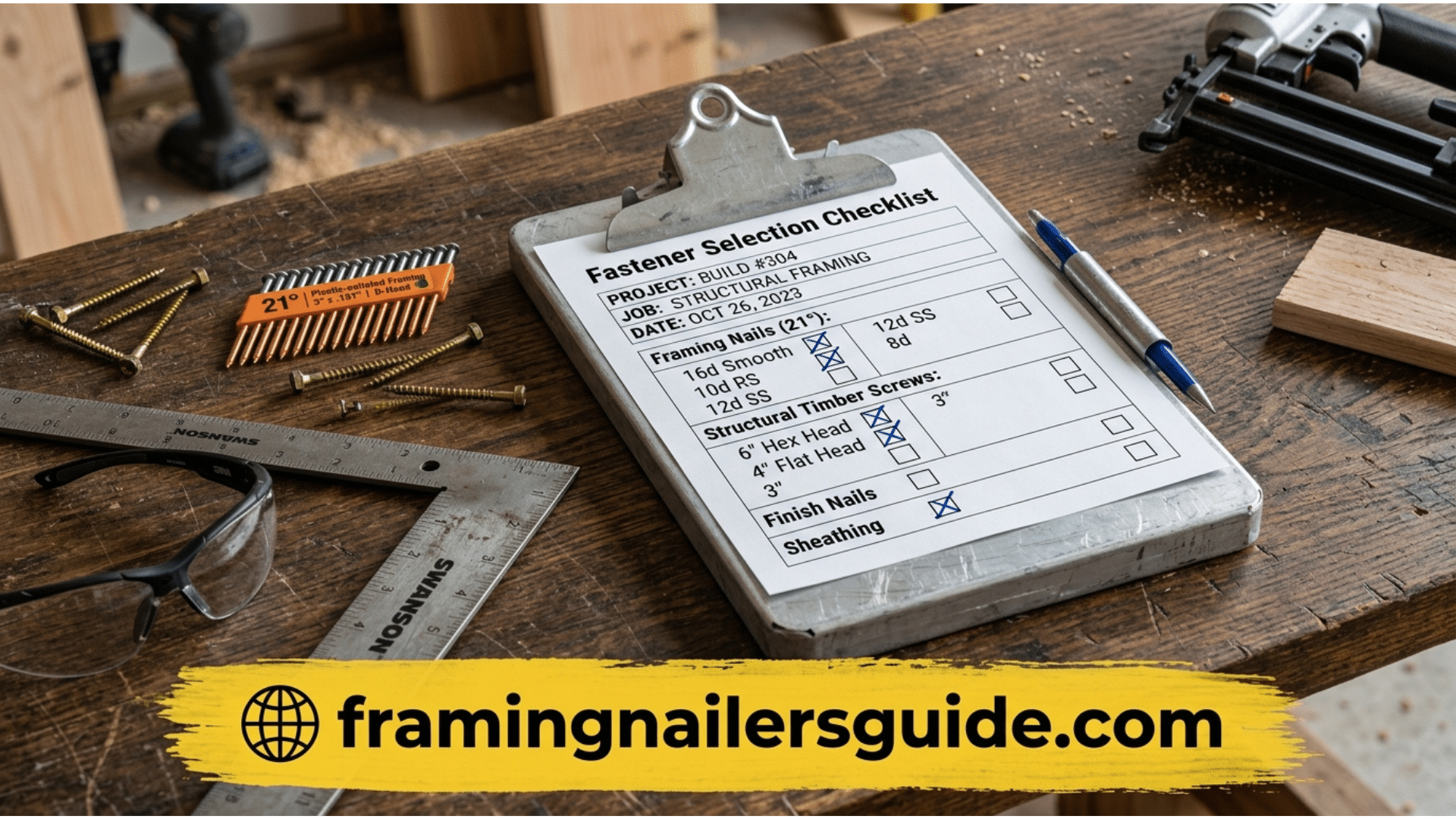
Fastener Selection Checklist: Nails vs. Screws Decision Matrix
Run this check before grabbing your tools:
Shear vs Tension: Is this a lateral shear application (studs, plates, headers)? Choose ductile framing nails.
Withdrawal Check: Is this a high-withdrawal pull-out application (subfloors, deck boards)? Choose structural screws.
Production Volume: Does the assembly require hundreds of repetitive joints? Choose a collated framing nailer.
Edge Distance: Are you fastening within 2 inches of board ends? Choose nails or pre-drill pilot holes for screws.
Reversibility: Will the project ever need non-destructive disassembly? Choose screws.
Code Compliance: Do your structural screws carry an active ICC-ES ESR report?
Frequently Asked Questions
Why do screws snap when nails only bend?
Screws are case-hardened for surface hardness, making their core brittle. Nails use ductile low-carbon steel that flexes under lateral shear load.
Do screws hold better than nails in 2×4 lumber?
Screws provide higher tensile pull-out resistance, but framing nails provide significantly higher lateral shear strength under structural building movement.
Can I use screws for outdoor deck joists?
Only certified structural connector screws. Standard drywall or gold deck screws will shear right off inside metal joist hangers.
Why does wood split when driving screws without pre-drilling?
Screw root shanks act like wedges, forcing wood fibers outward. Nails slice and compress fibers, minimizing edge splitting.
Are GRK and Spax screws subject to these disadvantages?
No. Premium structural lines from GRK and Spax use heat-treated ductile carbon alloy with published ICC-ES reports approved for load-bearing framing.
Final Summary & Key Takeaways
Match the engineering.
Screws pull lumber tight. Nails hold structures up.
Save screws for subfloors, cabinetry, and heavy engineered beams. Use collated framing nails for structural walls to keep builds fast, code-compliant, and rock-solid.
