

Last Updated on November 25, 2025 by John Patterson
Let’s be honest for a second. When you stand in the aisle of Home Depot or scroll through Amazon looking at nail guns, you’re usually looking at one number: the price tag.
$299 for a cordless framer? Hmm, a bit steep.
$120 for a pneumatic one? Sold.
But here’s the thing my old foreman used to drill into my head: The price of the tool isn’t the cost of the work.
If you’re running a business—or even just a serious side hustle—thinking only about the upfront cost is a rookie mistake.
It’s like buying a cheap truck without asking about the gas mileage or insurance premiums. You might save $50 today, but you’ll bleed thousands over the next year if you aren’t careful.
So, let’s break it down. The True Cost of Owning a Nail Gun in 2025. No fluff, just the math that keeps your profit margins safe.
1. The Upfront Hit: More Than Just the Gun

First, we have the obvious cost. You have to buy the thing.
But even this isn’t as simple as “cheaper is better.” You have three main contenders in the ring, and they each hit your wallet differently.
Pneumatic (Air-Powered)
These are your workhorses. Reliable. Cheap upfront. You can pick up a solid framing nailer for $150–$250.
-
The Catch: It’s a paperweight without air. You need a compressor ($150–$400) and a hose ($30–$50). If you already have these, great. If not, your “cheap” $150 gun just became a $500 investment.
Cordless Battery (Electric)
The new kings of convenience. No hoses, no compressors. Just slap in a battery and go.
-
The Cost: Pricey. Expect to pay $350–$500 for a kit with batteries. And if you’re on a different battery platform (e.g., you own Makita drills but buy a Milwaukee nailer), you’re paying extra for new chargers and batteries.
Gas-Hybrid (Paslode style)
These use a battery spark and a fuel cell to drive the nail. They are light and punchy.
-
The Cost: Mid-range upfront ($300–$400), but—and this is a big but—they have a “subscription model” built in. You have to keep buying gas cartridges forever.
2. The Recurring Costs: The “Silent Killers”
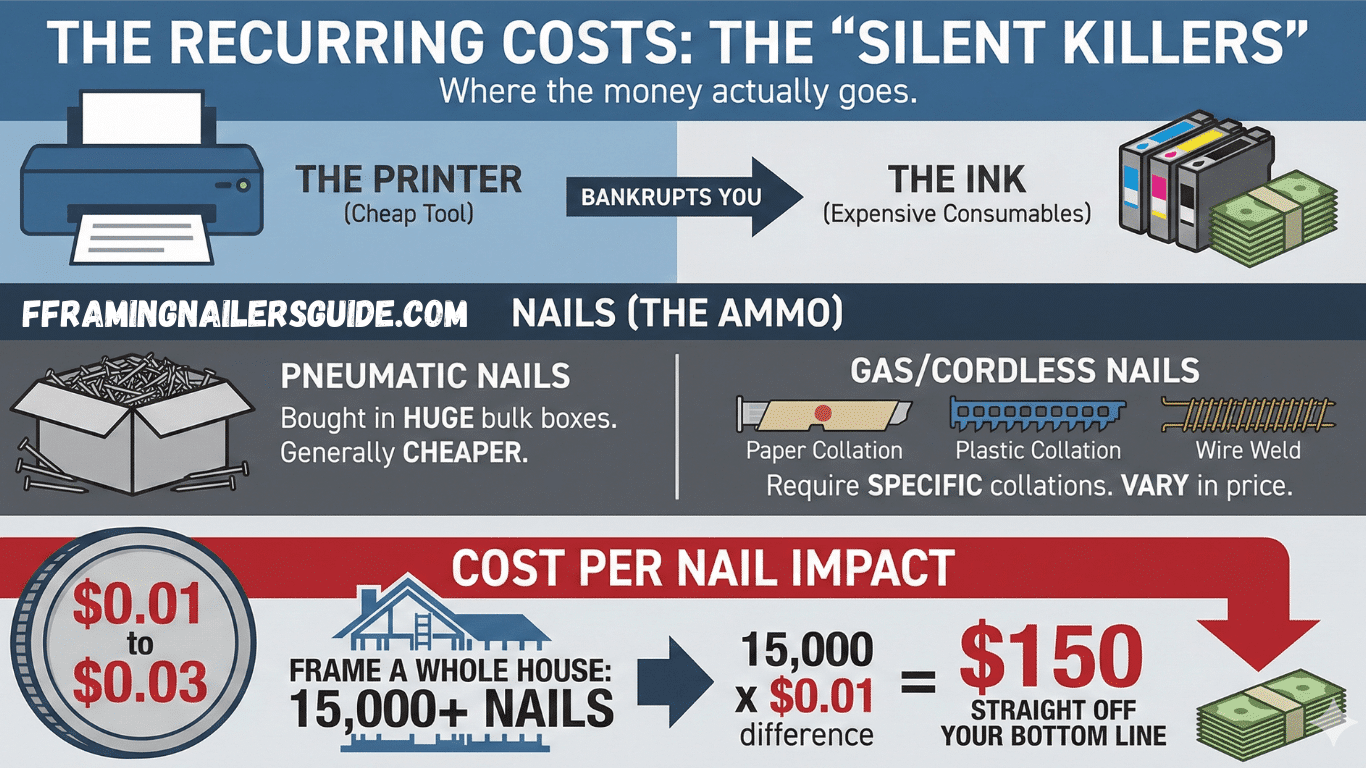
This is where the money actually goes.
Think of your nail gun like a printer. The printer is cheap; the ink is what bankrupts you.
Nails (The Ammo)
You’re going to fire thousands of these.
-
Pneumatic nails: generally cheaper, bought in huge bulk boxes.
-
Gas/Cordless nails: often require specific collations (paper vs. plastic vs. wire weld) which can vary in price.
-
Cost Per Nail: It sounds tiny—maybe $0.01 to $0.03 per nail. But frame a whole house? That’s 15,000+ nails. A penny difference per nail is $150 straight off your bottom line.

Fuel Cells (The Gas Tax)
If you run a Paslode or similar gas framer, you are paying for every shot.
-
A fuel cell costs about $12–$15.
-
It lasts for roughly 1,000–1,200 shots.
-
Math time: That adds roughly $0.01 to the cost of every single nail. Over a year, if you fire 100,000 nails, you just burned $1,000 in fuel. That’s enough to buy two shiny new battery nailers.
Batteries (The Fade)
Lithium-ion batteries are amazing, but they die. Not today, not tomorrow, but eventually.
-
Replacing a high-capacity battery costs $80–$150.
-
If you’re running a crew, batteries notoriously “walk away” or get dropped off roofs. Factor in at least one replacement per year per tool.
3. Hidden Costs: Insurance, Downtime, and Maintenance

Here’s the stuff nobody puts on the box.
Insurance & Safety (The Big One)
Did you know nail guns are the second most common cause of injury on construction sites?
-
Workers’ Comp: If you have employees, your insurance premiums are tied to risk. A nail gun injury (puncture, eye injury) can spike your premiums for years.
-
Safety Gear: You can’t skip this. Good safety glasses and hearing protection aren’t optional. That’s a small but real recurring cost.
Downtime (The Profit Killer)
What happens when your gun jams or breaks at 10 AM on a Tuesday?
-
Pneumatic: Usually a quick fix. A drop of oil, clear the jam, back to work.
-
Gas/Cordless: If the electronics fry or the gas line clogs in cold weather (Canada/UK folks, you know this pain), that tool is done for the day.
-
Cost of downtime: If you pay a crew of 3 guys $30/hour each, and they stand around for 1 hour because the only framing gun died, you just lost $90 plus the productivity.
Maintenance
-
Air tools: Need oil daily. Rebuild kits (O-rings) cost $20 every year or two.
-
Gas tools: Need regular cleaning. The cleaning kits cost money, and the time to disassemble and scrub them takes about 30 minutes. Time is money.
4. The Comparison: Cost Per Year Calculation

Let’s look at three scenarios.
Scenario A: The Weekend Warrior (DIYer)
-
Usage: 2,000 nails/year.
-
Best Bet: Cheap pneumatic (if you have a compressor) or a budget battery brad nailer. TCO is negligible because volume is low.
Scenario B: The Solo Contractor (Remodeler)
-
Usage: 20,000 nails/year. Needs mobility.
-
Best Bet: Battery Cordless.
-
Why: You save time not setting up a compressor. That time savings (15 mins/day x 200 days = 50 hours) is worth way more than the cost of batteries.
Scenario C: The Production Framer
-
Usage: 100,000+ nails/year.
-
Best Bet: Pneumatic.
-
Why: Fuel cells would cost you $1,000+. Batteries would wear out. Air is cheap, fast, and light.
Cost Breakdown Table (Estimated Year 1)
| Expense Category | Pneumatic Setup | Battery Cordless | Gas-Hybrid |
|---|---|---|---|
| Tool Cost | $200 | $400 | $350 |
| Total Year 1 | $520 | $400 | $1,400 |
| Maintenance | $20 (Oil) | $0 | $50 (Cleaning kits) |
| Fuel/Gas | $0 | $0 | $1,000 (approx.) |
| Compressor/Hose | $300 | $0 | $0 |
5. Conclusion: How to lower your TCO?
So, what’s the verdict?
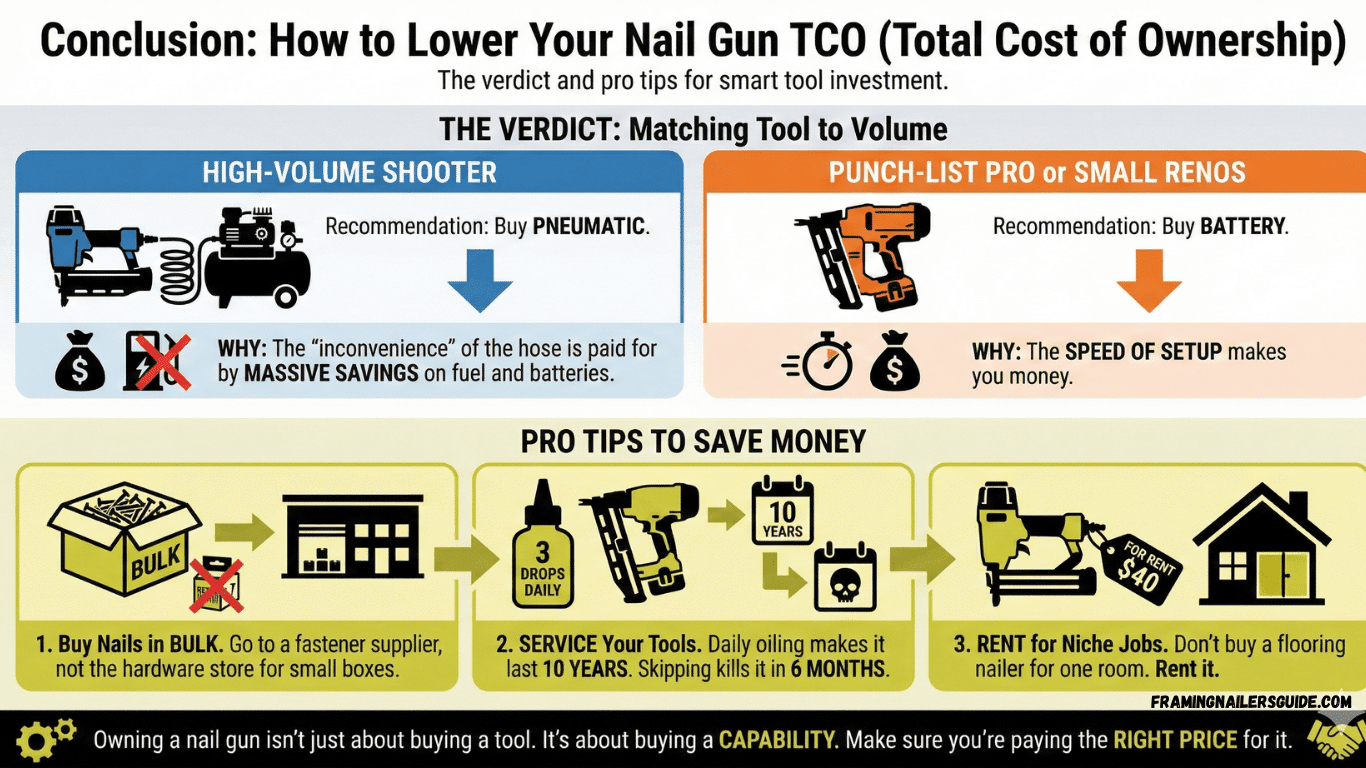
If you are a high-volume shooter, buy pneumatic. The “inconvenience” of the hose is paid for by the massive savings on fuel and batteries.
If you are a punch-list pro or doing small renos, buy battery. The speed of setup makes you money.
Pro Tips to Save Money:
-
Buy nails in bulk: Never buy the small boxes at the hardware store unless it’s an emergency. Go to a fastener supplier.
-
Service your tools: 3 drops of oil in an air nailer daily makes it last 10 years. Skipping it kills it in 6 months.
-
Rent for niche jobs: Need a flooring nailer for one room? Don’t buy it. Rent it for $40.
Owning a nail gun isn’t just about buying a tool. It’s about buying a capability. Make sure you’re paying the right price for it.
Frequently Asked Questions
Q: Do cordless nail guns really cost that much more to run?
A: No, battery cordless guns are actually very cheap to run (electricity is pennies). It’s the Gas-Hybrid ones that get expensive due to fuel cells.
Q: Does insurance really care about nail guns?
A: Directly? Maybe not. But they care about claims. Nail gun accidents are frequent and expensive. A good safety record keeps your premiums down.
Q: Can I use cheap generic nails?
A: You can, but be careful. Cheap nails often have poor collation (the paper/plastic holding them together). This causes jams. One bad jam can ruin your driver blade, costing you $50+ in repairs. It’s rarely worth the $5 savings.
Note: Prices and estimates are based on 2025 market averages and may vary by region.
