


Last Updated on August 23, 2026 by John Patterson
Look under the mudsill.
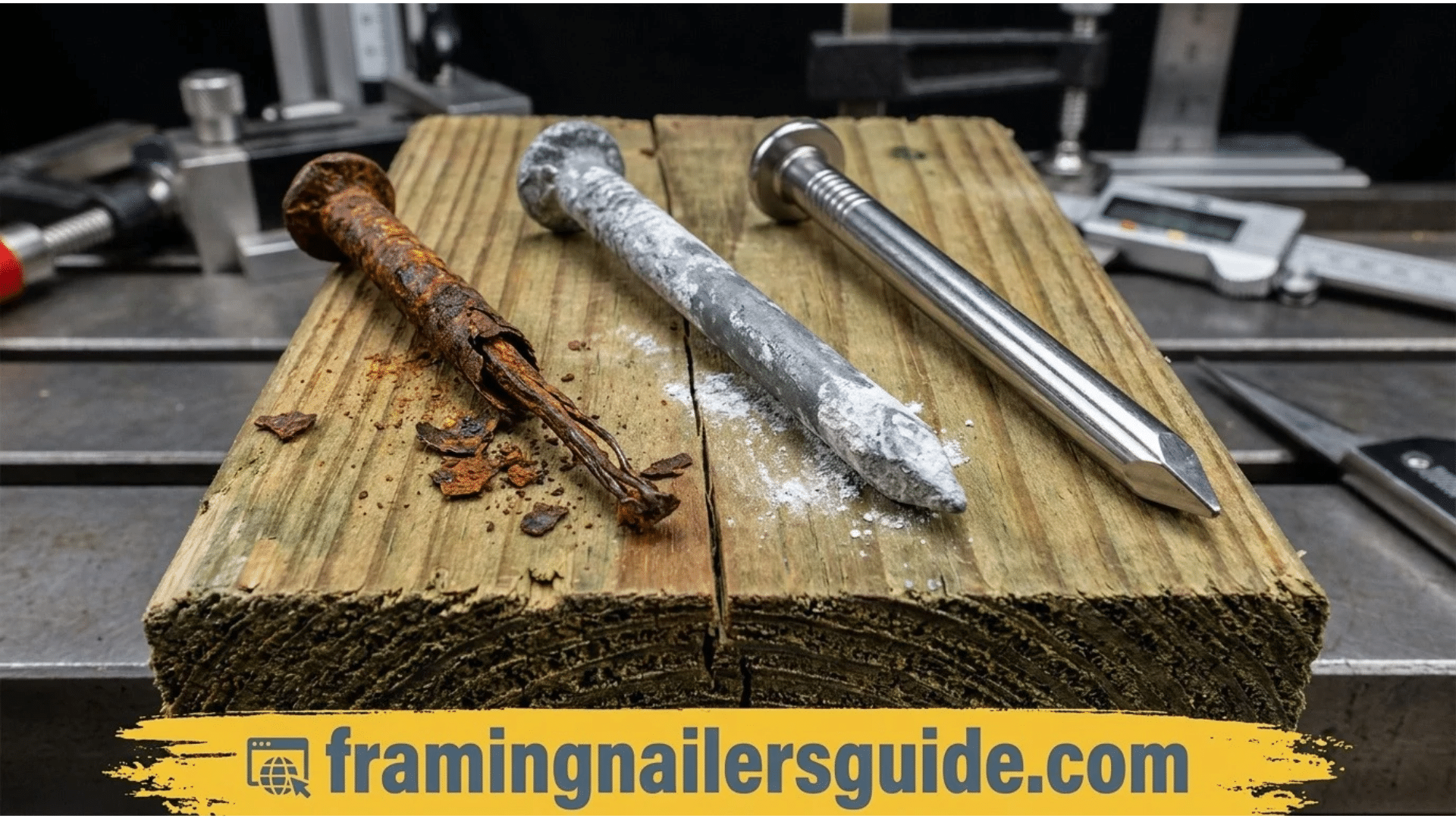
You pull apart a five-year-old deck or inspect a basement perimeter wall, only to find black chemical dust where solid steel nails used to be. The pressure-treated wood looks brand new, but the fasteners have completely dissolved.
That structural failure destroys your building integrity and triggers expensive reconstruction.
Let’s be direct. Modern treated lumber is packed with corrosive chemical salts.
Driving untreated or improperly coated nails into pressure-treated lumber causes rapid galvanic corrosion. Within two to three years, dynamic timber movement will snap the dissolved fastener shafts clean off.
GALVANIC CORROSION FORMULA
Raw Carbon Steel + ACQ Copper Salt + Ambient Moisture = Rapid Electrolytic Dissolution
For complete stud and joist length requirements before picking your fastener coatings, verify our reference on what size nails for framing.
Quick Answer: Which Framing Nails for Pressure-Treated Wood?
Short version?
Modern pressure-treated lumber contains high concentrations of copper that cause rapid galvanic corrosion on raw steel. You must use Hot-Dipped Galvanized (HDG) nails meeting ASTM A153 Class D or 304/316 Stainless Steel nails for pressure-treated sill plates and exterior framing.
Uncoated bright nails and thin electro-galvanized (EG) nails will dissolve and cause catastrophic structural failure.
Bright Steel Nails: Strictly prohibited for treated lumber; unrated bare wire dissolves within 12 to 24 months.
Electro-Galvanized (EG) Nails: Prohibited for structural exterior framing; the thin flash-plated zinc coating breaks down under chemical exposure.
Hot-Dipped Galvanized (HDG) Nails: The code-mandated minimum standard for pressure-treated sill plates, rim boards, and ground-contact framing.
304 / 316 Stainless Steel Nails: Mandatory for coastal environments, marine boardwalks, and acidic woods like western red cedar and redwood.
Make sure your nail gun can cycle heavy-coated fasteners without feeding jams by checking our framing nail compatibility chart.
The ACQ Chemical Reaction: Why Copper Eats Raw Steel
Chemistry is brutal.
Before 2004, pressure-treated lumber used Chromated Copper Arsenate (CCA). Today, lumber mills treat wood with Alkaline Copper Quaternary (ACQ), Copper Azole (CA), or Micronized Copper Azole (MCA).
These modern formulations contain double the copper ion concentration of older treatments.
ELECTROLYTIC CELL FORMULA
Noble Metal (Copper Ions) + Sacrificial Anode (Steel Nail) + Water = Galvanic Battery
Copper is a significantly more noble metal than iron or zinc on the galvanic chart.
When rainwater or ambient humidity enters the wood cell structure, it forms an active liquid electrolyte. The copper ions actively strip electrons from the mild steel nail, rapidly oxidizing the shank from the outside inward.
Within months, the nail shank thins down to a needle and snaps under normal framing weight.
Learn how proper lumber connections resist lateral loads in our guide on wood framing techniques
Bright vs. Electro-Galvanized vs. Hot-Dipped Galvanized (HDG)
Not all zinc is equal.
Fastener manufacturers apply zinc coatings using completely different processes, resulting in drastically different levels of chemical protection.
1. Bright Steel Framing Nails (Zero Protection)
Manufacturing Process: Raw low-carbon steel wire drawn through dies, cut, and headed with no protective surface plating.
Corrosion Resistance: Moisture and wood acids cause immediate surface rusting.
Approved Applications: Strictly for interior, climate-controlled, non-treated stud framing.
2. Electro-Galvanized (EG) Nails (Microscopic Flash Plating)
Manufacturing Process: Steel nails are submerged in a cold chemical bath where an electric current deposits a microscopic zinc film (roughly 0.1 to 0.3 mils thick).
Corrosion Resistance: Extremely low. The thin plating rubs off against wood fibers during entry.
Approved Applications: Interior drywall, interior door trim, and climate-controlled finish carpentry. Prohibited by code for structural treated timber.
3. Hot-Dipped Galvanized (HDG) Nails (Molten Metallurgical Bond)
Manufacturing Process: Nails are completely immersed in a bath of molten zinc at 850°F (454°C), creating multiple layers of zinc-iron alloy topped with pure zinc (over 1.5 to 3.0 mils thick).
Corrosion Resistance: Zinc acts as a sacrificial anode, corroding slowly to protect the inner steel core.
Code Standard: Must meet ASTM A153 Class D or ASTM F1667 requirements for pressure-treated wood contact.
COATING THICKNESS COMPARISON
Electro-Galvanized (0.2 mils / Cosmetic) vs. Hot-Dipped Galvanized (2.0+ mils / Structural Code Shield)
Review structural building code rules in IRC Section R317.3 (Fastener Protection in Treated Wood) before driving nails into foundation plates.
When Is 304 / 316 Stainless Steel Mandatory?

Salt air changes everything.
Hot-dipped galvanized nails offer robust sacrificial protection in standard inland environments, but airborne chloride ions destroy zinc rapidly.
Coastal Zones (Within 5 to 15 Miles of Saltwater): Airborne ocean salt breaks down zinc coatings within two to four years, leaving bare steel exposed to chemical attack.
Marine Boardwalks & Docks: Direct exposure to saltwater spray or brackish tides requires marine-grade 316 stainless steel containing molybdenum for acid resistance.
Cedar & Redwood Siding: Natural tannic acids in cedar and redwood chemically react with galvanized zinc coatings, causing permanent black bleed stains down the siding.
Ground-Contact UC4B / UC4C Timber: Heavy-retention commercial pilings and foundation retaining walls require 304 or 316 stainless steel to match the 50-year lifespan of the treated wood.
Never compromise on exterior fastener alloy selection. Replacing rusted framing fasteners behind finished cladding costs thousands in exploratory demolition.
If you are weighing structural timber screws against stainless framing nails, check out our analysis on can you use screws for framing.
Mud Sill Framing Rules: Code-Compliant Foundation Anchoring
Anchor the foundation safely.
The lowest horizontal framing member of a home—the mud sill (sill plate)—sits directly on porous, damp concrete foundations. Building codes mandate pressure-treated lumber (AWPA Use Category UC2 or UC4A) for all wood in direct contact with masonry.
Inspectors inspect sill plate connections meticulously during rough framing inspections.
SILL PLATE FASTENER RULE
Standard Stud Wall (Bright Nails Allowed) + Treated Mud Sill (HDG / Stainless Mandatory)
Stud-to-Sill Toe-Nailing: The nails penetrating the treated bottom plate MUST be hot-dipped galvanized (ASTM A153) or stainless steel.
End-Nailing Bottom Plates: Driving nails through the underside of a treated bottom plate into stud ends requires corrosion-resistant fasteners.
Rim Joist to Mud Sill: Fastening exterior rim boards to treated sill lumber requires HDG framing nails spaced 16 inches on-center.
Anchor Bolt Washers: Anchor bolts securing the sill plate must feature minimum 3-inch by 3-inch by 0.229-inch thick hot-dipped galvanized plate washers.
Driving standard bright framing nails into your bottom sill plate will result in a red tag during your structural framing inspection.
Need maximum withdrawal holding power on floor decking? Compare shank styles in our guide on ring shank vs. smooth shank framing nails.
Nail Gun Compatibility with HDG & Stainless Nails
Guns feel the coating thickness.
Hot-dipped galvanized nails are notoriously rough because molten zinc leaves uneven ridges and bumps along the nail shank.
Nail Jamming: Low-quality bulk HDG stick nails with excessive zinc flashing can bind inside tight magazine feeder channels.
Collation Selection: Plastic-collated (21-degree) and wire-weld (28-degree) strips handle rough HDG coatings better than moisture-sensitive paper tape.
Driver Blade Wear: Abrasive zinc coatings accelerate wear on the nail gun’s driver blade tip and nosepiece bumper over time.
Stainless Wire Softness: Austenitic 304/316 stainless steel is slightly softer than hardened carbon steel; ensure your tool’s drive depth is adjusted to avoid over-driving and shearing nail heads.
Follow official OSHA Nail Gun Safety Protocols when clearing fastener jams or loading coated strips.
Deciding between 16d common and sinker diameters for your nail gun? Review our full breakdown on 16d common vs 16d sinker nails.
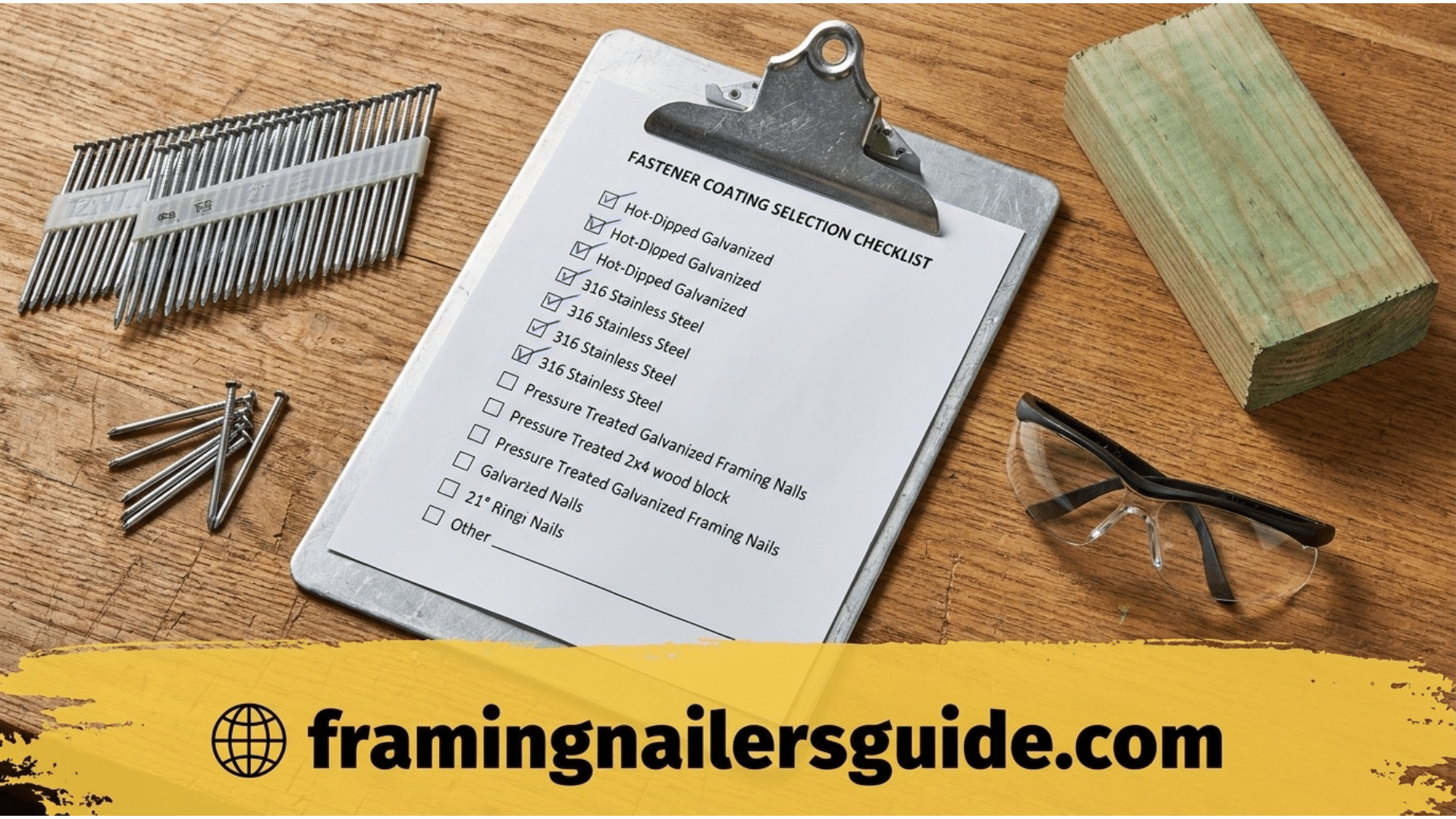
Pre-Framing Fastener Decision Checklist
Run this check before buying fastener boxes at the lumberyard:
Treated Check: Is any lumber in the assembly pressure-treated (ACQ, CA, MCA, or Borate)?
ASTM Rating: Do your galvanized fasteners carry the official ASTM A153 Class D hot-dipped certification stamp?
Hazard Clearance: Are all bright steel and electro-galvanized nails removed from exterior framing zones?
Coastal Proximity: Is the jobsite within 15 miles of a saltwater coast (requiring 304 or 316 stainless steel)?
Tannin Wood Match: Are you fastening western red cedar, redwood, or cypress (requiring stainless to stop tannin bleed)?
Hardware Compatibility: Are your anchor bolts, framing clips, and joist hangers rated for treated lumber contact (e.g., Simpson ZMAX or Stainless)?
Frequently Asked Questions
Can I use bright framing nails on pressure-treated wood?
No. Bright nails have zero protective zinc coating. Copper chemicals in pressure-treated wood cause galvanic corrosion that dissolves bare steel nails within 12 to 24 months.
Are electro-galvanized nails approved for exterior pressure-treated lumber?
No. Electro-galvanized (EG) nails have an extremely thin zinc plating (under 0.3 mils) designed for interior cosmetics. Building codes strictly require Hot-Dipped Galvanized (ASTM A153) or stainless steel fasteners for treated wood.
What ASTM standard is required for galvanized nails in treated wood?
Galvanized nails must meet ASTM A153 Class D (hot-dipped zinc coating) or ASTM F1667 structural standards to withstand modern ACQ and CA chemical treatments.
Why does cedar or redwood turn black around galvanized nails?
Natural tannic acids in cedar and redwood chemically react with zinc and iron to form black iron-tannate stains. Only 304 or 316 stainless steel nails prevent black streaks on cedar.
Do stainless steel framing nails work in pneumatic framing nailers?
Yes. Major fastener manufacturers produce plastic-collated and paper tape 304/316 stainless steel framing nails that cycle cleanly through standard 21-degree and 30-degree framing nailers.
Final Summary & Key Takeaways
Protect the steel.
Pressure-treated lumber resists fungal rot and termites, but its chemical copper salts destroy unprotected carbon steel fasteners.
Use bright nails exclusively for dry interior partition walls. Deploy ASTM A153 Class D Hot-Dipped Galvanized nails for foundation mud sills and standard exterior framing, and upgrade to 304 or 316 stainless steel for coastal builds and cedar trim.
Match your fastener coating to the chemical environment, satisfy building inspectors on the first visit, and build structures that last for decades.
