


Last Updated on August 23, 2026 by John Patterson
Listen to the floor.
You walk across a freshly laid subfloor and hear an agonizing squeak under your boots. You nailed every single sheet on layout, but the plywood is already lifting.
That callback stings your reputation and eats your afternoon.
Let’s get straight to the point. Shank design determines whether your framing stays rock-solid or backs out over time.
A nail can have the exact length and wire gauge your building inspector demands, yet still fail under seasonal moisture changes.
FASTENER PERFORMANCE FORMULA
Smooth Shank (Low Friction / High Shear) vs. Ring Shank (Mechanical Interlock / Max Withdrawal)
For a complete breakdown of code-approved stud and joist lengths, review our reference on what size nails for framing.
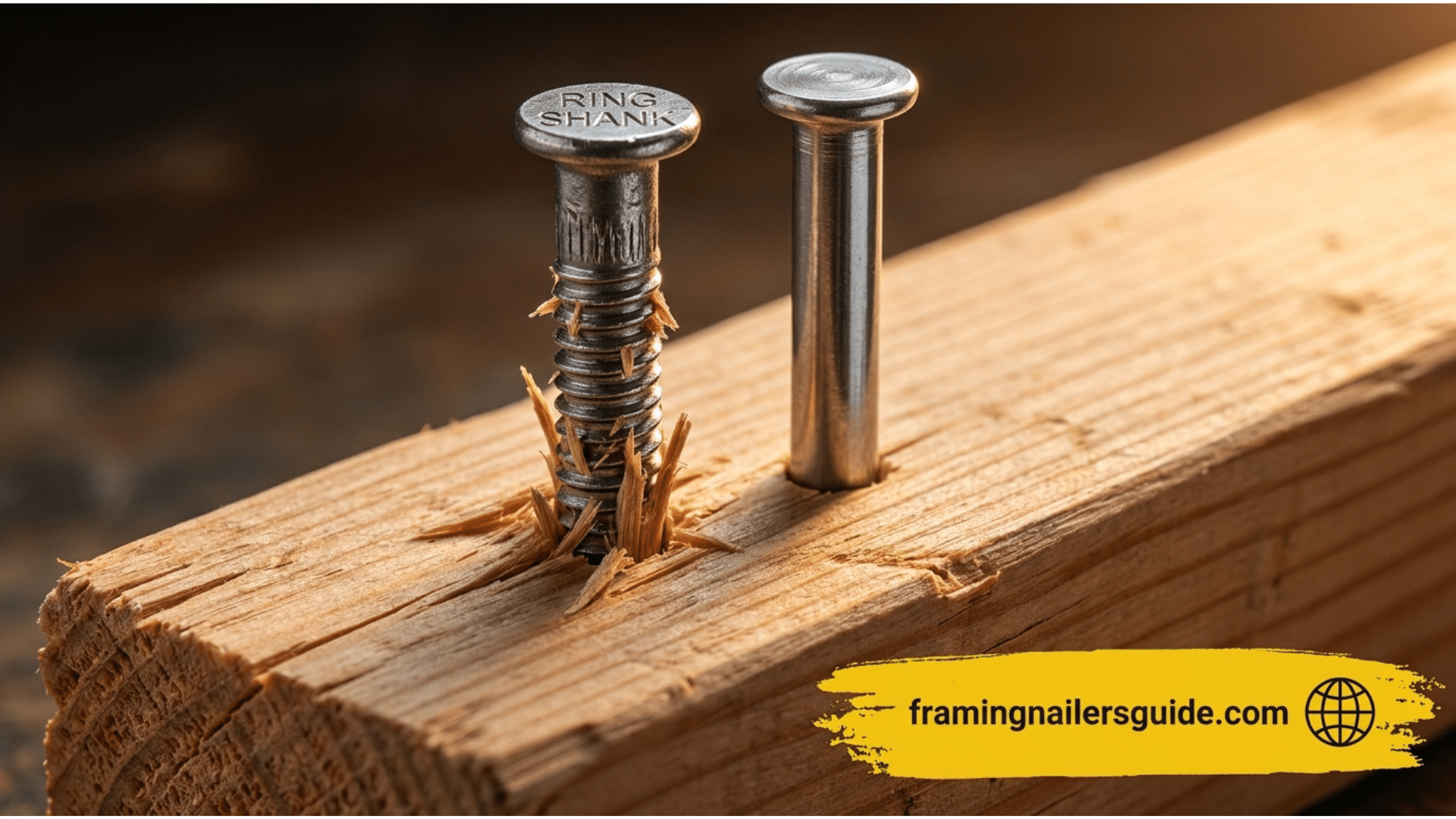
Quick Answer: Ring Shank vs Smooth Shank Framing Nails
Short version?
Ring shank nails provide up to 40% to 100% greater withdrawal resistance than smooth shank nails. Annular rings cut into the shank wedge into wood fibers to stop nails from backing out.
Smooth shank nails drive faster, cost less, require less air pressure, and offer superior shear strength for general wall framing.
Smooth Shank Nails: Best for standard 2×4 wall studs, top/bottom plates, corner posts, and temporary framing.
Ring Shank Nails: Required for subflooring, roof sheathing, wall shear panels, and exterior siding.
Driving Effort: Smooth nails sink effortlessly; ring shanks demand higher tool PSI and battery output.
Make sure your nail strip angle and wire diameter fit your specific gun using our framing nail compatibility chart .
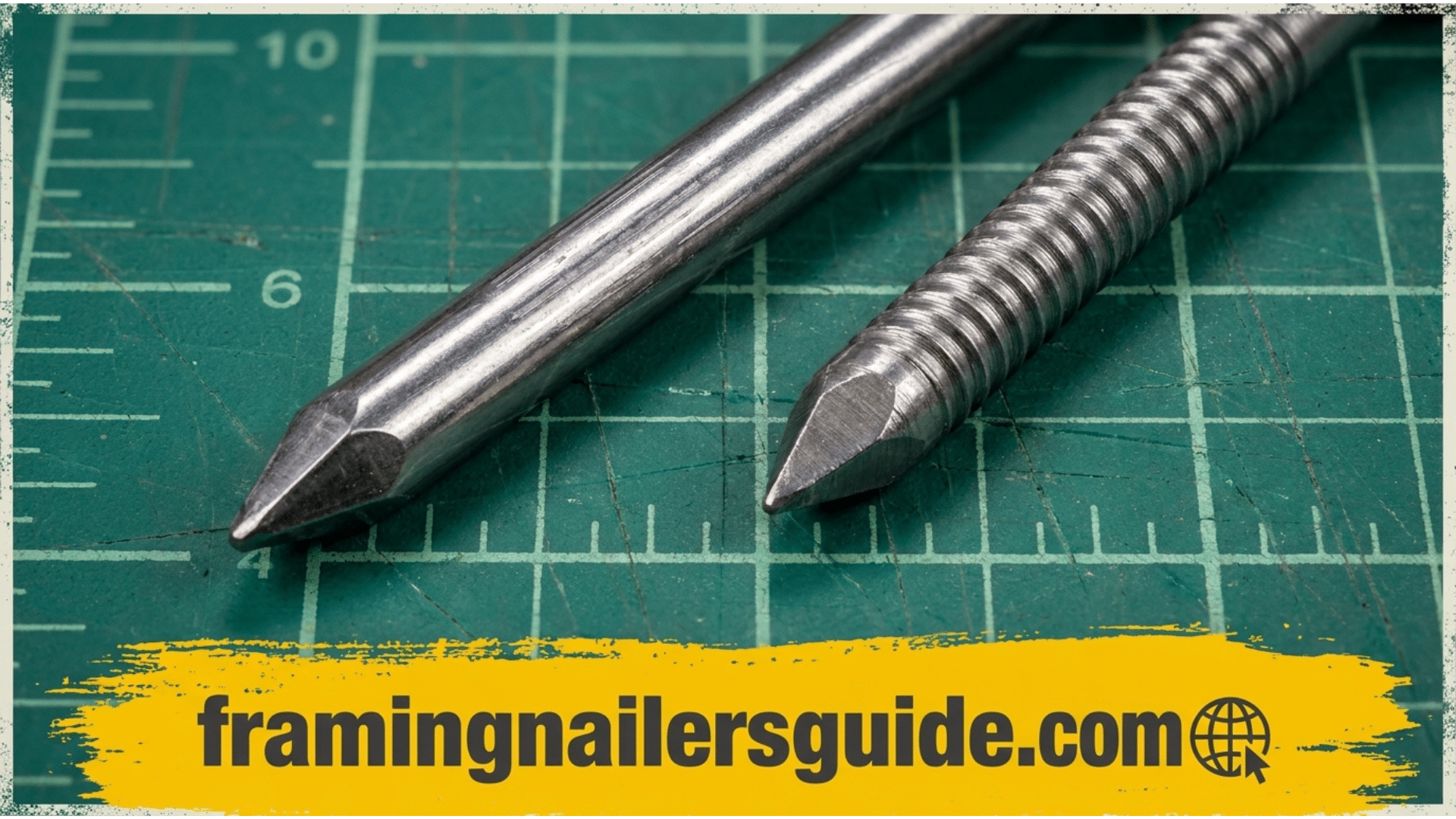
What Is a Smooth Shank Framing Nail?
Speed and simplicity.
A smooth shank nail features a continuous, polished cylindrical wire body from the head to the diamond point.
Because the surface has zero texture, it meets the least resistance as it penetrates lumber.
Lowest Driving Resistance: Sinks smoothly into dense kiln-dried framing timber with minimal compressor air.
Maximum Lateral Shear: Solid steel cross-section with no cut-out ridges delivers uncompromised sideways strength.
Easy Jobsite Demolition: Smooth shanks can be pried out cleanly with a cat’s paw or hammer claw without destroying lumber.
Smooth shanks rely entirely on wood fiber friction to hold a joint together.
When lumber dries out and shrinks, that friction drops. The nail can slowly loosen over time.
What Is a Ring Shank Framing Nail?
Mechanical grip.
A ring shank nail features a series of raised annular rings pressed along the middle and lower portion of the shaft.
As the nail drives into lumber, pointed diamond tips push wood grain fibers downward into each ring valley.
MECHANICAL INTERLOCK PRINCIPLE
Annular Ring Recess + Expanding Wood Grain = Permanent One-Way Wedge Lock
When you attempt to pull the nail backward, those wood fibers wedge tightly against the flat upper lip of the rings.
Unbeatable Pull-Out Grip: Delivers withdrawal values comparable to standard structural screws.
Squeak Prevention: Locks subfloor plywood tight against joists, eliminating movement underfoot.
High-Wind Resistance: Stops hurricane uplift from ripping roof sheathing off trusses.
You cannot easily pull a ring shank nail out. If you misdrive one, removing it usually splinters the surrounding lumber.
Withdrawal Resistance vs. Shear Strength: The Mechanical Showdown
Physics never lies.
Fasteners in timber construction face two distinct mechanical forces:
Withdrawal Load (Tensile Force): Forces pulling the fastener straight out along its axis.
Lateral Shear Load (Side-to-Side Force): Perpendicular pressure trying to slice the fastener in two.
Ring shank nails dominate withdrawal resistance. They hold up to twice as much tension as smooth nails before pulling out.
Smooth shank nails hold a slight edge in pure lateral shear. Machining annular rings reduces the nail’s minor root diameter slightly at each groove.
STRUCTURAL APPLICATION MATRIX
Shear Applications (Wall Studs & Headers) = Smooth Shank Framing Nails
Withdrawal Applications (Subfloors & Roof Sheathing) = Ring Shank Nails
Under ASTM F1667 structural fastener guidelines and the
International Residential Code (IRC Table R602.3(1)) both shanks have designated structural roles.
Need to decide between screws and nails for load-bearing assemblies? Read our analysis on can you use screws for framing .
Where to Use Ring Shank Nails
Put them where lumber moves.
Wood naturally swells in humid summers and shrinks in dry winters. Ring shank nails ensure that movement does not back fasteners out.
Subfloor Decking: Fastening 3/4-inch OSB or plywood over floor joists to stop floor squeaks permanently.
Roof Sheathing: Securing 1/2-inch OSB roof panels against high wind uplift forces.
Exterior Wall Sheathing: Locking structural plywood shear panels to resist hurricane and seismic racking.
Treated Lumber Decking: Resisting the severe cupping and warping forces of wet ACQ-treated boards.
Siding & Cedar Shingles: Preventing exposed finish nails from backing out over years of rain cycles.
Learn foundational layout and fastening setups in our guide on wood framing techniques.
Where to Use Smooth Shank Nails
Keep production fast.
When assemblies experience pure shear load or require hundreds of repetitive shots, smooth nails deliver speed and efficiency.
Stud-to-Plate Framing: Nailing 2×4 and 2×6 studs into top and bottom plates (end-nailing and toe-nailing).
Multi-Ply Window Headers: Nailing multiple 2×10 or 2×12 plies together to build solid structural lintels.
Corner Posts & Partition T-Walls: Fastening wall stud packs and blocking together.
Temporary Bracing & Formwork: Securing temporary wall braces that must be removed cleanly later.
Choosing a magazine format for high-speed wall framing? Compare tool angles in our guide on 21 vs 30 degree framing nailer platforms.
Nail Gun Performance: Air Pressure, Battery Draw, and Jamming
Tools feel the difference.
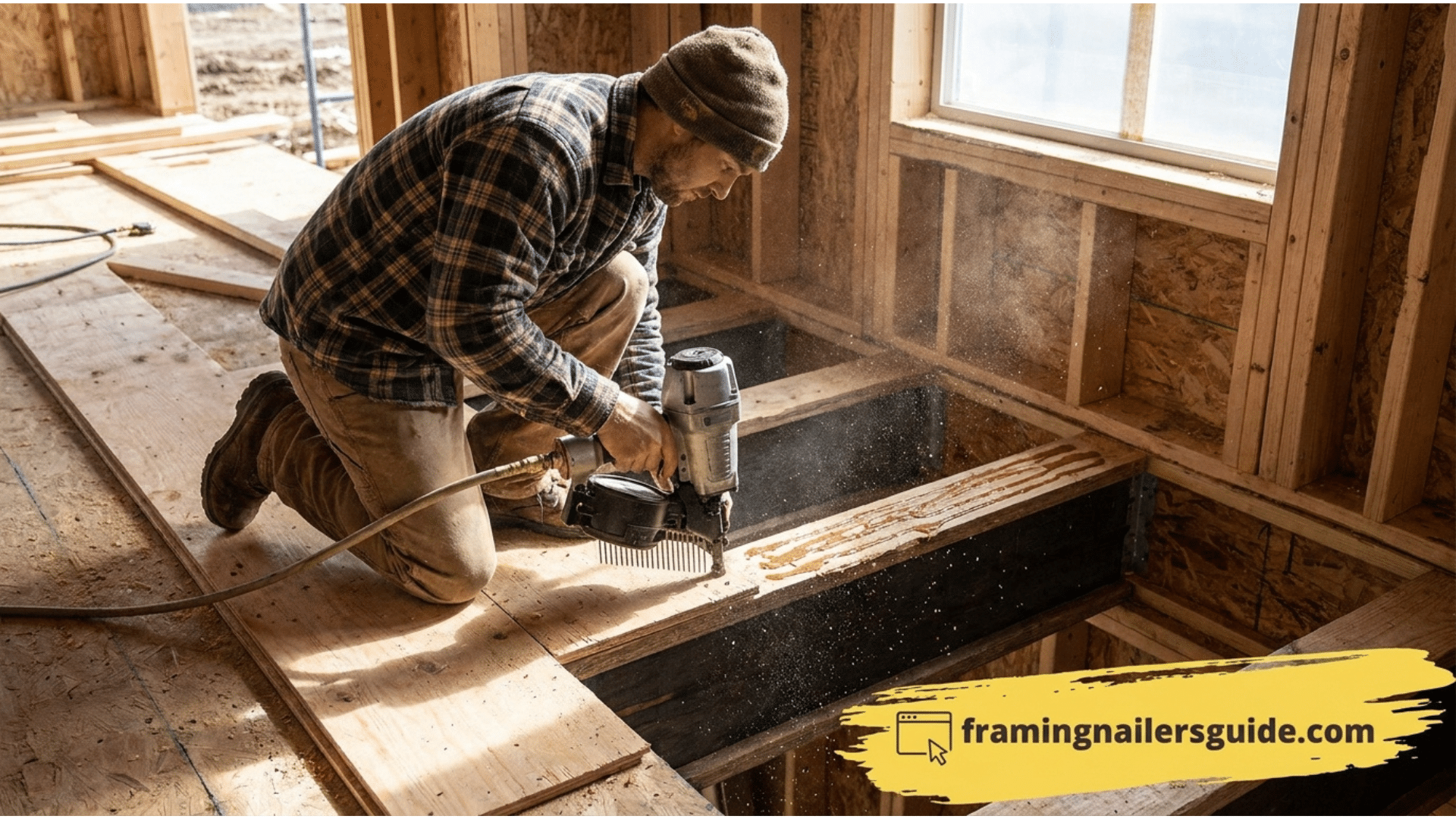
Driving a ring shank nail creates significantly more friction than driving a smooth wire nail.
Pneumatic Air Pressure: Ring shanks often require 10 to 15 extra PSI at the regulator to seat flush into dense lumber.
Cordless Battery Drain: Battery-powered flywheels work harder to drive rings, reducing shots-per-charge by roughly 15% to 20%.
Driver Blade Wear: Increased penetration friction accelerates wear on your nailer’s driver tip over time.
Nosepiece Jamming: If your air pressure is too low, ring shank nails will stall halfway, causing dangerous driver blade jams.
Follow the official OSHA Nail Gun Safety Guidelines avoid driver channel jams and misfires.
Working on interior casing or delicate trim next? Check our brad nailer vs framing nailer comparison to avoid splitting thin molding.
Pre-Purchase Fastener Decision Checklist
Run this check before buying cartons at the supply yard:
Withdrawal Check: Is this a high-withdrawal application (subfloors, roof ply, treated deck framing)? Choose ring shank nails.
Shear Check: Is this a primary shear application (studs, plates, headers, blocking)? Choose smooth shank nails.
Tool Power Check: Does your compressor or cordless battery deliver enough power to sink ring shanks flush?
Magazine Angle: Does the box degree match your gun’s magazine angle (21°, 28°, or 30°-34°)?
Collation Match: Does the collation binding match your magazine feed system (plastic, paper, or wire weld)?
Corrosion Rating: Are the fasteners hot-dipped galvanized (HDG) or stainless steel if working with treated lumber?

Frequently Asked Questions
Do ring shank nails hold better than smooth shank nails?
Yes. Ring shank nails provide up to double the withdrawal resistance of smooth nails because annular rings lock directly into wood grain fibers.
Can you use smooth shank nails on subflooring?
No. Smooth nails will loosen as lumber shrinks and expands, creating loose plywood and squeaky floors. Always use ring shank nails paired with subfloor adhesive.
Are ring shank nails harder to pull out?
Significantly harder. The annular rings create a mechanical wedge that resists withdrawal. Attempting to pull one usually splinters the wood.
Why are smooth shank nails used for framing walls?
Wall studs experience lateral shear loads rather than pull-out withdrawal. Smooth shanks provide full solid-wire shear strength, drive faster, and cost less.
Do ring shank nails split wood more easily?
Yes. Annular rings displace more wood grain than smooth shanks. Avoid driving ring shank nails too close to board edges without pre-drilling.

Final Summary & Key Takeaways
Match the shank to the mechanical load.
Smooth shanks give you speed, high shear strength, and low cost for framing stud walls.
Ring shanks give you unbeatable pull-out grip for subfloors and roof sheathing.
Check the box, tune your air pressure, and keep your framing rock-solid.
