


Last Updated on August 23, 2026 by John Patterson
Stop shooting framing nails into metal hangers.
You have a pneumatic framing gun loaded with 3-1/4-inch stick nails, and you need to hang thirty deck joists before sunset. Pulling the trigger feels fast and effortless.
Then the building inspector looks beneath your deck and pulls out a red tag. Your crew must pull and replace every single hanger.
Let’s be direct. Standard framing gun nails fail structural hardware.
Framing nails are too long, too thin, and lack the lateral shear capacity required to hold floor loads safely inside stamped steel brackets.
STRUCTURAL HARDWARE FORMULA
Short Heavy-Gauge Shank (1.5″ x .148″) + Full Round Head = 100% Hardware Shear Rating
Before choosing nails for your floor framing, review our reference on what size nails for framing.
Quick Answer: Joist Hanger Nails vs Framing Nails?
Short version? No.
Standard 3-1/4-inch framing nails cannot be used in metal joist hangers because their extra length blows through adjoining lumber and their thin shanks (.120-inch to .131-inch) lack required shear strength.
Joist hangers require 1-1/2-inch by .148-inch (10d short) or .162-inch (16d short) structural connector nails with a full round head designed to seat flush against steel plates without shearing.
Standard Framing Nails: Thin shanks (.120″-.131″) shear under live floor loads, causing joist sag.
Structural Connector Nails (Teco): Thick shanks (.148″-.162″) deliver full lateral shear capacity without blowing through 2x ledger boards.
Standard Wood Screws: Prohibited unless stamped and certified (e.g., Simpson Strong-Tie SD Connector Screws).
Ensure your fastener collation angle matches your gun using our framing nail compatibility chart.
The Blowout Problem: Why Standard 3-Inch Nails Ruin Hanger Joints
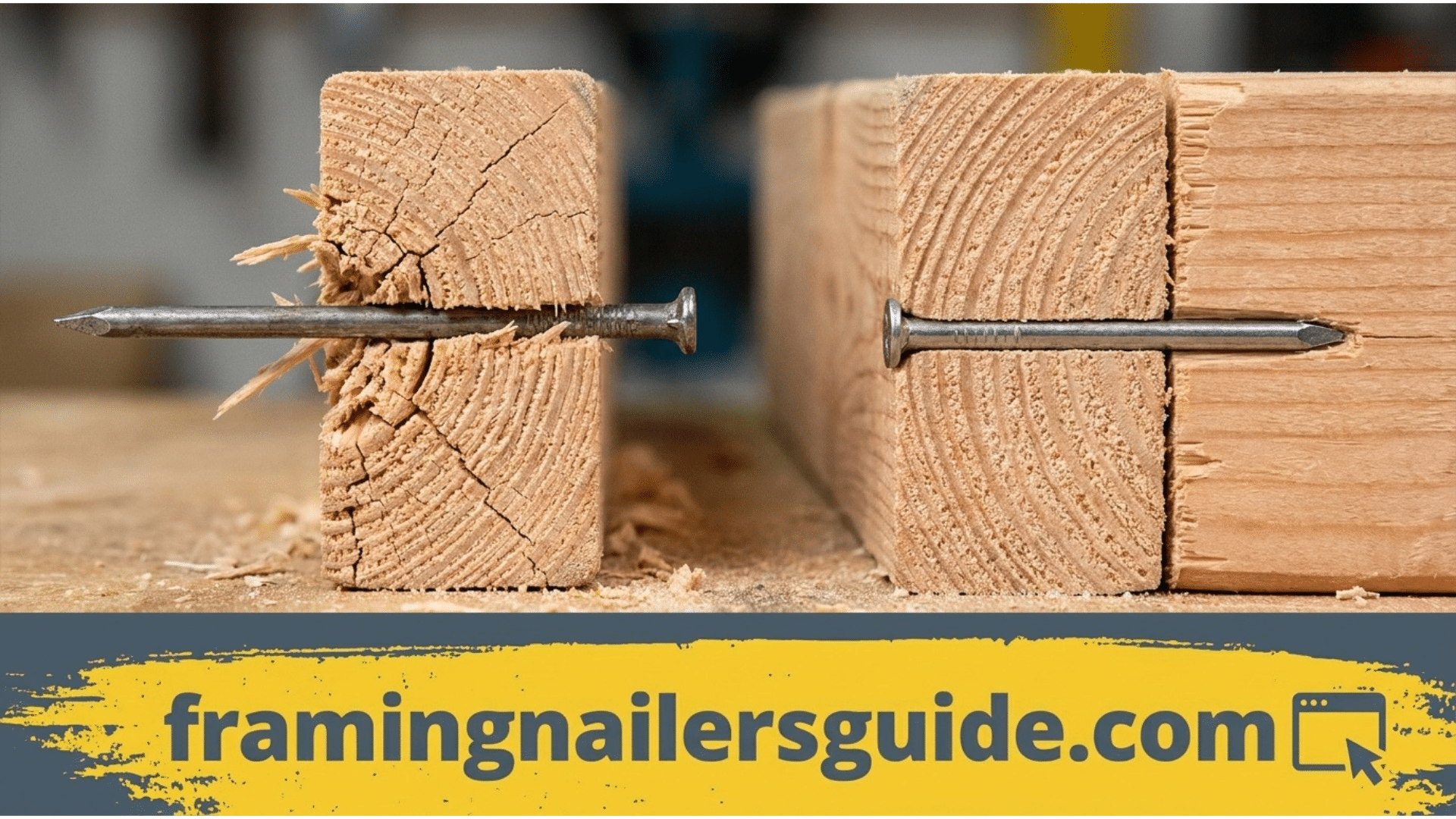
Physics never lies.
A standard residential deck ledger or single rim joist is 1-1/2 inches thick. Driving a 3-1/4-inch or 3-1/2-inch framing nail through a metal hanger punches straight out the back of the ledger.
That exposed sharp point creates zero structural holding power in open air and destroys water-proofing flashing behind the board.
Ledger Blowout: Poking through the back of a single 2x ledger splits wood grain and compromises building wrap.
Shear Reduction: Standard stick nails use thin wire (.120″ to .131″). A joist carrying a 50 PSF live load exerts direct slicing pressure across the nail.
Head Pull-Through: Clipped-head and offset-round framing nails do not seat flat across round metal hanger holes, allowing joists to bounce and loosen.
SHEAR LOAD RATIO
Thin .120″ Wire Shank = Severe Shear Deflection
Thick .148″ Connector Shank = Zero Sag Under Maximum Load
Learn how improper fastener selection causes dangerous structural failure in our guide on the disadvantages of using screws.
Anatomy of a True Joist Hanger Nail (Teco Nails Explained)
Engineered for steel brackets.
Structural connector nails—historically called ‘Teco nails’ after the Timber Engineering Company—are specifically proportioned for sheet metal hardware.
They feature an intentionally shortened length paired with a massive wire shank diameter.
1-1/2″ Short Length: Full 1-1/2 inches to maximize embedment depth in 2x lumber without penetrating the back face.
Heavy-Gauge Shank (.148″ – .162″): Heavy .148-inch (10-gauge) or .162-inch (8-gauge) solid low-carbon steel wire designed for lateral shear.
Full Round Head: Wide, thick circular head engineered to seat flat against stamped steel holes without pulling through under dynamic vibration.
HDG Coating: Hot-Dipped Galvanized (ASTM A153 Class D) to resist corrosive chemical salts in pressure-treated lumber.
All structural hardware fasteners must comply with Simpson Strong-Tie Fastening Specifications and the
International Building Code (IBC Section 2304.10).
What Is a Positive Placement Nail Gun?
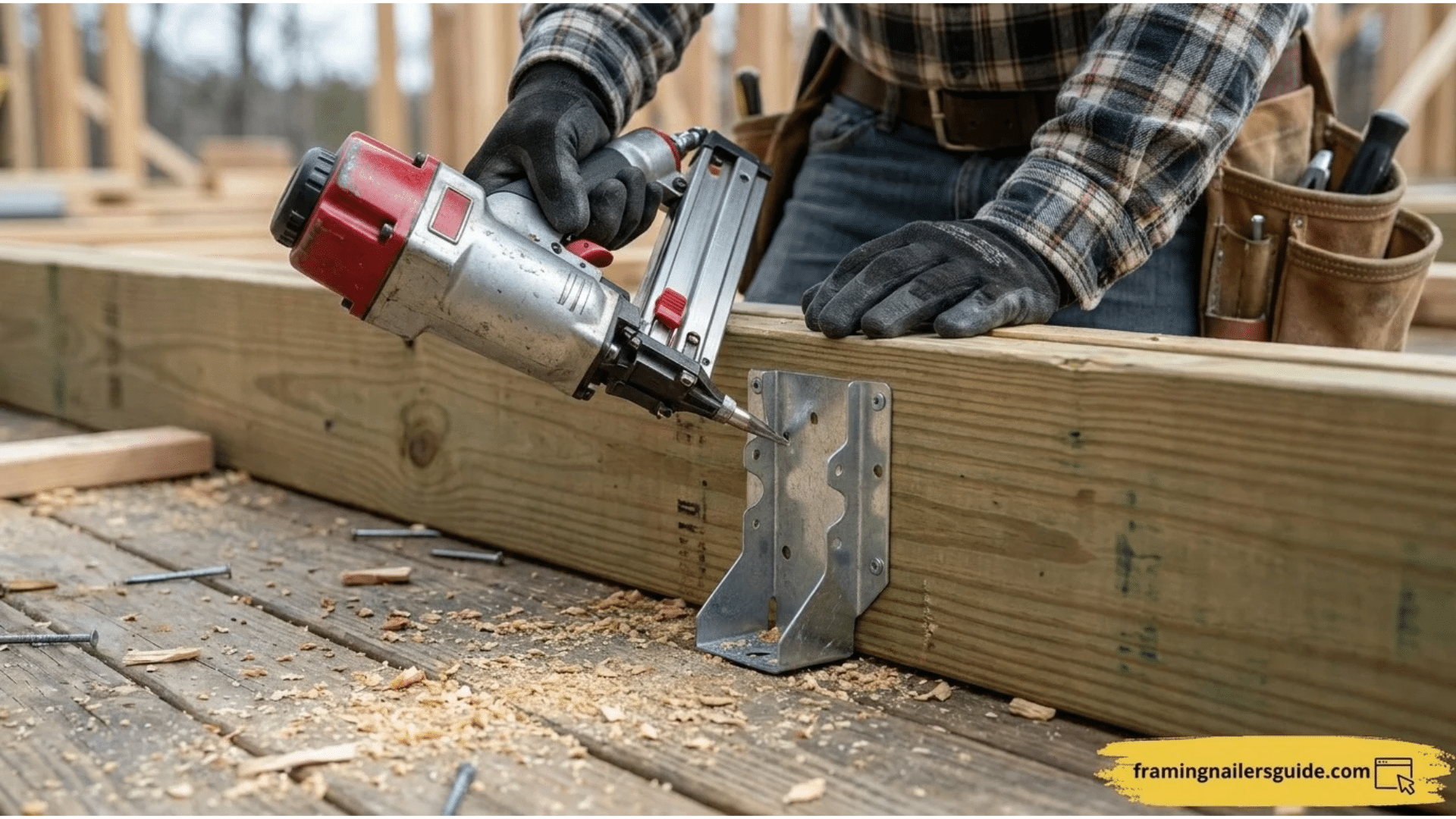
Never guess the hole.
Hand-nailing sixty metal hangers with a 2-lb hammer is exhausting and slow. But shooting a standard framing nailer blindly into metal hardware is dangerous.
If a standard nailer’s safety nose contacts steel, the fastener can ricochet violently into your face.
Exposed Guide Probe: Features an exposed, hardened probe tip that physically seats into the hanger’s stamped hole before the trigger can trip.
Dedicated Magazine: Cycles dedicated 1-1/2″ x .148″ paper-tape or plastic-collated metal connector nails rapidly.
Speed & Accuracy: Drives every connector nail in less than one second with 100% placement accuracy and zero hand fatigue.
Review mandatory safety guidelines under the official OSHA Nail Gun Safety Protocols.
Can You Use Screws in Joist Hangers?
Put down the drywall screws.
Driving gold deck screws, drywall screws, or general construction screws into metal joist hangers is an instant structural inspection violation.
Under load, the sharp edges of the stamped steel hanger hole act like a pair of scissors against brittle, case-hardened screw shafts, slicing the heads right off.
SCREW HARDWARE WARNING
Drywall/Deck Screws in Metal Hardware = 100% Shear Snapping Failure
Simpson Strong-Tie SD Connector Screws = Code-Approved Fasteners
Standard Wood Screws: Strictly prohibited; zero lateral shear strength against steel edges.
Simpson Strong-Tie SD Screws: Code-approved for metal brackets; features thick, heat-treated ductile shanks engineered specifically for hardware shear loads.
Learn when engineered screws are legal in timber structures in our guide on can you use screws for framing.
Face Nailing vs. Double-Shear Nailing in Hangers
Holes have specific rules.
Metal joist hangers feature two distinct types of nail holes:
Header / Ledger Face Holes: Straight round holes driven straight into the supporting ledger board (requires 1-1/2″ x .148″ nails).
Joist Flange Double-Shear Holes: Angled side tabs requiring nails driven at a 45-degree angle through the joist AND into the ledger (requires full-length 3″ or 3-1/2″ 10d/16d common nails for full double-shear load capacity).
If a joist hanger specifies double-shear angled nailing, using a 1-1/2-inch short nail in the side tab reduces the hanger’s load rating by over 30%.
For full pennyweight sizing and gauge standards, check out our guide on 16d common vs 16d sinker nails.
The Deck Inspector Checklist: Avoiding Red Tags on Metal Connectors
Run this check before the building inspector walks the job:
Hole Fill Rate: Are all face holes filled with 1-1/2″ x .148″ (10d short) structural connector nails?
Double Shear Check: Are all double-shear angled holes driven with full-length 10d or 16d common nails?
Hazard Clearance: Are all drywall screws, general deck screws, and thin framing stick nails removed from hardware?
Corrosion Rating: Are all fasteners hot-dipped galvanized (ASTM A153) or stainless steel for pressure-treated wood contact?
Hardware Compliance: Are all hurricane ties and rafter clips fastened with approved structural connector nails?

Frequently Asked Questions
Can I use 3-inch framing nails in joist hangers?
No. Standard 3-inch framing nails blow through the back of 1-1/2-inch ledgers, split lumber, and have thin .120-inch shanks that lack required lateral shear strength.
What size nails go in Simpson Strong-Tie joist hangers?
Most Simpson joist hangers specify 1-1/2-inch by .148-inch (10d short) or 1-1/2-inch by .162-inch (16d short) structural connector nails for face holes, and full-length 10d/16d commons for double-shear side holes.
Can I use regular wood screws in joist hangers?
No. Standard wood and deck screws are brittle and will snap under shear loads. Only use manufacturer-certified structural screws like Simpson Strong-Tie SD Connector Screws.
Do joist hanger nails need to be galvanized?
Yes. Fasteners used in exterior pressure-treated lumber must be Hot-Dipped Galvanized meeting ASTM A153 Class D or 304/316 stainless steel to prevent chemical ACQ corrosion.
What happens if I miss a hole in a joist hanger?
Building codes require 100% of specified fastener holes to be filled. Missing even one nail reduces the bracket’s load-bearing capacity and causes a failed framing inspection.
Final Summary & Key Takeaways
Match the nail to the hardware.
Framing nails hold wood to wood. Structural connector nails lock steel brackets to timber.
Use 1-1/2-inch by .148-inch HDG connector nails for face holes, drive full-length commons in double-shear tabs, and pass deck inspection on the first visit.
