


Last Updated on August 23, 2026 by John Patterson
Check the plans.
Architectural blueprints call for ’16d nails’ on your wall stud schedule. You grab a box of 16-penny framing nails from the store, load your gun, and start shooting plates.
Then the building inspector pulls out a digital caliper. You used thin gun sinkers instead of true commons, and your framing fails inspection on the spot.
That callback stings your wallet and stalls your crew.
Let’s clear the air. A 16d nail is not a single, standardized fastener.
Pennyweight indicates length, but it tells you nothing about wire thickness. If you shoot a .131-gauge sinker where building code demands a .162-gauge common, you cut your shear strength nearly in half.
SHEAR VS PRODUCTION SIZING FORMULA
16d Common (3.5″ x .162″) = Code Baseline | 16d Sinker (3.25″ x .148″/.131″) = Gun Production Standard
For full structural stud and joist fastening schedules, check out our master guide on what size nails for framing.
Quick Answer: 16d Common vs 16d Sinker vs 16d Box Nails
Short version?
A 16d common nail measures 3-1/2 inches long with a thick .162-inch diameter and a flat head. It is the heavy-duty baseline for structural building codes.
A 16d sinker nail measures 3-1/4 inches long with a thinner .148-inch (or .131-inch gun nail) diameter, a countersunk checkered waffle head, and a vinyl coating for easy driving.
A 16d box nail measures 3-1/2 inches long but uses a slender .135-inch diameter to prevent splitting non-structural lumber.
16d Common Nails (.162″ shank): Delivers maximum lateral shear strength for shear walls, load-bearing headers, and double top plates.
16d Sinker Nails (.131″ – .148″ shank): The production standard for pneumatic and cordless framing nail guns.
16d Box Nails (.135″ shank): Lighter structural resistance, strictly used to prevent splitting thin or delicate boards.
Before buying boxes, verify your magazine angle and gauge limits with our framing nail compatibility chart.
What Does the ’16d’ Penny Size Actually Mean?
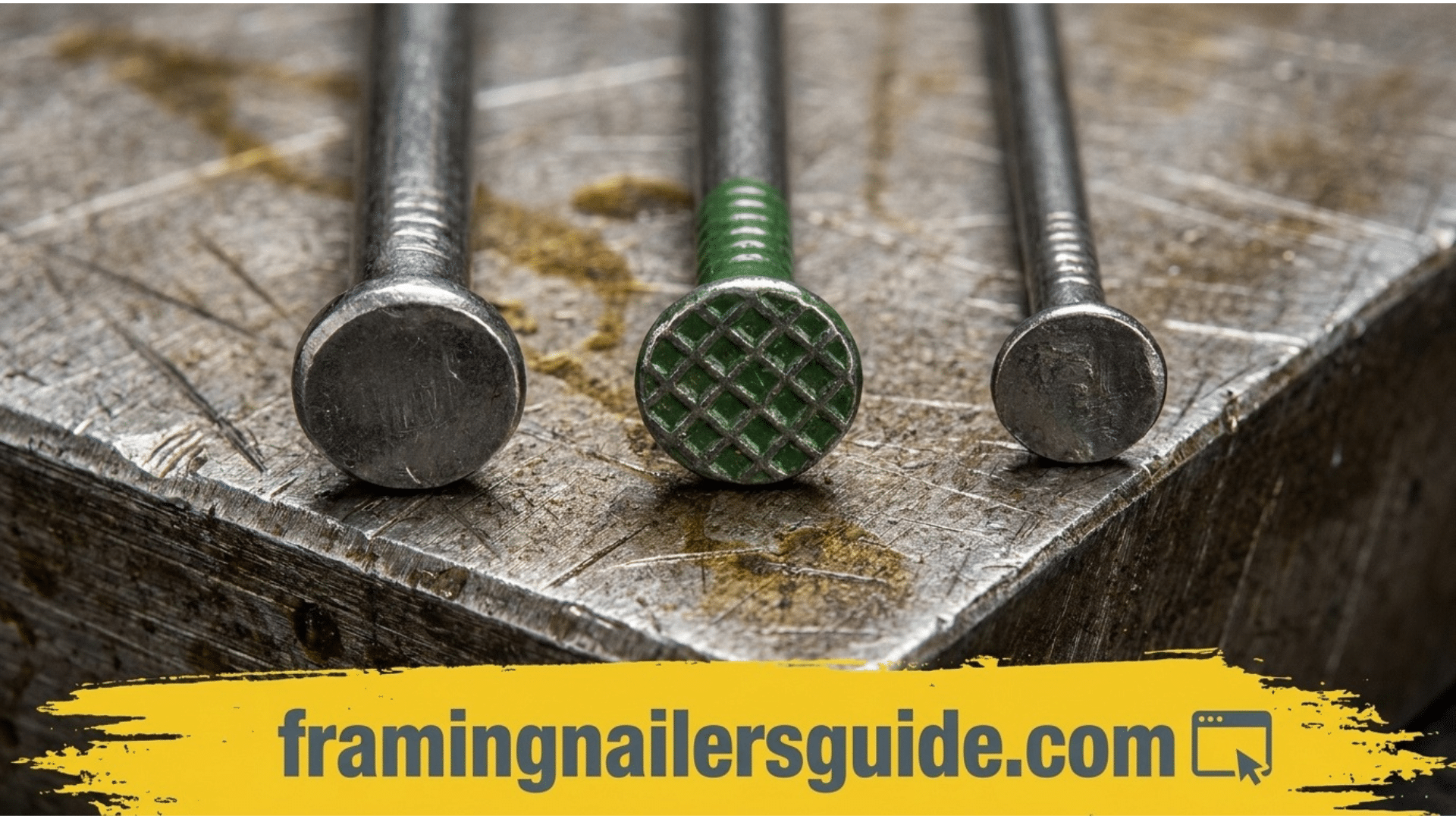
History meets hardware.
The ‘d’ abbreviation stands for denarius, an ancient Roman coin associated with English pennies. In medieval England, ’16-penny’ nails originally cost 16 pence per hundred fasteners.
Today, pennyweight serves purely as a length classification.
PENNYWEIGHT VS SHEAR EQUATION
Penny Rating (d) = Fastener Length | Wire Gauge (.113″ to .162″) = Fastener Shear Strength
A 16d common, 16d sinker, and 16d box nail share the same ’16-penny’ family name, but their steel thickness is vastly different.
Assuming every 16d nail delivers the same structural holding power is a fatal jobsite mistake.
What Is a 16d Common Nail?
The structural heavyweight.
A true 16d common nail is manufactured from thick, heavy-gauge low-carbon wire (.162-inch diameter, roughly 8-gauge) measuring a full 3-1/2 inches in length.
It features a wide, flat circular head that sits flush on the wood surface without sinking into outer fibers.
Maximum Shear Strength: The thick .162-inch steel body resists extreme lateral sliding forces during high winds and earthquakes.
Code Baseline Fastener: International building codes write all wood framing fastening schedules around the shear capacity of 16d common nails.
Driving Effort: Driving a .162 common by hand takes serious hammer power and easily splits dry lumber ends.
True 16d common nails are the gold standard for laminated beams, rim joists, and structural shear walls.
Standard specifications are defined under ASTM F1667 structural fastener guidelines.
What Is a 16d Sinker Nail?
The framer’s best friend.
A 16d sinker nail is modified specifically to make driving faster, cleaner, and easier on your hands and tools.
Sinkers are slightly shorter than common nails (3-1/4 inches) and noticeably thinner (.148-inch diameter, roughly 9-gauge).
Checkered Waffle Head: Prevents hammer faces from slipping off the nail head when swinging at awkward angles.
Countersunk Rim: Beveled head design sinks cleanly flush or slightly below the lumber surface.
Vinyl / Resin Coating: Coated with slick green or gold resin that melts under friction, lubricating the shaft during entry before hardening to lock the nail in place.
Collation stick nails sold for framing guns are almost universally classified as sinkers (.131″ to .148″ diameter).
Deciding between manual hand-driving and fast gun production? Compare tool setups in our guide on 21 vs 30 degree framing nailer systems.
What Is a 16d Box Nail?

The non-splitting specialist.
A 16d box nail retains the full 3-1/2-inch length of a common nail, but cuts the shank diameter down to a slender .135-inch.
Originally developed for wooden shipping crates, box nails are engineered to avoid splitting thin or brittle lumber.
Reduced Driving Resistance: Slender wire penetrates easily with low striking force.
Zero Splitting Risk: Displaces significantly less wood grain than thick common nails.
Lower Shear Capacity: Thinner shank yields lower lateral shear strength under structural loads.
Never use 16d box nails for primary structural framing unless your local code explicitly allows an increased nail schedule count.
Building Code Rules: IRC Nailing Schedules Explained
Inspectors check stamps and diameters.
The International Residential Code (IRC Table R602.3(1) explicitly differentiates between common, sinker, box, and gun nails.
Because sinkers and gun nails use thinner steel, building codes require you to drive extra fasteners to match the shear strength of 16d common nails.
IRC CODE EQUIVALENCY FORMULA
2-16d Common Nails (3.5″ x .162″) = 3-16d Box / Sinker Nails (3.25″ x .131″-.135″) per Stud Bay
Stud-to-Top/Bottom Plate (End-Nail): Requires (2) 16d common nails OR (3) 16d box/sinker nails OR (4) 3″ x .131″ gun nails.
Stud-to-Plate (Toe-Nail): Requires (3) 8d common nails OR (4) 8d box/sinkers OR (3) 10d common nails.
Double Top Plate Splice: Requires (8) 16d common nails OR (12) 16d box/sinkers on each side of the joint.
Built-Up Headers (2x lumber with 1/2″ spacer): Requires 16d common nails at 16″ on-center OR 16d box/sinker nails at 12″ on-center.
Always check your local municipal fastening schedule before framing. In hurricane or seismic zones, inspectors strictly enforce .162-inch common diameters.
Master compliant wall connections in our detailed guide on wood framing techniques.
Why Your Framing Nailer Shoots Sinkers (Not Commons)
Tools have mechanical limits.
Most standard pneumatic and cordless framing guns are engineered around .120-inch to .131-inch collated wire.
Shooting true 16d common nails (.162″ thick) requires a heavy-duty nailer with an oversized driver channel and wide feed piston.
Nailer Jams: Forcing .162 common nails into a gun rated for .131 wire will lock the driver blade instantly.
Magazine Capacity: Thinner sinkers pack tighter in paper and plastic strips, giving you more shots between reloads.
Driver Wear: Driving .162 common wire accelerates internal piston and bumper wear on cordless flywheels.
If your plans mandate true 16d commons, buy a nailer rated specifically for .162 common fasteners or hand-drive those connections.
Need extra withdrawal grip on subfloors instead of pure shear? Read our comparison on ring shank vs. smooth shank framing nails.
16-Gauge Finish Nails vs. 16d Framing Nails: Don’t Confuse Them
Avoid the classic beginner trap.
’16-gauge’ and ’16d’ sound identical in conversation, but they are completely unrelated fasteners.
16-Gauge Finish Nail: A tiny 1/16-inch thick wire nail used for baseboards, door casing, and interior trim.
16d Framing Nail: A massive 3-1/2-inch structural fastener used to build load-bearing residential walls.
Driving 16d framing nails into delicate molding splits the wood instantly.
Switch to the correct tool using our brad nailer vs framing nailer guide.
Review jobsite safety rules under the official OSHA Nail Gun Safety Standards.
Thinking about using structural screws instead? Learn the engineering limits in our article on can you use screws for framing.
Pre-Purchase Fastener Decision Checklist
Run this check before buying framing nail cartons:
Blueprint Check: Do your engineering plans specify ’16d Common’ (.162″) or standard gun sinkers (.131″-.148″)?
Nailer Clearance: Is your framing nailer magazine rated to cycle .148″ or .162″ wire?
Nail Schedule Adjustment: If shooting thinner .131″ gun nails, have you adjusted your nail count to meet IRC code schedules?
ASTM Standard: Are all fasteners stamped with ASTM F1667 structural compliance?
Corrosion Protection: Are you using hot-dipped galvanized (HDG) nails for pressure-treated bottom sill plates?

Frequently Asked Questions
What is the difference between a 16d common and 16d sinker nail?
A 16d common nail is 3-1/2 inches long with a thick .162-inch diameter. A 16d sinker is 3-1/4 inches long with a thinner .148-inch diameter, a countersunk waffle head, and a vinyl coating.
Can I use 16d sinkers instead of 16d common nails for wall framing?
Yes, but you must drive additional fasteners. Because sinkers are thinner, the IRC building code requires three 16d sinkers where two 16d common nails are specified.
Why do framing nail guns shoot 3-1/4″ nails instead of 3-1/2″?
Most framing nailers are optimized for 3-1/4″ sinkers (.131″ to .148″ diameter) to prevent tool jams, reduce gun weight, and increase strip collation capacity.
What gauge wire is a 16d common nail?
A true 16d common nail (.162″ diameter) corresponds roughly to 8-gauge steel wire. A 16d sinker (.148″ diameter) corresponds to 9-gauge wire.
Are 16d box nails legal for structural framing?
Only if your local building official approves an increased nailing schedule. Their slender .135-inch diameter provides lower shear strength than common nails.
Final Summary & Key Takeaways
Match the diameter to the structural load.
Penny size tells you length, but wire diameter gives your walls lateral shear strength.
Use 16d common nails for heavy load-bearing headers and shear walls. Use 16d sinkers in your framing gun for fast production stud framing, increase your nail count to satisfy code, and pass inspection on the first visit.
