Last Updated on December 15, 2025 by John Patterson
Look, I get it. You’re standing in the tool aisle (or scrolling through Amazon at midnight), looking at two framing nailers that cost different amounts, and the only visible difference seems to be… a number on the box. 21 degrees. 30 degrees. It feels like marketing nonsense, right?
Here’s what I wish someone had told me before I bought my first cordless framing nailer: that angle?
It’s everything. Not because the nail shoots in at a weird slant—that’s not it at all. The angle actually refers to the magazine design, which is the housing that holds and feeds your nails.
And this seemingly tiny engineering decision cascades into real-world consequences that affect how fast you work, where you can work, which nails you can buy, and whether you’re even legal according to your local building codes.
So let me walk you through this properly. Because once you understand what’s actually happening here, choosing between these tools becomes intuitive instead of confusing.
At a Glance: 21 vs 30 Degree Framing Nailers

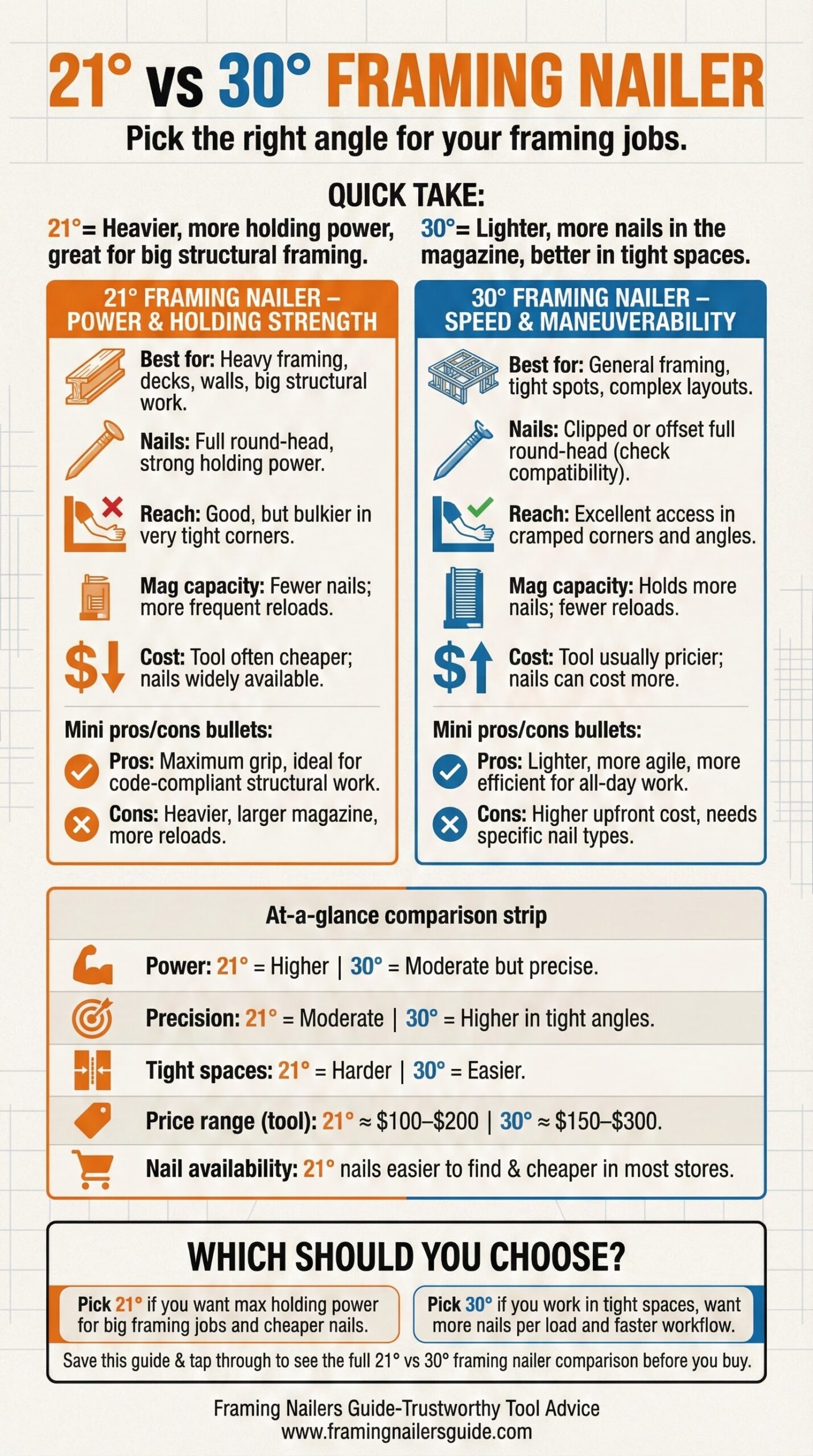
Before we get into the weeds, here’s the snapshot. Bookmark this table. Share it with your crew. It’ll save you time at the tool counter.
| Feature | 21 Degree Framing Nailer | 30 Degree Framing Nailer |
|---|---|---|
| Magazine Angle/Design | Shallower angle, bulkier front-to-back profile | Steeper angle, noticeably slimmer overall footprint |
| Collation Type | Plastic strip collation | Clipped head or offset full round head options |
| Nail Cost Trend | Stable, competitive pricing | Slightly variable by region; paper collation sometimes premium |
| Typical Price Range | $100-$200 (pneumatic); $200-$400 (cordless) | $150-$300 (pneumatic); $300-$500+ (cordless) |
| Code Compliance | Full round heads accepted everywhereFull round heads accepted everywhere | Requires verification (clipped heads restricted in some jurisdictions) |
| Tight Space Access | Difficult to maneuver | Significantly easier to position and work |
| Magazine Capacity | 60-70 nails per strip | 80-90+ nails per strip |
| Typical Use Cases | Heavy framing, deck construction, general-purpose building | Wall framing, renovation work, toenailing, confined spaces |
Speed & Efficiency on the Job: Making Your Workday Count
Time. That’s really what this comes down to. On a job site—whether you’re a pro contractor billing by the hour or a DIY enthusiast who just wants to finish before sunset—every minute of unnecessary downtime costs you.
Reload Frequency & Magazine Capacity: The Math That Matters

Let’s do some quick math. The 30-degree nailer holds 80-90 nails per strip. The 21-degree? 60-70. That’s roughly 25-30% more nails before you need to reload.
Now imagine you’re on day two of sheeting a three-story residential framing project. You’re positioning nails every 6-8 inches across plywood sheets. Standard practice. You burn through a magazine fast. And every single time you pause mid-flow to reload… you lose momentum.
It doesn’t sound like a lot. But across an eight-hour day? That’s potentially 4-5 fewer interruptions with the 30-degree. Fewer trips to your tool belt. Fewer moments of “where did I put that next strip of nails.” Fewer mental transitions out of the zone.
For a homeowner doing a weekend project, this matters less. But for professionals? This is literally the difference between finishing a day strong and finishing drained.
Debris Cleanup: The Hidden Efficiency Tax (Plastic vs Paper Collation)

Here’s something that genuinely surprised me the first time I noticed it. The 21-degree nailer uses plastic strips to collate nails—basically little plastic bands that hold the nails in line.
And those plastic pieces? They shatter when the nails fire. Little plastic fragments everywhere. On your work surface. Mixed in with sawdust and debris. Sometimes even sticking to nail heads (which carpenters call “flagging”).
I’ve spent more time than I’d like to admit picking plastic shrapnel out of expensive materials that were supposed to look pristine. The 30-degree uses paper tape collation instead—it just disintegrates into practically nothing. Cleaner. Simpler. Less cleanup.
And here’s the tangent: your job site cleanliness actually affects quality. Cleaner debris field means fewer foreign objects getting between materials, better visibility of your nailing pattern, and fewer callbacks to fix issues caused by trapped plastic fragments. So this efficiency gain isn’t just about time—it’s about output quality too.
Nailing Speed in Tight Spaces: Geometry Is Destiny
This is where the magazine angle really shows its teeth. Because of that steeper 30-degree design, the entire tool has a narrower profile—it’s geometrically slimmer.
You know that 14.5-inch gap between studs on 16-inch-on-center walls? Standard residential framing? Try fitting a 21-degree nailer in there comfortably while maintaining proper shooting angle and trigger access. It’s doable, but it’s cramped. You’re contorting yourself. Your hand position is awkward. Your aiming becomes imprecise.
The 30-degree? It practically slides in. You can position it exactly where you need it. Your body stays comfortable. Your aim stays true. And here’s the thing—comfortable positioning directly translates to faster, more consistent nailing.
Toenailing—that technique where you’re driving nails at an angle to join two pieces of wood (like fastening a joist to a ledger board)—becomes almost enjoyable with a 30-degree. The magazine angle naturally aligns with your trajectory. With a 21-degree, you’re essentially fighting the tool’s design geometry.
Accuracy & Access in Real Framing Work: Theory Meets Practice
Speed is fine and dandy. But if your nails end up in wrong places… or if you’re spending energy just positioning the gun instead of driving the nail… speed doesn’t matter much, does it?
Working Between Studs & Joists: The Bread and Butter of Framing
Let me be direct: the 30-degree nailer excels in the exact scenarios that make up most residential framing work.
You’re fastening bottom plates to the rim board? That 30-degree slides in easily between layout marks, and you can angle it slightly to ensure the nail grabs both pieces. You’re tying joists to beams overhead? The narrower profile means your hands aren’t cramped, so you maintain better trigger control and pressure on the nail.
The 21-degree works fine in open areas. Honestly. For framing an exterior wall in a large open space, where you’ve got room to maneuver? Both tools are equally capable. The efficiency difference is minimal.
But the moment you’re working in confined spaces—and framing inherently involves confined spaces—the 30-degree pulls ahead noticeably. It’s not flashy. It’s just… pragmatic.
Overhead and Ladder Work: Fatigue Is Real
Both of these tools are heavy. I’m not going to pretend otherwise. If you’ve used a cordless framing nailer overhead for more than an hour, your shoulder knows what I’m talking about. It’s substantial weight held at arm’s length while you’re also managing balance on a ladder.
But here’s where magazine capacity makes a real difference: The 30-degree’s 80-90 nail capacity means fewer reloads while you’re up there.
Think about it. You’re on a ladder, driving nails into ceiling joists. Your weight is distributed across a narrow footprint. You’ve got one hand on the ladder, one hand on the nailer. You’re partially supported by the wall you’re leaning against. Now imagine you run out of nails. You need to climb down, reload, climb back up, find your position again, and continue.
One reload might not sound like much. But when you’re doing a full ceiling of 16-inch-on-center joists? You could be doing that four, five, six times. Every single trip adds fatigue. Every repositioning increases fall risk. And every break disrupts the rhythm that makes overhead work manageable.
The 30-degree’s higher capacity means you might only reload once instead of multiple times. That’s a material difference in your end-of-day exhaustion level.
Code Requirements (Full-Round vs Clipped Head): The Legal Stuff You Can’t Ignore
Okay. This section is important because it directly affects whether you can legally use your nailer in certain applications.
Building codes—especially in hurricane-prone regions like Florida, seismic zones like California, and various other jurisdictions—have specific requirements about nail head styles for structural fastening. Many require full round head nails for framing work. Full stop.
The reasoning? Full heads have slightly more surface area than clipped heads. In theory (and this is debated in the construction world), the larger bearing surface prevents nails from overdriving through lumber, which could reduce holding power in extreme conditions like hurricanes or earthquakes.
Here’s the practical implication:
21-degree nailers only use full round head nails. Period. You’re automatically code-compliant everywhere in North America. This is actually a huge advantage if you’re working across multiple jurisdictions or if you want to eliminate guesswork about code compliance.
30-degree nailers can use clipped heads OR offset full round heads. You have options. But—and this is crucial—you need to verify what your local code allows. Call your building inspector. Seriously. Spend five minutes on the phone.
Most jurisdictions allow both. Some don’t. And the consequences of using the wrong fastener? Failed inspections. Work that needs to be redone. Liability issues if something goes wrong. That’s not worth saving a few bucks on nail costs.
If you’re working in areas with strict code requirements, the 21-degree removes all ambiguity. If you’re working in areas with more flexible codes, the 30-degree gives you efficiency gains plus flexibility.
Cost-Benefit Analysis: The Real Investment Question
Everyone wants to know: which tool pays for itself faster? Which one has better long-term value?
The answer is more nuanced than “buy the cheaper one.”
Tool Price Ranges: What You’ll Actually Spend
21-degree framing nailers start at around $100-$150 for a decent pneumatic model. Cordless (usually 20V battery-powered) runs $200-$400 depending on brand reputation and features.
30-degree framing nailers tend to cost 20-40% more. Pneumatic: $150-$250. Cordless: $300-$500+. Sometimes even higher for premium brands with advanced features like single-pass no-mar tips or electronic depth adjustment .
The upfront cost difference is real. If you’re a homeowner doing occasional projects on a tight budget, that extra $100-$200 might genuinely affect your purchasing decision.
But—and here’s the thing that catches people off guard—the tool cost is only one piece of the puzzle.
Nail Cost and Availability: Where the Ongoing Expenses Live
The 21-degree uses full round head nails with plastic collation. These are everywhere. Home Depot, Lowe’s, your local mom-and-pop hardware store, that sketchy place next to the gas station—they all stock them. Availability is almost never an issue .
Pricing is stable and competitive. You’re buying a commodity. Minimal regional variation.
The 30-degree uses paper-collated nails. Also widely available. But—and this varies by region—they sometimes cost slightly more per nail because paper collation is more expensive to manufacture than plastic.
If you’re doing a monster project that requires 5,000 nails, price out both options in your specific area before committing. Ordering online? Check shipping costs too. Nails are heavy.
Here’s the subtle consideration: which tool do you want to be dependent on? With a 21-degree, you’re locked into full round heads (which is fine—they’re the most secure option anyway). With a 30-degree, you have flexibility to use clipped heads if your code allows, which opens up cheaper sourcing options in some regions.
Long-Term Maintenance and Jam Issues: Hidden Costs Over Time
Paper tape collation (30-degree) generally causes fewer jams than plastic strips. Less debris. Cleaner feeding mechanisms. Less buildup inside the magazine that causes friction and misfeeds.
With plastic collation (21-degree), if nails get jostled in your truck bed between jobs, individual nails can pop out of their plastic strips. This creates a feeding problem—the gun tries to drive a nail that’s not properly positioned, and you get a jam. Now you’re stopped mid-job, disassembling the magazine, clearing debris, reassembling, and getting back to work.
Does this happen every day? No. But across dozens of jobs throughout a year? It’s a cumulative efficiency loss.
Maintenance-wise, both tools benefit from regular cleaning. Sawdust, dirt, and collation debris build up inside the mechanisms. But the 30-degree’s paper collation produces fewer hard plastic fragments that cause abrasion, so wear and tear is slightly lower.
Neither of these is a deal-breaker. Just small advantages that compound over time.
When to Choose Which Tool: Decision Framework
Choose the 21-degree framing nailer if:
- You primarily do heavy framing, deck building, or exterior work where full round heads are ideal anyway
- You need guaranteed code compliance everywhere without verification hassles
- Nail availability in your area is important (full round heads are universally stocked)
- You’re budget-conscious and want the cheapest entry point
- You’re working across multiple jurisdictions with varying codes (full heads work everywhere)
- You do occasional projects and don’t want to overthink specifications
Check out professional options like the Bostitch F21PL or explore our complete framing nailer roundup for more 21-degree options.
Choose the 30-degree framing nailer if:
- Your work involves wall framing, renovation projects, or tight-space nailing
- You do toenailing regularly and want natural magazine alignment
- You’re working in areas with code flexibility regarding clipped heads
- Your local codes allow clipped head nails, which can reduce costs in some regions
- You value reload efficiency and want fewer interruptions per shift
- You do overhead framing (ceilings, soffits) where fewer reloads matters
- Cleaner debris and less maintenance appeals to you
Solid options in this category include the Porter-Cable FR350BR and the budget-friendly PowRyte 500024.
Frequently Asked Questions: The Questions Everyone Actually Asks
Q: Can I use 21-degree nails in a 30-degree nailer, or vice versa?
A: No. Magazine design is specific to collation angle. 21-degree plastic strips won’t mechanically fit into a 30-degree magazine, and vice versa. Using the wrong collation will jam the tool or cause complete feeding failure. They’re not interchangeable .
Q: Are clipped head nails actually weaker than full round heads?
A: Not scientifically. Testing shows equivalent withdrawal resistance. However—and this matters for code compliance—some inspectors believe the larger bearing surface of full heads better prevents overdriving in wood members. Whether this concern is justified is debated in construction circles. But code is code, so follow your jurisdiction’s requirements.
Q: Which angle is better for deck building?
A: The 21-degree, hands down. Full round heads provide maximum holding power for outdoor structures exposed to weather, UV exposure, and seasonal wood movement. Decks need the most secure fastening you can get, and full round heads deliver that. Plus, deck building usually happens in open spaces where the 21-degree’s larger profile isn’t a limitation.
Q: What if my job requires both tight-space access AND code-strict full head nails?
A: This is where some pros own both tools. 21-degree for heavy framing and decks, 30-degree for wall work and renovations. It’s not cheap, but tools are investments that you’re using for years. If you’re billing clients, the efficiency gains often justify dual ownership.
Q: I’m a homeowner doing my first project. Which should I buy?
A: The 21-degree. Here’s why: simpler decision-making (one nail type, universal code compliance), wider nail availability if you need emergency supplies, and lower upfront cost. You won’t feel restricted by the larger profile on typical residential framing . As you get more experience and take on different project types, you might add a 30-degree later.
Q: How much weight difference is there between the two?
A: Generally minimal—usually 0.5-1.5 pounds difference depending on materials and design. The 21-degree might be slightly heavier due to the plastic strip magazine vs. paper tape. For overhead work, however, even one pound feels like five when you’re working above your head, so cumulative design efficiency (reload frequency, not raw weight) matters more.
Q: Can I use cordless and pneumatic nailers interchangeably?
A: The magazine design and nail type remain the same—21-degree nails work in all 21-degree tools, whether cordless or pneumatic. But cordless has advantages: no air hose to manage, faster cycle times on some models, consistent performance in cold weather. The angle considerations (21 vs. 30) apply regardless of power source.
The Bottom Line: Making Your Decision
You’re not overthinking this. The angle does matter—just not the way you initially thought. It’s not about trajectory. It’s about engineering, efficiency, code compliance, and practical real-world fit.
The 21-degree is the reliable workhorse: straightforward, code-legal everywhere, proven by decades of use, backed by universal nail availability. Perfect if you want simplicity and guaranteed compliance.
The 30-degree is the refined specialist: better for tight spaces, higher efficiency through magazine capacity, cleaner operation with paper collation, natural toenailing alignment. Perfect if your work involves complex framing scenarios and you’ve verified local code acceptance.
Neither is “wrong.” They’re different tools optimized for different priorities. Choose based on your actual work, your local requirements, and your job site scenarios.
And once you know what you’re getting, you’ll finally understand why that number on the box matters.
Additional Resources
- Building Code Reference: ICC Building Code Standards – Search your jurisdiction for clipped vs. full head requirements
- Professional Framing Practices: National Association of Home Builders Construction Standards – Best practices for framing installation
- Compare Our Reviews: Complete Framing Nailer Guide