

Last Updated on August 23, 2026 by John Patterson
Clear the chamber.
You pull the trigger on your framing nailer, hear a dull thud, and watch the driver blade freeze halfway down the nosepiece. The next nail is mangled against the feed claw.
You pry at the jammed nose with a claw hammer, destroying a $40 driver blade and losing thirty minutes of production.
Let’s stop the cycle.
Framing nailers do not jam at random. Piston stalls, proud nails, and feeding jams result from specific mechanical mismatches and air supply starvation.
JAM-FREE OPERATION FORMULA
Correct Magazine Angle + Full 90–120 PSI + Daily Lubrication = Zero Jamming
Before troubleshooting, verify your strip collation specs in our framing nail compatibility chart.
Quick Answer: Why is my Framing Nailer Jamming?
Short version?
Framing nailers jam primarily due to incorrect magazine degree alignment (loading 21° nails into a 30° tool), wet paper tape collation, low pneumatic air pressure (below 90 PSI), or a bent driver blade.
To fix jams, disconnect air or battery power, clear the nosepiece with a steel punch, lubricate the cylinder with pneumatic tool oil, and verify nail gauge clearance.
Nail Wedged in Nosepiece: Caused by collation angle or wire gauge mismatches. Fix: Disconnect air, clear with a punch, and verify fastener box degree.
Nails Left Proud (Sticking Up): Caused by low regulator PSI or undersized 1/4″ hoses. Fix: Increase air pressure to 105–115 PSI and upgrade to a 3/8″ high-flow hose.
Dry Firing (No Nail Shot): Caused by a dirty magazine track or weak pusher spring. Fix: Clean track with dry silicone spray and inspect follower tension.
Driver Blade Frozen Down: Caused by lack of oil or blown piston O-rings. Fix: Add 5 drops of pneumatic tool oil and tap the blade back into the cylinder.
Double-Nail Feeding: Caused by wet paper tape or damaged nosepiece lips. Fix: Inspect feed channel and discard damp collation strips.
Mistake 1: Fastener Collation & Magazine Angle Mismatch
Angles are not interchangeable.
Loading a 20-to-22-degree plastic strip nail into a 30-degree magazine—or vice versa—is the single most common cause of violent feeder jams.
The feeder claw cannot align mismatched angles against the driver blade channel, forcing two nails into the nosepiece simultaneously.
Wire Gauge Binding: Nails with .148″ or .162″ thick shanks will wedge tightly inside guns engineered strictly for .113″ to .131″ wire.
Length Clearance: Loading 3-1/2″ nails into a magazine restricted to 3-1/4″ sinkers jams the bottom pusher spring.
Compare tool angles and collation specs in our guide on 21 vs 30 degree framing nailer.
Mistake 2: Pressure Drop & Regulator Starvation (Proud Nails)

Pressure is power.
If your framing nailer leaves nails sticking out 1/2-inch above the wood, the tool is not defective—it is starving for air.
A framing gun requires an instantaneous burst of 100 to 120 PSI at the tool inlet to drive long nails completely flush.
The 1/4-Inch Hose Trap: A long 100-foot, 1/4-inch narrow hose creates massive friction loss, dropping 120 PSI at the tank down to 80 PSI at your gun.
Compressor CFM Deficit: Running multiple nailers off a single pancake compressor drains the tank faster than the motor can recover.
PNEUMATIC POWER FORMULA
Upgrade to 3/8″ High-Flow Air Hose + Set Regulator to 110 PSI = Zero Proud Nails
Mistake 3: Bent Driver Blade & Piston Channel Obstructions
Metal fatigues over time.
Striking an embedded steel hurricane tie, anchor bolt, or concrete foundation will bend the hardened driver blade tip.
Even a microscopic 0.5mm warp prevents the blade from retracting cleanly back into the cylinder, causing instant jams on every subsequent shot.
Visual Inspection: Disconnect air, open the magazine, and visually inspect if the driver blade rests fully seated at the top of the cylinder.
Replacement Rule: If the blade is chipped, mushroomed, or warped, replace the driver assembly immediately.
Fastening metal brackets? Avoid striking steel plates by using dedicated fasteners from our joist hanger nails vs framing nails guide.
Mistake 4: Lack of Lubrication & Worn O-Ring Seals
Oil your tools daily.
Pneumatic framing guns contain high-speed aluminum pistons running inside tight cylinder sleeves.
Without oil, friction shreds rubber O-ring seals, causing internal air blow-by and leaving the piston stranded midway through its stroke.
Daily Oiling Routine: Add 4 to 6 drops of non-detergent pneumatic tool oil directly into the air inlet fitting before every work shift.
The Solvent Trap: Never use WD-40, motor oil, or penetrating solvents. Petroleum solvents dissolve synthetic rubber O-rings and destroy cylinder seals.
Step-by-Step Safe Jam Clearing Procedure (OSHA Lockout)
Never look directly down the nosepiece of a loaded or pressurized nail gun.
Follow this OSHA-compliant jam clearing procedure:
Step 1 (Disconnect Power): Disconnect the air hose or remove the lithium battery pack immediately to eliminate accidental discharge.
Step 2 (Unload Fasteners): Pull back the magazine follower pusher and slide out all remaining collated nail strips.
Step 3 (Dislodge the Jam): Use a steel punch and small hammer to tap the jammed nail from the nose channel. Never strike the driver blade face directly.
Step 4 (Reset the Driver): Push the driver blade fully upward into the cylinder until it clicks into its reset position.
Step 5 (Lubricate & Test): Add 3 drops of oil, reconnect air, and test-fire into a scrap 2×4 before resuming production framing.
Review mandatory safety guidelines under official OSHA Nail Gun Safety Protocols.

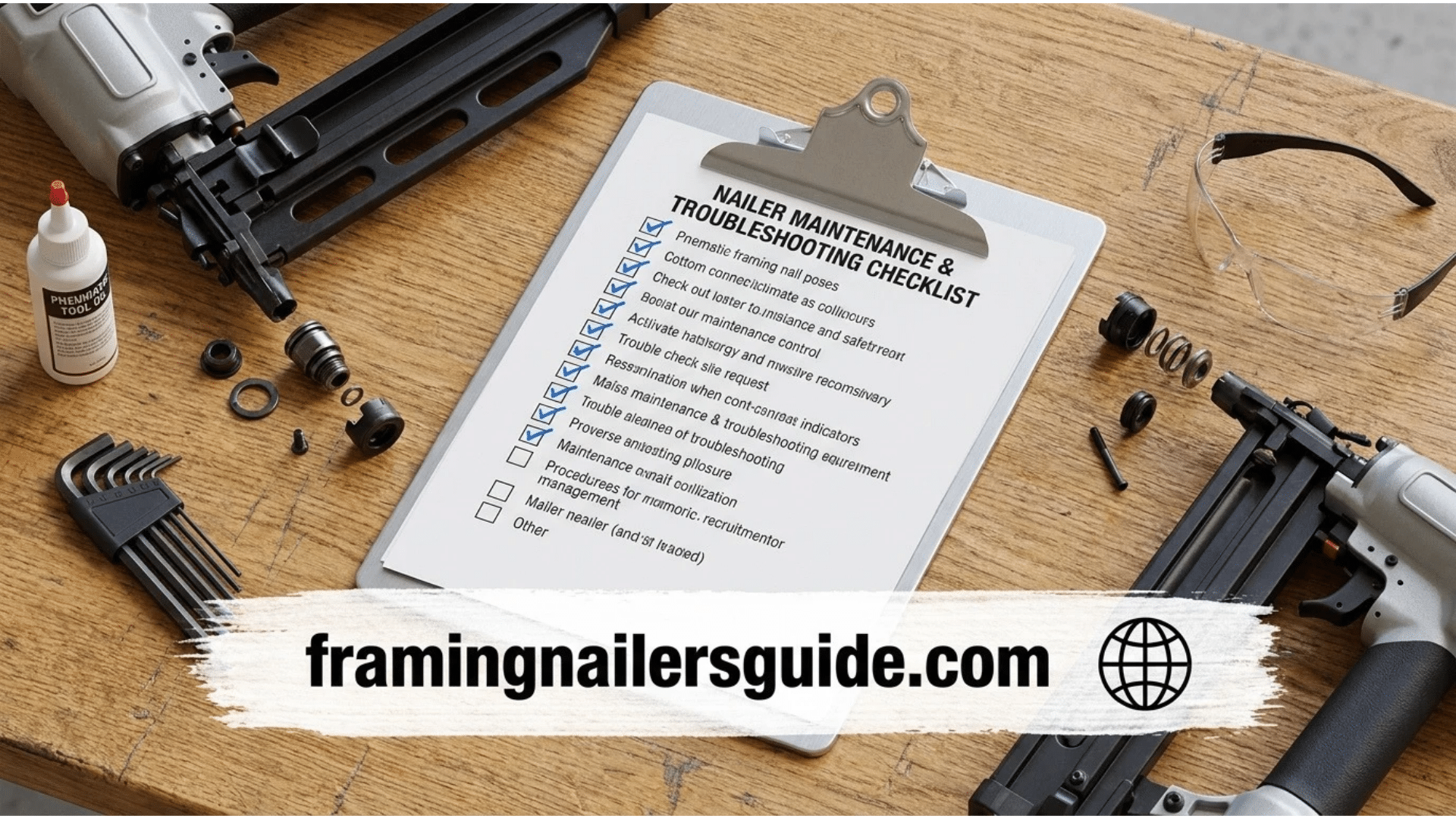
Jobsite Troubleshooting & Maintenance Checklist
Run this check whenever your framing nailer acts up:
Power Lockout: Did you disconnect the air hose or battery before inspecting the nosepiece?
Angle Verification: Does your nail collation degree match your magazine label exactly (21° vs 30°)?
Air Supply Check: Is your compressor delivering 105–115 PSI through a minimum 3/8″ air hose?
Lubrication Check: Did you add 4–6 drops of pneumatic oil to the air inlet today?
Track Cleanliness: Is the magazine feeder track clean and free of wood dust and plastic shrapnel?
Collation Moisture: Are your paper-collated nail strips dry and crisp (not softened by rain)?
Frequently Asked Questions
Why does my framing nailer leave nails sticking out?
Nails stand proud due to low air pressure (under 90 PSI), narrow 1/4-inch hoses, an empty compressor tank, or an incorrectly adjusted tool depth-of-drive wheel.
Can I use WD-40 to lubricate my pneumatic nail gun?
No. WD-40 is a solvent, not a lubricant. It strips factory grease and dissolves internal rubber O-rings. Always use dedicated non-detergent pneumatic tool oil.
What causes a framing nailer to dry-fire without shooting nails?
Dry-firing occurs when the magazine feeder track is clogged with debris, the pusher spring has lost tension, or the nail collation strip is bent.
Why does my framing gun shoot two nails at once?
Double-nail firing happens when the driver blade fails to retract fully, the nosepiece feed lip is worn, or the operator hesitates during bump-fire mode.
How do I unjam a cordless battery framing nailer?
Remove the battery, loosen the magazine nose bolts with the onboard hex key, clear the jammed nail with a punch, and turn the jam-release lever to reset the piston.
Final Summary & Key Takeaways
Prevent jams before they stop your build.
Match your nail degree precisely, feed 110 PSI through a 3/8-inch hose, and oil your tool daily.
When jams occur, disconnect power safely, clear the nose with a punch, and keep your framing production moving.
