


Last Updated on August 22, 2026 by John Patterson
Load the drum.
You drop a coil of 300 wire-welded nails into your nailer’s canister, lock the door, and start sheeting a 2,000-square-foot subfloor. While your framing partner reloads a stick gun four separate times, you keep walking without breaking your driving cadence.
Then you step into a 14-1/2-inch stud bay to toe-nail wall plates, and the wide round drum bangs against the adjacent lumber.
That physical tradeoff defines the choice.
Coil and stick framing nailers fire the exact same structural fasteners into dimensional lumber, but their magazine architecture, weight balance, and reloading efficiency serve fundamentally different carpentry jobs.
MAGAZINE ARCHITECTURE FORMULA
Coil (300 Nails / Wire-Weld / High-Speed Sheathing) vs. Stick (60-80 Nails / Compact Profile / Stud Framing)
Before choosing your gun platform, verify code-approved fastener lengths in our master guide on what size nails for framing.
Quick Answer: Coil vs Stick Framing Nailer
Short version?
A coil framing nailer holds 200 to 300 nails in a circular canister, drastically cuts reloading downtime on subfloors and roof decking, and offers a centered balance, but features a bulky body that cannot squeeze into tight 16-inch stud bays.
A stick framing nailer holds 60 to 80 nails in a straight magazine, fits effortlessly between studs and rafters, and weighs less when loaded, but requires frequent reloading during high-volume sheathing.
- Coil Nailer Capacity: Massive 200 to 300-nail canister capacity eliminates frequent stops on high-volume production decking.
- Stick Nailer Capacity: 60 to 80-nail linear capacity requires 4x more reloading stops during extensive subflooring runs.
- Coil Ergonomic Balance: Shorter overall length with a low center of gravity directly beneath the tool body, reducing wrist roll.
- Stick Stud Clearance: Slim, linear magazine profile slips between 16-inch on-center studs and tight roof truss corners effortlessly.
- Collation Durability: Wire-welded coils are 100% waterproof and never soften in rain; stick paper tape can degrade when soaked.
- Price Point: Coil guns cost $320–$480; stick framing nailers cost $180–$300 for equivalent pneumatic models.
Ensure your fastener collation angle matches your gun using our framing nail compatibility chart.
Magazine Capacity & Reloading Speed: 300 Nails vs. 60–80 Nails
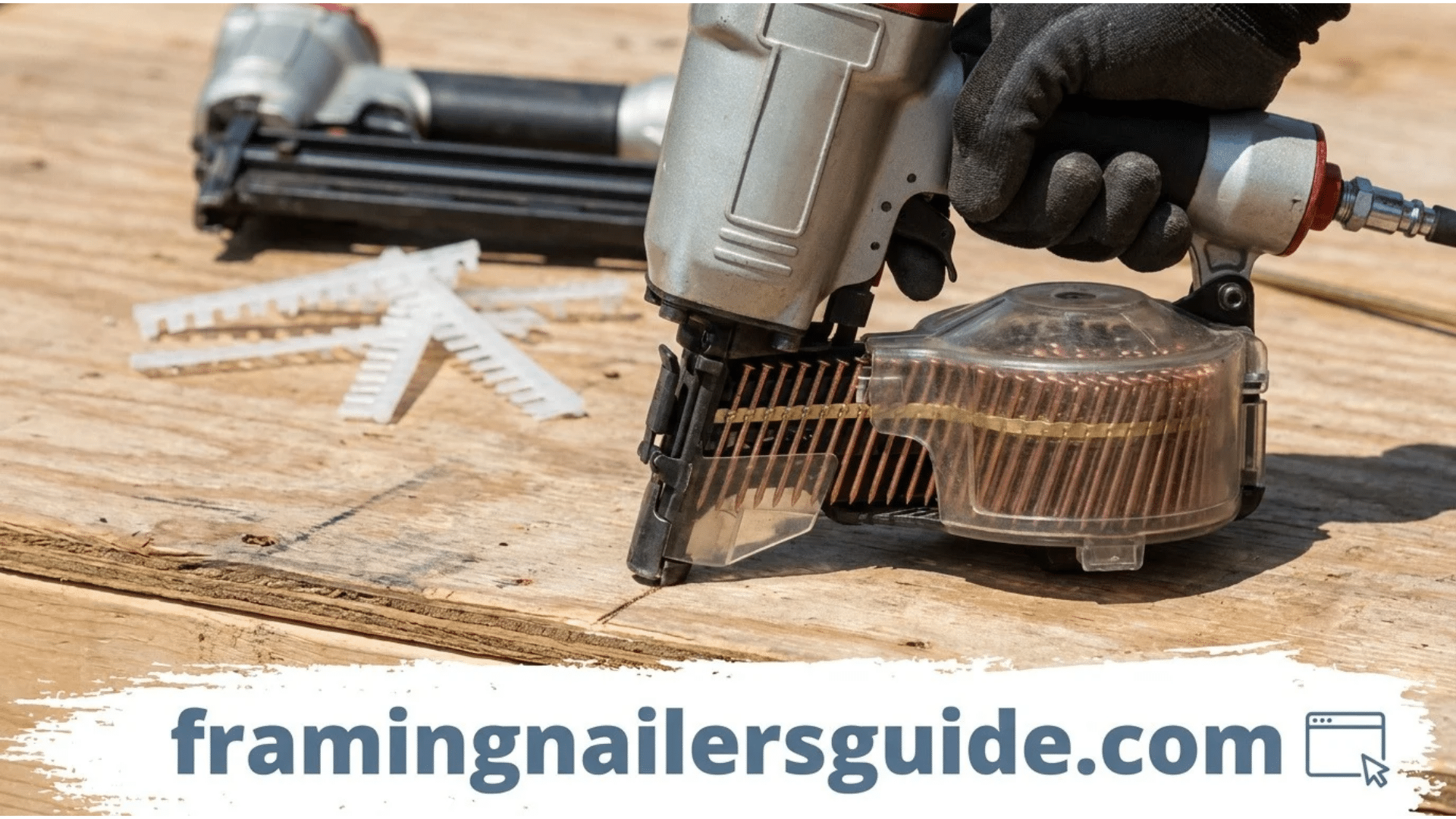
Time is profit.
Fastening a 60-sheet subfloor requires over 2,000 structural fasteners driven at 6-inch perimeter and 12-inch field intervals.
With a stick framing nailer holding 60 to 70 nails per strip, a carpenter must stop, draw a new strip from their tool belt, and reload approximately 30 times.
- Coil Production Advantage: Requires only 7 coil reloads for the exact same 2,000-nail subfloor deck, saving 20 to 30 minutes of production stoppage per day.
- Stick Reload Downtime: Frequent reload cycles interrupt bump-fire rhythm and force framers to carry bulky stick collation strips in nail pouches.
CAPACITY MULTIPLIER
1 Coil Load (300 Nails) = 4 to 5 Stick Strips (60-70 Nails Each)
Need superior pull-out grip to eliminate floor squeaks? Check out our comparison of ring shank vs. smooth shank framing nails.
Center of Gravity & Ergonomic Weight Distribution
Feel the leverage.
A bare coil nailer weighs roughly 8.0 lbs, while a fully loaded coil of 300 3-inch nails adds another 4.5 lbs, bringing total tool weight to 12.5 lbs.
Yet on flat decking, a coil gun often feels lighter to handle than a loaded stick nailer.
- Coil Center of Gravity: The round nail canister sits directly below the motor cylinder and close to the main grip. The weight centers in the palm of your hand with minimal wrist torque.
- Stick Leverage Strain: A 21° or 30° stick magazine extends 18 to 22 inches rearward. That cantilevered tail creates rotational leverage on your wrist every time you pivot the nose.
- Overhead Framing: A stick nailer loaded with one strip weighs only 8.5 lbs total, making it far superior for holding overhead while nailing ceiling joists and roof rafters.
Compare magazine clearance and reach angles in our guide on 21 vs 30 degree framing nailer systems.
Collation Durability: Wire-Weld Coils vs. Paper and Plastic Sticks
Weather destroys collation.
Fastener collation strips react completely differently to harsh jobsite conditions and dynamic feeding stresses.
1. Wire-Welded Coils (15-Degree Standard)
- Collation Material: Nails are micro-spot-welded to two thin strands of copper-coated steel wire.
- Moisture Resistance: Wire coils are completely waterproof. They can sit in rainwater or mud puddles on winter jobsites without degrading or falling apart.
- The Wire Burr Factor: As nails are driven, tiny wire fragments shear off and can occasionally sting exposed skin; wearing eye protection is non-negotiable.
2. Paper Tape and Plastic Sticks (21° & 30°)
- Paper Tape Performance: Glued paper tape shears cleanly without shrapnel, but softens and jams feeding trays when soaked in heavy rain.
- Plastic Strip Performance: Rigid plastic strips resist water, but shatter into thousands of sharp fragments that litter the jobsite subfloor.
Always wear certified eye protection as mandated under official OSHA Nail Gun Safety Protocols.
Siding & Multi-Material Versatility: The Dual-Use Advantage
Maximize tool utility.
Stick framing nailers are strictly engineered for heavy structural framing (2-inch to 3-1/2-inch fasteners).
Coil framing nailers offer a broader fastener adjustment range that allows them to cross over into exterior siding and packaging.
- Siding & Sheathing Crossover: Many coil framing guns feature adjustable canister trays that cycle shorter 1-1/2″ to 2-1/2″ coil nails for fiber cement siding, cedar shingles, and wood fencing.
- Crate & Pallet Assembly: The high nail capacity makes coil guns the undisputed choice for building wooden shipping pallets, timber crates, and truss manufacturing.
Working with pressure-treated lumber? Ensure your fasteners comply with our guide on framing nails for pressure-treated wood.
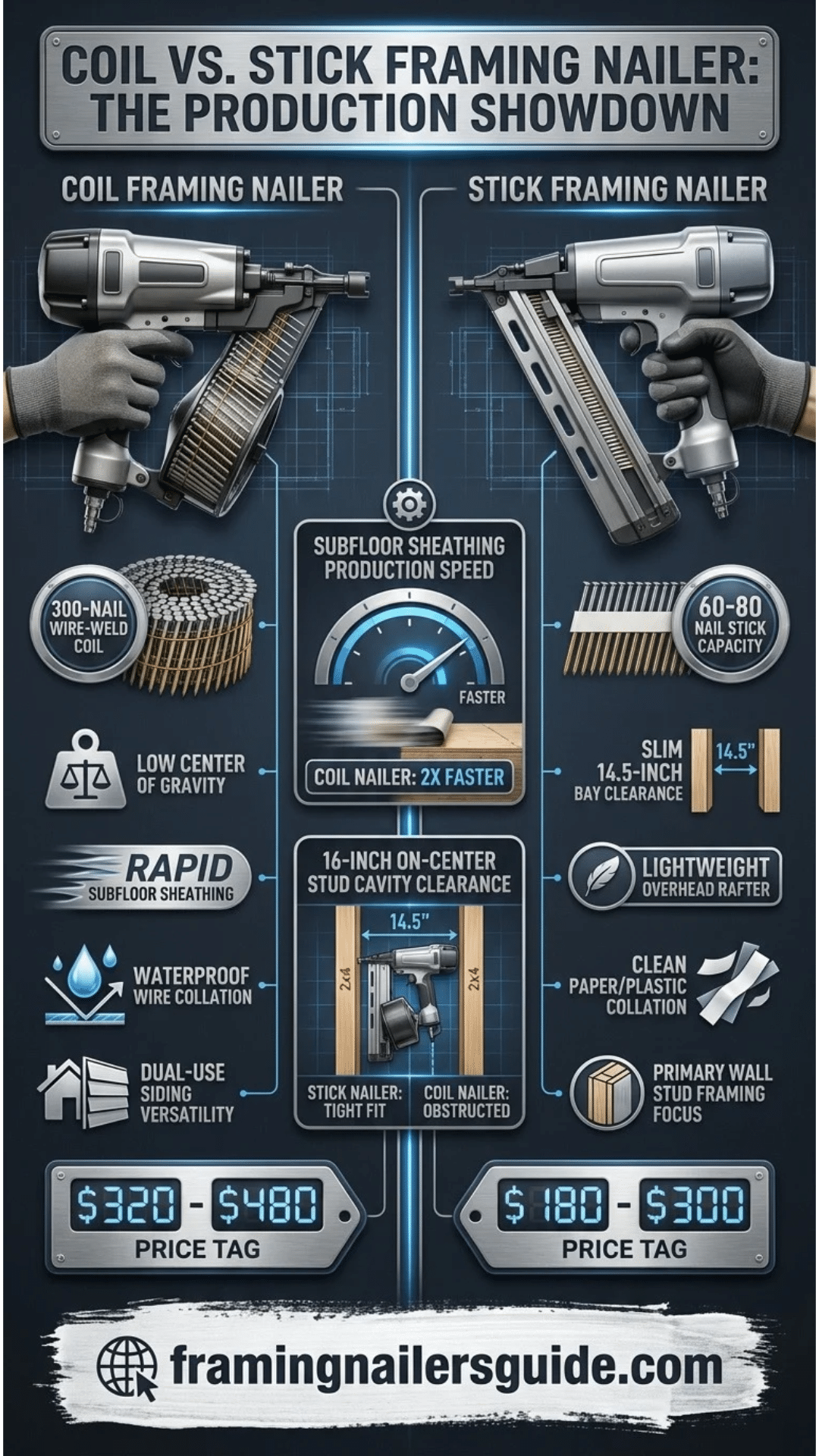
Comprehensive Vertical Infographic
Use this complete visual architecture for Pinterest, social channels, and editorial embeds:
Pre-Purchase Framing Nailer Decision Checklist
Run this check before investing in your next framing nailer platform:
Production Decking: Do you primarily frame subfloors, roof sheathing, wall decking, and high-volume flats? (Choose Coil).
Stud Bay Clearance: Do you spend most of your time framing walls, 16″ OC stud bays, rafters, and headers? (Choose Stick).
Ergonomic Balance: Do you want a compact tool center-of-gravity that prevents wrist twisting on horizontal planes? (Choose Coil).
Overhead Weight: Do you need the lightest possible loaded tool for overhead rafter and truss work? (Choose Stick).
Multi-Material Use: Do you need a dual-purpose tool that also shoots shorter nails for siding and fence boards? (Choose Coil).
Tool Budget: Is your tool budget restricted under $250 for a professional pneumatic tool? (Choose Stick).

Frequently Asked Questions
Why are coil framing nailers more expensive than stick nailers?
Coil nailers feature complex feed pistons, rotating canister trays, and hardened pawl mechanisms that require more precision machining than simple spring-loaded stick magazines.
Can you frame an entire house with a coil framing nailer?
Yes. Coil nailers excel at subflooring, exterior wall sheathing, and roof decking. However, toe-nailing studs in tight corner bays will require maneuvering around the wide drum.
Are coil framing nails more expensive than stick framing nails?
No. Because wire-welded coils are manufactured in massive industrial batches of 3,000 to 4,000 nails per carton, coil nails often cost 5% to 10% less per thousand than stick collation.
Why don’t residential wall framers use coil nailers all the time?
Wall framers prefer stick nailers because the slim magazine slips between 16-inch stud bays for toe-nailing and weighs 4 lbs less overhead when loaded.
Can a coil framing nailer shoot siding nails?
Many coil framing nailers can shoot down to 2-inch or 2-1/4-inch coil nails for siding, but dedicated coil siding nailers are lighter and optimized for thinner .092-gauge wire.
Final Summary & Key Takeaways
Match the tool to the task.
Choose a coil framing nailer for relentless speed on subfloors, roof sheathing, and high-volume production decking where 300 nails keep you moving.
Choose a stick framing nailer for everyday wall framing, rafter installations, and tight stud bay toe-nailing where a slim profile is king.
