


Last Updated on August 25, 2026 by John Patterson
Step onto the roof deck.
You stand on a 6/12 pitch roof with bundles of architectural shingles on one side and a heavy pneumatic framing gun in your hand.
It seems tempting to load short framing nails and start fastening shingles to save money on buying a dedicated roofing coil nailer.
Let’s analyze the mechanical engineering physics of a framing nailer vs roofing nailer.
Using a framing nailer on asphalt roofing shingles is an instant building code violation, voids manufacturer warranties, and punches clean holes right through the fiberglass mat.
PNEUMATIC FASTENING LAW
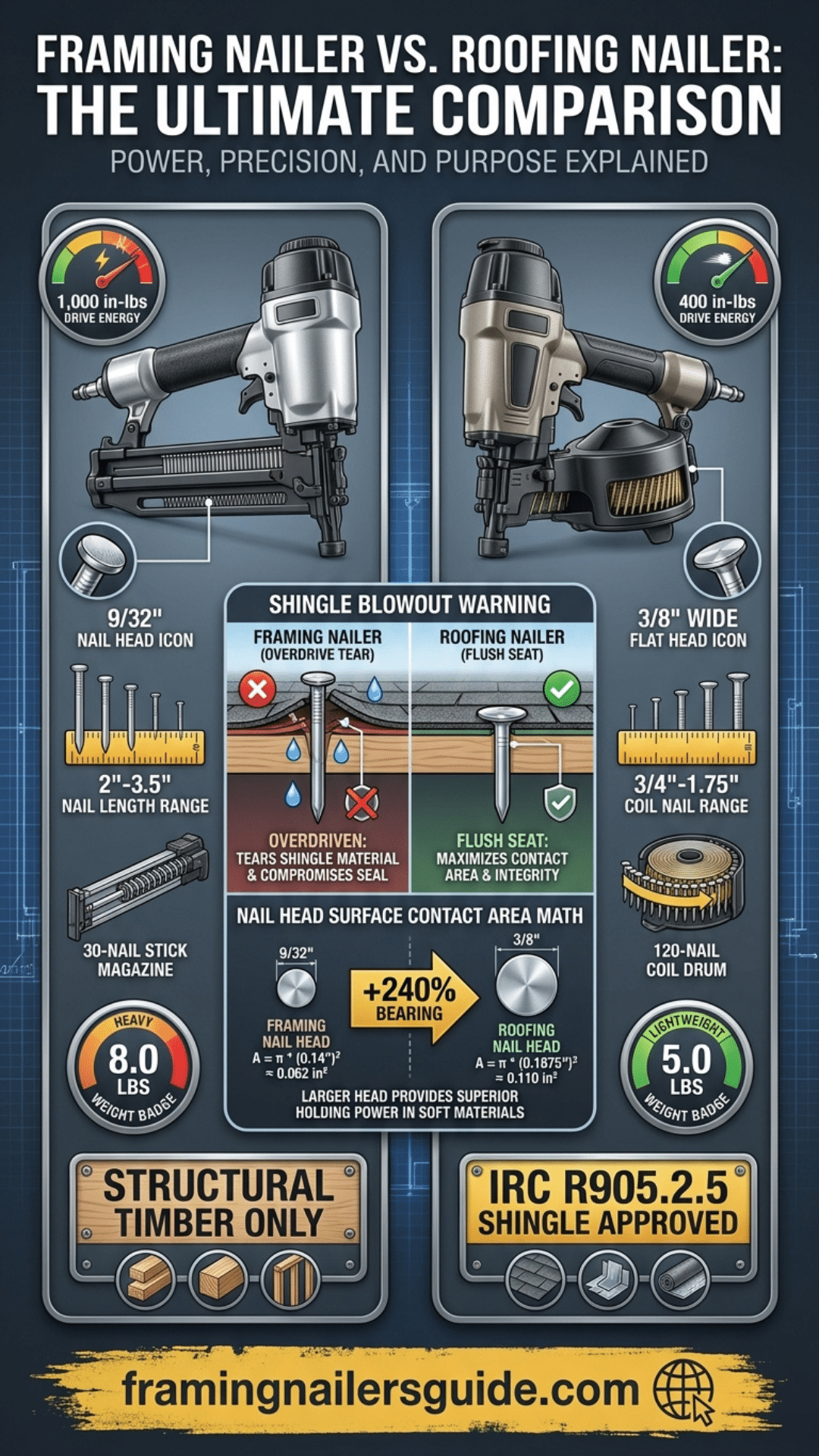
Framing Gun (1,000 In-Lbs / 9/32″ Head / Blow-Through) vs. Roofing Gun (400 In-Lbs / 3/8″ Head / Flush Clamping)
Before choosing fasteners for structural timber or roof trusses, review our master guide on what size nails for framing.
Evaluating strip magazines versus round coil canisters? Read our analysis on coil vs. stick framing nailers.
Quick Answer: Can You Use a Framing Nailer for Roofing?
Short version?
No. You cannot use a framing nailer to install asphalt shingles. A framing nailer generates 900 to 1,050 inch-pounds of kinetic drive energy and fires nails with small 9/32-inch heads, which instantly punch clean blow-through holes through fragile shingle mats and violate IRC Section R905.2.5.
A roofing nailer operates at lower drive energy (350 to 450 in-lbs), fires 15-degree wire-collated coil nails with massive 3/8-inch (0.375″) to 7/16-inch (0.4375″) wide flat heads, and features a wide carbide nosepiece engineered to seat fasteners 100% flush without tearing the fiberglass reinforcement.
Framing Gun Drive Energy: Delivers 900–1,050 in-lbs of impact energy designed to bury 3-1/2″ nails into dense solid timber; blows completely through asphalt shingles.
Roofing Gun Drive Energy: Delivers 350–450 in-lbs of calibrated energy; seats wide-head nails flush against delicate granular asphalt mats without crushing fiberglass cores.
Framing Nail Head Hazard: Small 9/32″ head provides almost zero surface clamping area; shingles blow off in 40-mph winds (violating ASTM D3462).
IRC Section R905.2.5 Code Rule: Mandates minimum 12-gauge (0.105″) shank and minimum 3/8″ (9.5 mm) head diameter; framing nails fail this standard automatically.
Magazine Capacity: Hold 120 nails per coil to cover entire shingle squares rapidly without stopping; stick framing nailers hold only 30 to 60 nails.
Drive Energy Physics: 1,000 In-Lbs vs. 400 In-Lbs (The Blow-Through Risk)
Piston displacement dictates impact force.
A framing nailer is a high-kinetic demolition-grade driver built with a massive aluminum piston bore designed to sink thick 16d common nails into dense Douglas fir studs.
When you fire a framing nailer against a 1/8-inch asphalt shingle, the tool releases over 1,000 inch-pounds of kinetic energy.
Overdrive Destruction: Even with tool depth-of-drive dials backed completely out and air compressor pressure dialed down to 70 PSI, the heavy piston mass drives the nail head right through the shingle mat like a hole punch.
Calibrated Low-Mass Piston: A roofing nailer utilizes a smaller, short-stroke piston calibrated specifically for 350 to 450 in-lbs of impact energy, stopping the driver blade precisely flush with the shingle surface.
Water Intrusion Void: Once an asphalt shingle’s top fiberglass reinforcement layer is severed by an overdriven nail head, its wind-uplift rating drops to zero, guaranteeing leaks during the first thunderstorm.
IMPACT KINETIC ENERGY EQUATION
Kinetic Energy = 0.5 × Piston Mass × Velocity² (Framing Piston = 2.5x Kinetic Energy of Roofing Piston)
Nail Head Diameter & Surface Bearing: 9/32″ Framing vs. 3/8″ Roofing Heads
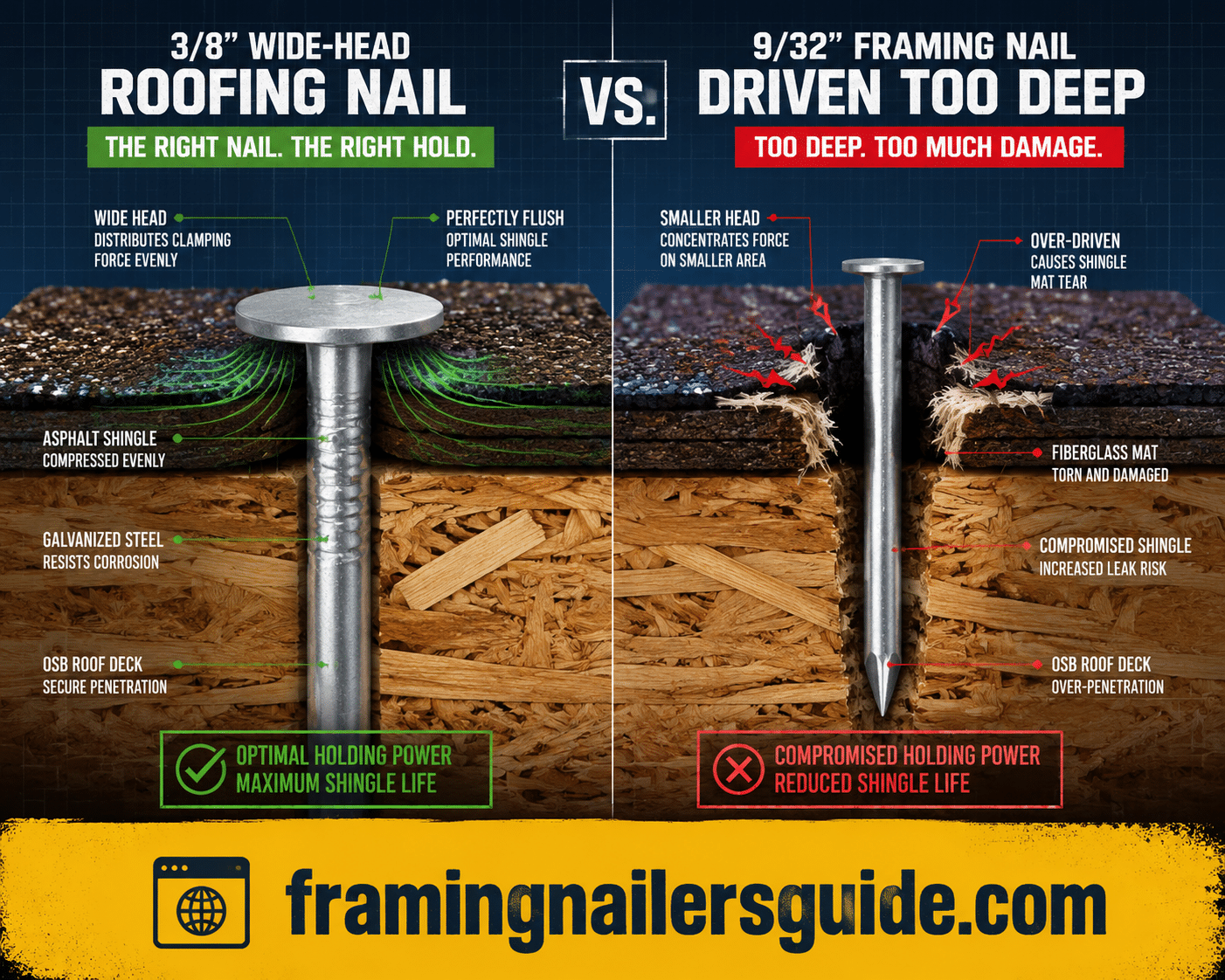
Head diameter governs holding power.
Asphalt shingles are flexible composite sheets consisting of asphalt-coated fiberglass topped with ceramic granules.
They rely entirely on the surface bearing area of the fastener head to clamp the shingle against the wood roof deck under hurricane wind loads.
Framing Nail Head (9/32″): Measures approximately 0.281 inches in diameter, providing a surface bearing contact area of just 0.062 square inches. Under wind uplift, the shingle simply pulls over the small head.
Roofing Nail Head (3/8″ to 7/16″): Measures 0.375 to 0.4375 inches in diameter, providing up to 0.150 square inches of surface bearing area—over 240% more clamping surface than a framing nail.
ASTM D3462 Compliance: Requires shingles to resist nail head pull-through forces up to 130-mph wind speeds. Fastening with narrow framing heads causes immediate structural tearing.
Review asphalt shingle manufacturing standards under the ASTM International Standard D3462 (Asphalt Shingle Specifications) and ARMA (Asphalt Roofing Manufacturers Association Fastener Guidelines) .
Fastener Length & Sheathing Penetration: IRC Section R905.2.5 Code Rules
Codes enforce strict roof fastening.
The International Residential Code (IRC Section R905.2.5) explicitly defines legal fastener specifications for asphalt shingle application.
Using the wrong nail type or length will result in an immediate failed roof inspection.
IRC Fastener Dimensions: Fasteners must be minimum 12-gauge (0.105-inch shank), corrosion-resistant hot-dipped galvanized or stainless steel, with a minimum 3/8-inch (9.5 mm) head diameter.
Deck Embedment Depth: Nails must penetrate a minimum of 3/4 inch into roof sheathing, or penetrate completely through the underside of sheathing by at least 1/8 inch.
The Attic Spike Hazard: Roofing nails range from 3/4″ to 1-3/4″ in length. Driving 3″ or 3-1/2″ framing nails through a 1/2″ plywood roof deck leaves 2-1/2 inches of sharp steel spike protruding into the attic space, puncturing HVAC ducts, electrical cables, and creating severe puncture hazards.
All roof assembly fasteners must comply with the International Residential Code (IRC Section R905.2.5) and
ASTM F1667 (Standard Specification for Driven Fasteners).
Magazine Capacity & Weight Ergonomics: 120-Nail Coils vs. 30-Nail Sticks
Roof production demands high capacity.
Shingling a standard 2,500-square-foot roof requires driving approximately 8,000 to 10,000 nails.
The magazine design and tool weight determine how efficiently a roofer navigates steep inclines.
15-Degree Coil Roofing Drum: Houses 120 nails in a compact, round plastic drum. A roofer can install nearly two full bundles of shingles without stopping to reload.
Stick Framing Magazine: Holds only 25 to 35 nails per strip. Using a framing gun on a roof would force the operator to stop and reload over 250 times during a single roofing job.
Tool Weight Comparison: Roofing nailers weigh 4.8 to 5.5 lbs with a low center of gravity; framing guns weigh 7.5 to 9.0 lbs, causing severe wrist and forearm fatigue on steep roof slopes.
When CAN You Use a Framing Nailer on a Roof? (Structural vs. Cladding)
Draw the line between framing and cladding.
While a framing nailer must never touch asphalt shingles, it is the primary tool required for constructing the underlying roof framework.
Roof Framing & Trusses: Fastening roof rafters, engineered trusses, collar ties, and structural ridge beams with 16d common (3-1/2″ x .131″ or .148″) framing nails.
Roof Sheathing Installation: Nailing 7/16″ OSB or 1/2″ plywood sheathing to rafters using 8d common (2-1/2″ x .131″) or ring-shank framing nails spaced 6″ on edges and 12″ in the field.
Fascia & Lookout Framing: Fastening subfascia and 2x rake boards to rafter tails using 16d sinker framing nails.
Pre-Roofing Fastener Compliance Checklist
Run this check before driving the first fastener into an asphalt shingle roof:
Dedicated Tool Check: Are you using a dedicated 15-degree coil roofing nailer (never a framing gun)?
Shank Diameter: Do roofing nails meet IRC Section R905.2.5 (minimum 12-gauge / 0.105″ shank)?
Head Diameter Standard: Are fastener heads minimum 3/8-inch (0.375″) to 7/16-inch wide flat heads?
Galvanization Rating: Are nails hot-dipped galvanized (ASTM A153) or stainless steel for corrosion protection?
Air Pressure Calibration: Is compressor pressure adjusted between 75 and 90 PSI to seat nails perfectly flush?
Deck Embedment Depth: Do nails penetrate 3/4″ into decking or 1/8″ completely through roof sheathing?
Flush Seating Inspection: Are 100% of nails driven straight and flush without cutting the top shingle mat?
Frequently Asked Questions
Can I use 2-inch framing nails to install roof shingles?
No. Even short 2-inch framing nails have small 9/32-inch heads and excessive kinetic drive energy that punches holes straight through shingle mats, resulting in immediate wind blow-offs and roof leaks.
What kind of nailer do I need for roof plywood sheathing?
Roof plywood or OSB sheathing must be installed using a framing nailer firing 8d common (2-1/2″ x .131″) or ring-shank nails. Roofing coil nailers cannot be used for structural roof sheathing.
What air pressure should a roofing nailer be set to?
Most pneumatic roofing nailers operate optimally between 75 and 90 PSI. Setting pressure too high causes nail heads to cut into shingles, while too low leaves heads sticking up.
Can you use a roofing nailer for wood siding?
A roofing nailer can be used for cedar shakes, but should not be used for lap siding or fiber cement siding because its wide 3/8-inch nail head is visible and cannot be blind-nailed cleanly.
How many nails go into a standard architectural roof shingle?
Standard installation requires four roofing nails per shingle. In high-wind zones (over 110 mph), building codes and manufacturer specifications require six nails per shingle.
Final Summary & Key Takeaways

Respect the tool boundaries.
Use framing nailers exclusively for structural framing, roof trusses, and 1/2-inch roof deck sheathing.
Use coil roofing nailers with wide 3/8-inch heads and 400 in-lbs of calibrated drive energy for all asphalt shingles to ensure 100% weather resistance and full IRC code compliance.
