
Last Updated on August 18, 2026 by John Patterson
How Far Can A Nail Gun Shoot?
Quick Answer Box:
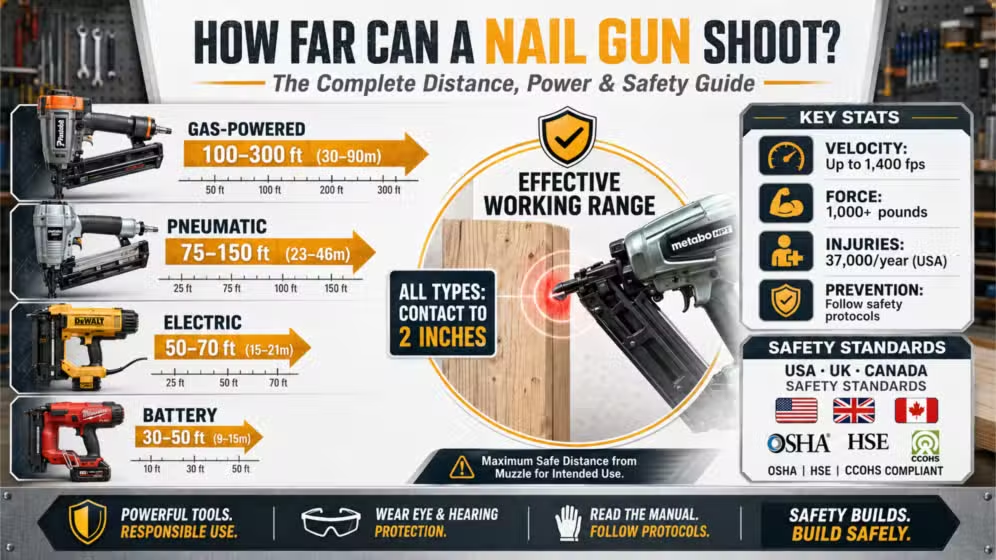
A framing nail gun can shoot a nail up to 100–300 feet (30–90 meters) if fired into the air without a safety mechanism engaged.
However, the effective working range is arm’s length—typically 12–18 inches (30–45 cm) from the material surface.
Always treat a nail gun like a loaded firearm. Never point it at anyone, and never disable safety features.
Look, I’ve been working with nail guns for over a decade. Framing houses, building decks, installing trim… You name it.
And one question keeps coming up—whether it’s from DIYers, apprentice carpenters, or even seasoned contractors who’ve never really thought about it: How far can a nail gun actually shoot?
The answer might surprise you. And honestly? It should make you respect these tools a whole lot more.
Understanding Nail Gun Shooting Distance
When people ask about shooting distance, they’re usually asking two different questions without realizing it.
Maximum projectile distance – How far a nail could travel if you fired it into the air like some kind of construction cowboy (please don’t).
Effective working range – The actual distance at which the tool is designed to operate safely and effectively.
Let me break this down clearly:
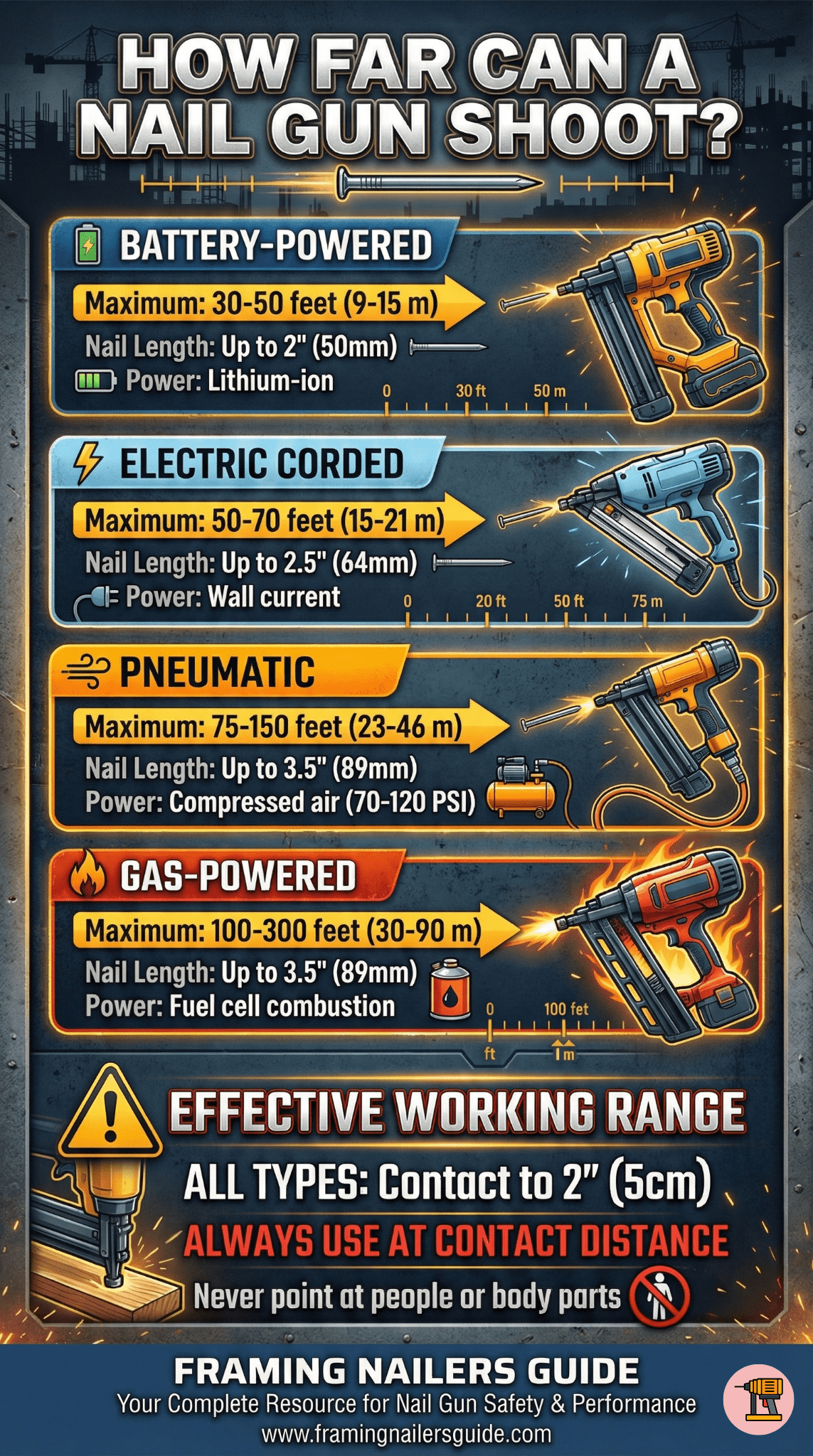
| Nail Gun Type | Maximum Nail Length | Maximum Projectile Distance | Effective Working Range | Power Source |
|---|---|---|---|---|
| Electric Nail Gun | 2.5 inches (64 mm) | 50–70 feet (15–21 meters) | Contact to 2 inches (5 cm) | Corded electric |
| Gas-Powered Framing Nailer | 3.5 inches (89 mm) | 100–300 feet (30–90 meters) | Contact to 2 inches (5 cm) | Fuel cell + battery |
| Battery-Powered Nail Gun | 2 inches (50 mm) | 30–50 feet (9–15 meters) | Contact to 2 inches (5 cm) | Lithium-ion battery |
| Pneumatic Nail Gun | 3.5 inches (89 mm) | 75–150 feet (23–46 meters) | Contact to 2 inches (5 cm) | Compressed air |
Notice something? The effective working range is basically the same across all types. Because that’s how they’re designed to work—pressed against the material surface.
The maximum distance? That’s what happens when things go wrong. When safety mechanisms fail. When someone gets careless.
I’ve seen a pneumatic framing nailer shoot a 3-inch (76 mm) nail clear across a construction site—probably 80 feet (24 meters)—after a guy accidentally bumped the trigger while the safety tip wasn’t depressed. The nail embedded itself 2 inches into a wooden beam.
Nobody was hurt that day. But it was a wake-up call for the entire crew.
Nail Gun Types and Their Shooting Capabilities
Let me walk you through the different nail guns I use regularly, and what kind of power each one packs.
Framing Nailers – The Heavyweights
These are the monsters of the nail gun world.
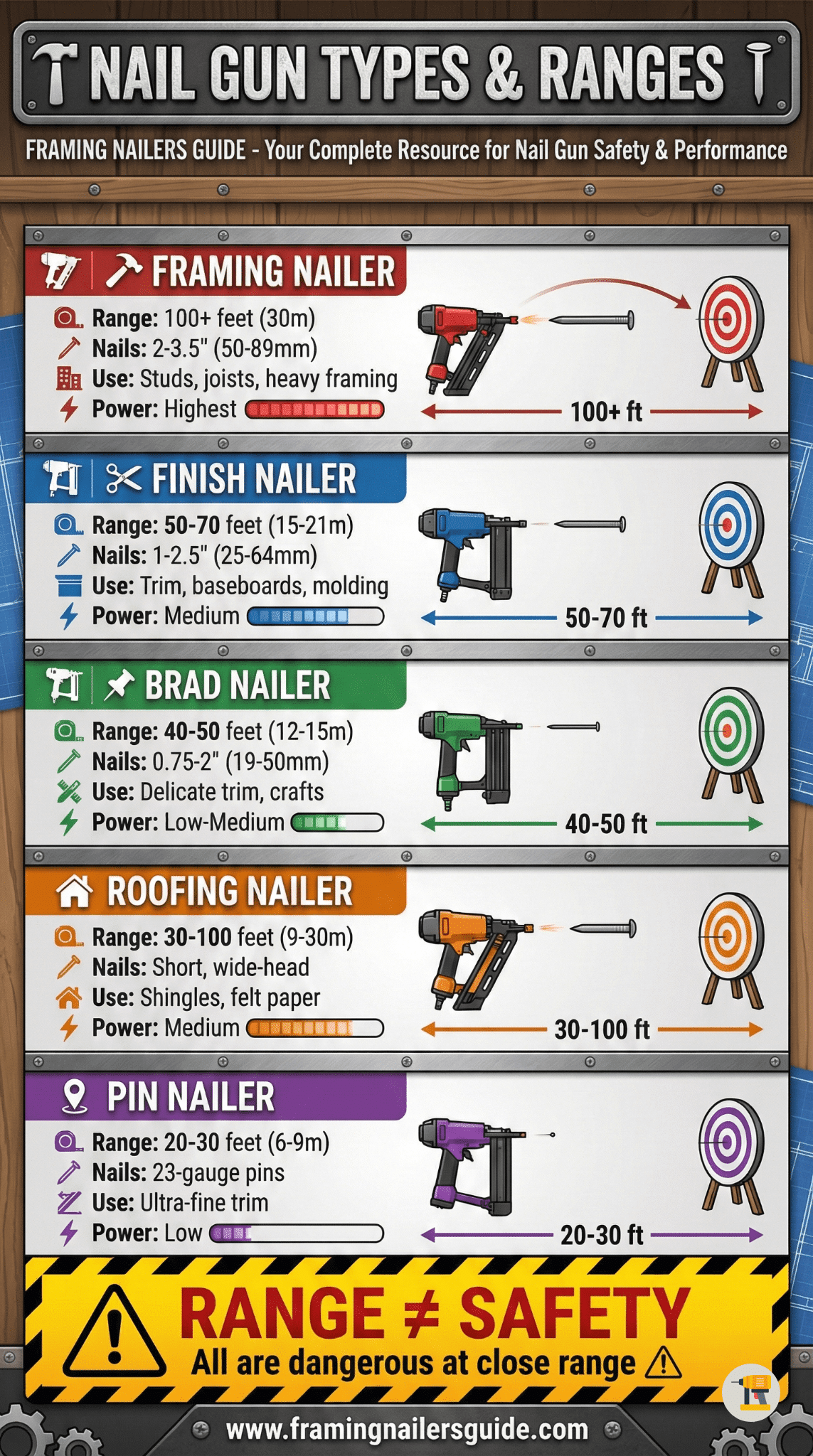
A heavy-duty pneumatic framing nailer is the most powerful tool in my arsenal. It shoots 2-inch to 3.5-inch (50–89 mm) nails and can drive them through double 2x4s like butter.
In terms of raw projectile distance if fired without material contact? We’re talking 100+ feet (30+ meters) easily.
I use mine for everything from wall framing to deck joists. The power is necessary—you’re often shooting through thick lumber at angles. But that same power demands serious respect.
Finish Nailers – Precision Tools
Finish nailers are gentler. They typically shoot 1-inch to 2.5-inch (25–64 mm) nails and have a maximum projectile range of around 50–70 feet (15–21 meters).
I reach for my finish nailer when installing baseboards, crown molding, or cabinet trim. The nails are thinner (15–16 gauge), and the impact is calibrated for delicate work where you don’t want to split wood or leave big holes.
Brad Nailers – The Detail Workers
Brad nailers shoot even thinner nails (18 gauge) up to about 2 inches (50 mm) long. Maximum shooting distance? Maybe 40–50 feet (12–15 meters) if you really tried.
But here’s the thing—I never think about “shooting distance” when I’m using a brad nailer for picture frames or delicate trim. The entire purpose of this tool is close-contact precision work.
Roofing Nailers – Specialized Power
Roofing nailers have a medium range—typically 30–100 feet (9–30 meters) maximum projectile distance depending on the model and power source.
They’re designed to shoot short, wide-head nails rapidly into shingles and decking. I’ve used both coil and strip roofing nailers, and let me tell you… the coil versions with their 120-nail capacity can turn a full roof tear-off and reshingle into a weekend project instead of a week-long ordeal.
Pin Nailers and Palm Nailers – Close-Quarters Specialists
Pin nailers shoot virtually headless 23-gauge pins. They leave almost no visible mark, making them perfect for ultra-fine trim work. Shooting distance? Negligible—maybe 20–30 feet (6–9 meters) at most.
Palm nailers are compact, handheld tools designed for tight spaces where you can’t swing a hammer or fit a standard nailer. Joist hangers, metal connectors, tight corners… that’s where these shine. But again, the “shooting distance” is irrelevant because you’re working within inches of the target surface.
What Determines How Far A Nail Gun Shoots?
Several factors control both the maximum distance and the penetration power of any nail gun.
Power Source
This is the biggest variable.
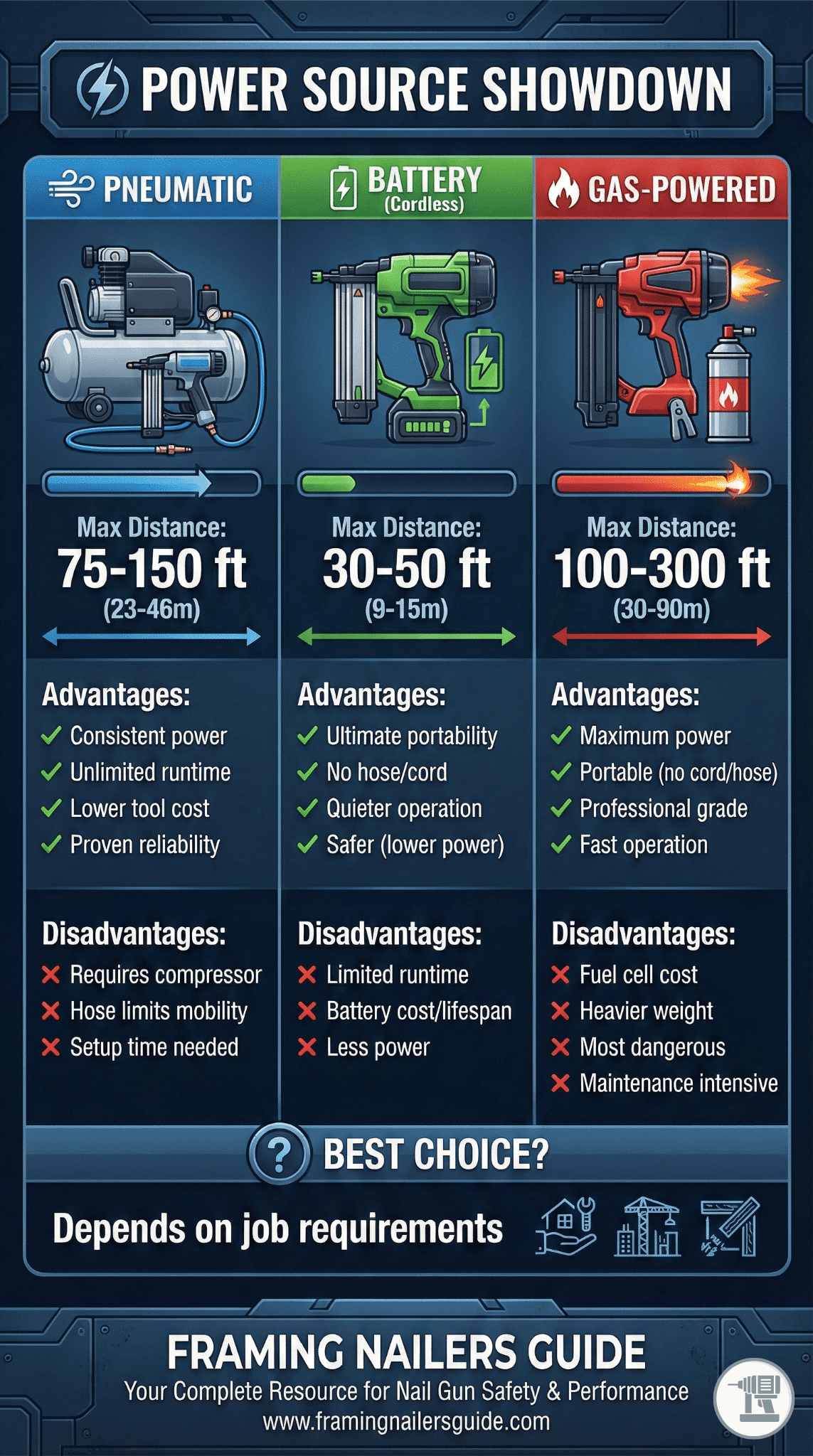
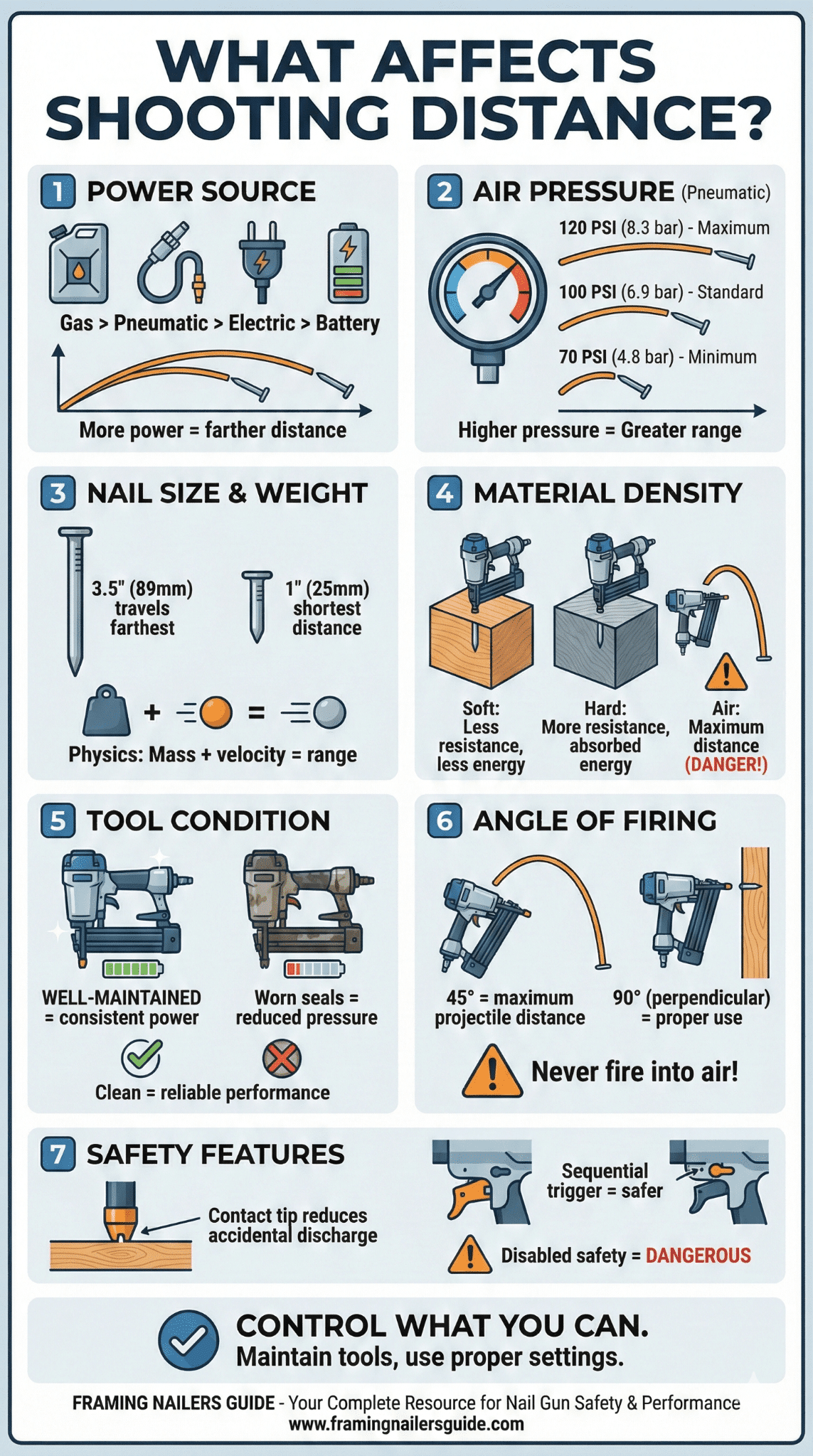
Pneumatic (compressed air) – These run on air compressors, typically set between 70–120 PSI (4.8–8.3 bar).
Higher pressure equals more force, which translates to both deeper penetration and longer potential projectile distance.
According to OSHA guidelines, pneumatic tools must be equipped with proper safety mechanisms to prevent accidental discharge.
Gas-powered (fuel cell) – These use a small fuel cell and battery-powered ignition to create a combustion event that drives the piston.
They’re incredibly powerful and completely portable. Maximum shooting distance can exceed 100 feet (30 meters), which is why professional framers love them… and why safety training is absolutely critical.
Battery-powered (cordless electric) – These use lithium-ion batteries and a flywheel or solenoid mechanism.
Less powerful than pneumatic or gas models, but safer in terms of accidental discharge and much quieter. Maximum distance typically caps around 30–40 feet (9–12 meters).
Corded electric – Similar to battery models but with consistent power from wall current. Shooting distance falls in the 40–50 foot (12–15 meter) range for most models.
Nail Size and Weight
Physics matters here.
A longer, heavier nail carries more momentum. A 3.5-inch (89 mm) framing nail will travel significantly farther than a 1-inch (25 mm) brad when fired with equivalent force.
That’s basic kinetic energy: mass times velocity squared, divided by two. Heavier projectile, more energy transferred, longer flight distance before gravity and air resistance bring it down.
Material Density and Hardness
When you’re actually using the nail gun properly (contact nailer against material), the density and hardness of the material dramatically affect penetration depth and how much force is required.
Softwoods like pine? Easy penetration with minimal pressure. Hardwoods like oak or maple? You might need higher PSI settings and longer nails to achieve proper fastening without bending the nail.
Engineered lumber (LVL, PSL) is even denser. I’ve had nails bounce off incorrectly angled shots into LVL beams.
Concrete, masonry, and steel require specialized powder-actuated tools or concrete nailers—entirely different category with much more controlled (and dangerous) power.
Air Pressure Settings (Pneumatic Models)
Most pneumatic nailers have adjustable pressure regulators or depth-of-drive adjustments.
Low pressure (60–70 PSI / 4.1–4.8 bar) – Sufficient for soft materials, reduces nail gun shooting distance and penetration.
Medium pressure (80–100 PSI / 5.5–6.9 bar) – Standard setting for most framing and general carpentry.
High pressure (110–120 PSI / 7.6–8.3 bar) – Maximum power for hardwoods and challenging materials, also maximum shooting distance if accidentally discharged.
Adjusting your air pressure properly isn’t just about performance—it’s about safety. Over-pressurized tools are more dangerous.
Operator Technique and Experience
Here’s something most articles won’t tell you: operator skill dramatically impacts both safety and effectiveness.
An experienced carpenter knows how to position the tool, apply the right amount of downward pressure to engage the safety contact tip, and anticipate the recoil. They don’t fumble. They don’t accidentally trigger the gun between shots.
A rookie? They’re more likely to bump-fire (accidentally discharge while moving between nail points), to not fully seat the safety tip, or to position their free hand in the danger zone.
I’ve trained probably two dozen apprentices over the years. The first hour with a nail gun is always white-knuckle time for me—not because I don’t trust them, but because I know how easy it is to get complacent with a tool that feels simple but packs serious power.
Regional Safety Standards and Regulations
Different countries have different safety standards governing nail gun use. Understanding these helps you stay compliant and safe.
United States – OSHA Requirements
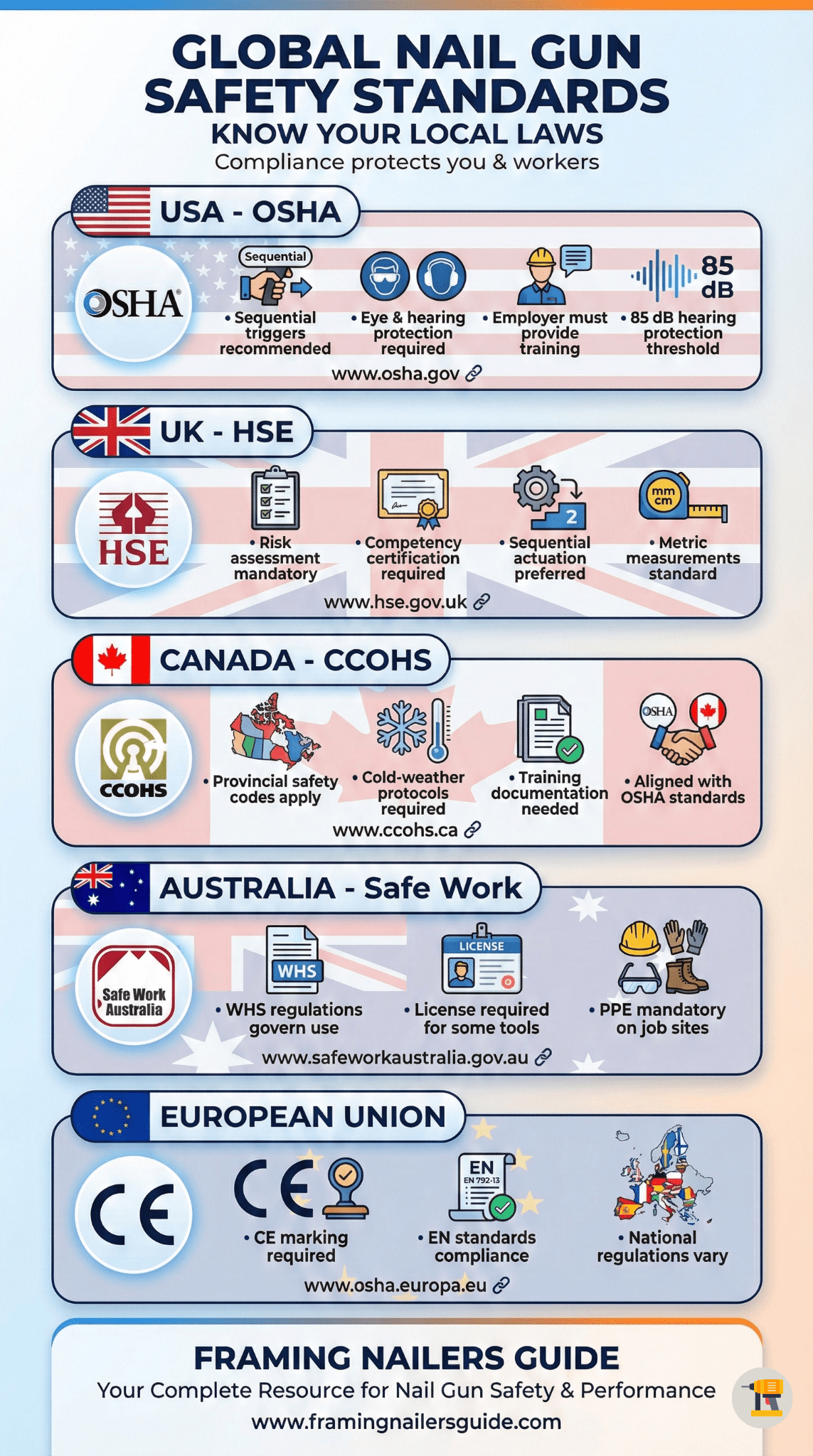
The Occupational Safety and Health Administration (OSHA) regulates construction tool safety in the U.S. Under OSHA standards, employers must provide training on proper nail gun operation, and tools must have functioning safety mechanisms.
Key OSHA requirements:
- Sequential trigger systems recommended over contact/bump triggers for framing
- Mandatory eye protection (safety glasses or goggles)
- Hearing protection when SPL exceeds 85 decibels
- Tool inspection before each use
For complete OSHA nail gun safety guidelines, visit the U.S. Department of Labor at www.osha.gov.
United Kingdom – HSE Guidelines
The Health and Safety Executive (HSE) in the UK governs construction safety. Their guidelines emphasize:
- Risk assessments before tool use
- Proper training and competency certification
- Use of sequential trigger mechanisms in high-risk environments
- Clear protocols for tool maintenance and inspection
UK measurements are metric, so always convert your nail sizes and specifications accordingly when working with imported tools or following American tutorials.
For official UK construction safety standards, consult HSE resources at www.hse.gov.uk.
Canada – CCOHS Standards
The Canadian Centre for Occupational Health and Safety (CCOHS) provides guidance aligned with provincial safety codes.
Canadian building codes require similar safety protocols to OSHA, with particular emphasis on cold-weather tool operation (battery performance degrades below freezing, pneumatic tools require winter-grade oil).
Essential Safety Tips When Using Nail Guns
Let me be blunt: nail guns are dangerous. Period.
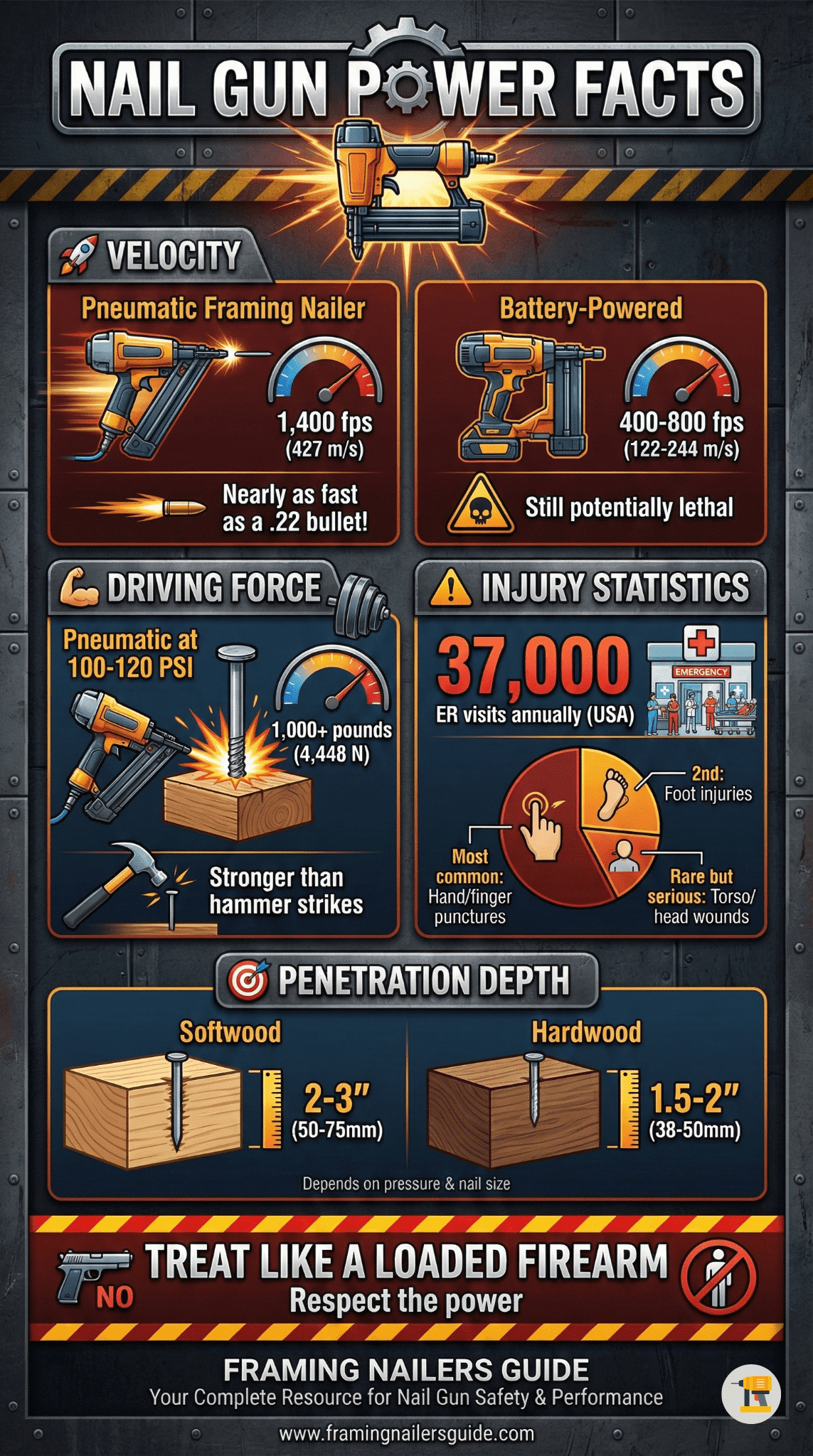
According to research, approximately 37,000 people visit emergency rooms annually in the U.S. due to nail gun injuries. That’s not because the tools are defective—it’s because people get careless.
Always Wear Proper Safety Equipment
Non-negotiable items:
- Safety glasses or goggles– Flying debris, ricocheting nails, wood splinters
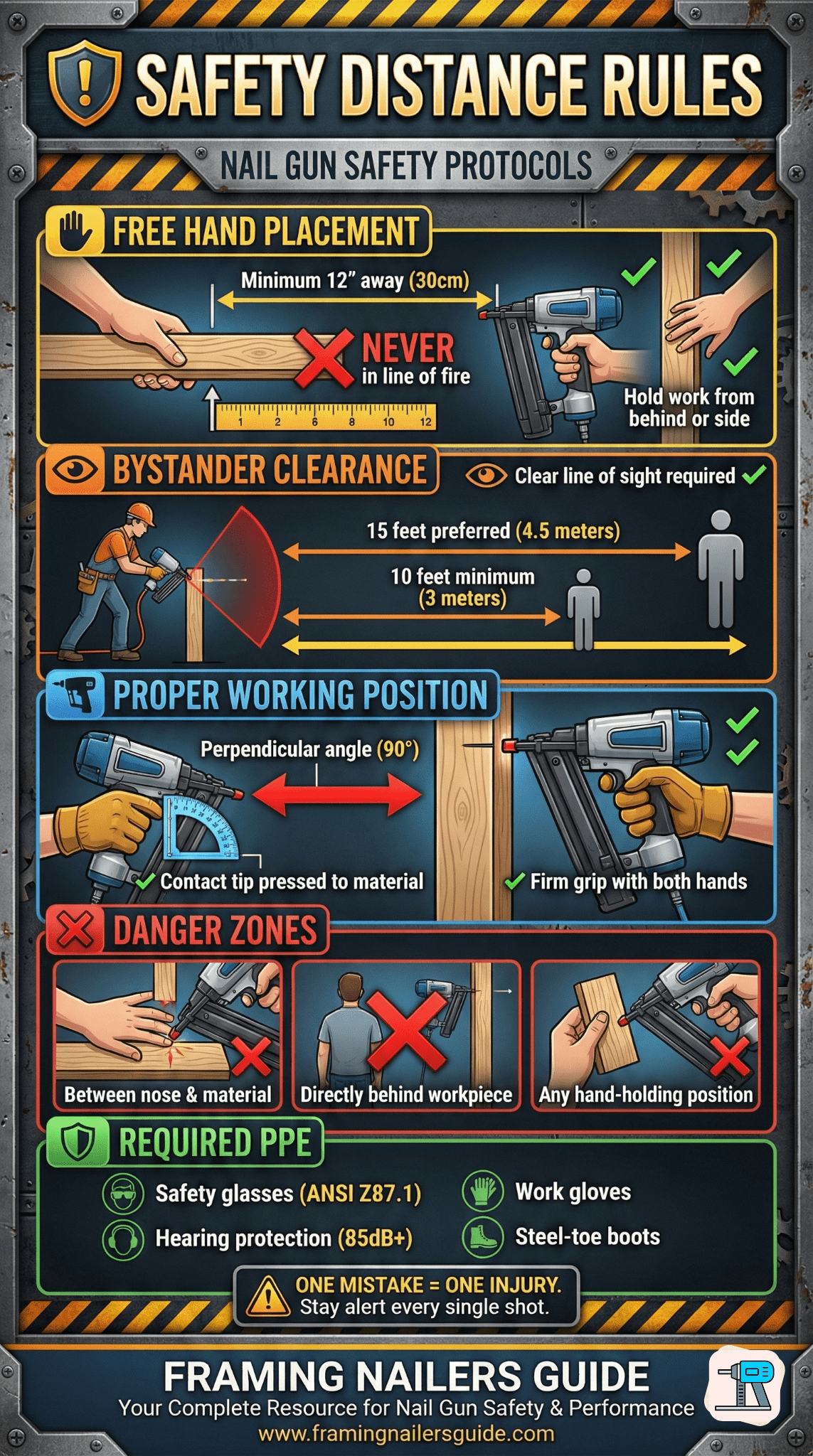
- Hearing protection– Nail guns produce 90–110 decibels; repeated exposure causes permanent hearing damage
- Work gloves– Protects hands from splinters and provides better grip
- Steel-toe boots– Dropped nail guns or accidental foot discharge (yes, it happens)
I keep duplicate safety glasses in my truck, my toolbox, and my workshop. No excuses.
Maintain Safe Hand Positioning
Keep your free hand at least 12 inches (30 cm) away from the nosepiece at all times.
This is where the original article had that bizarre “daffodils fingers” error. What they meant to say: never place your free hand where a nail could go if the gun misfires or if you miss your target.
I use my free hand to steady the work piece from behind or to the side—never in the direct line of fire. Never.
Never Disable Safety Mechanisms
Every nail gun has safety features—usually a contact tip (safety nose) that must be depressed against the material before the trigger will activate.
Some guys disable these or tape them down to enable “bump firing” (rapid sequential nailing by holding the trigger and bouncing the nose against the surface).
Don’t. Just don’t.
Bump firing is faster, sure. But it’s exponentially more dangerous. One slip, one unexpected recoil, and you’ve just shot a nail into your leg, a coworker, or something you didn’t intend to hit.
Follow Manufacturer Guidelines
Every nail gun comes with a manual. Read it. Seriously.
It specifies:
- Recommended nail sizes and types
- Proper air pressure settings
- Maintenance schedules
- Compatible accessories
Deviating from manufacturer specs voids warranties and creates safety hazards. I’ve seen nail guns jam, misfire, and even explode (yes, explode—pneumatic tool housing failure) because someone used the wrong nails or over-pressurized the system.
Store Nail Guns Securely
When not in use:
- Disconnect the air hose (pneumatic models)
- Remove the battery (cordless models)
- Unplug the cord (electric models)
- Clear any remaining nails from the magazine
- Store in a locked cabinet or high shelf away from children
I keep mine in a locked tool chest. My kids know where my hammers and screwdrivers are—they don’t know where the nail guns live.
Practical Applications and Real-World Experience
Let me share some actual scenarios where understanding shooting distance and tool selection made a difference.
Building a Two-Story Frame
Last summer, I framed a 2,400 sq ft two-story home using a pneumatic framing nailer (Paslode style, 3.5-inch / 89 mm capacity).
The shooting power on that thing? Incredible. I could toe-nail studs to bottom plates with a single shot, drive through doubled top plates, and secure rim joists without pre-drilling.
But on day three, a new laborer on the crew was carrying the nailer by the trigger guard (never do this) while the air hose was still connected. He stumbled on some scrap lumber, squeezed instinctively to catch himself, and discharged a nail that traveled about 60 feet (18 meters) before embedding in a stack of plywood.
Nobody hurt. But we shut down for thirty minutes, had a safety meeting, and established new protocols. Tools get disconnected any time someone moves more than 10 feet from their work area. Period.
Installing Crown Molding
Different job, different tool.
For interior trim work—especially crown molding—I use a 15-gauge finish nailer. It shoots 2-inch (50 mm) nails, which is perfect for securing molding to wall studs and ceiling joists without splitting the delicate wood profiles.
The “shooting distance” on this tool is irrelevant to the work. I’m always pressed against the material. But understanding the power helps me adjust air pressure so nails set flush without overdriving or leaving dimples I’ll have to fill and sand.
Roofing a Garage
Roofing nailers are unique. They’re designed for speed—you’re shooting hundreds or thousands of nails in a single day.
Last fall, I re-roofed my garage using a coil roofing nailer. 120-nail capacity, bump-fire enabled (for roofing, this is actually standard practice and relatively safe because you’re working on a flat surface with clear lines of sight).
The tool could probably shoot a nail 80 feet (24 meters) if I fired it into the air. But on the roof? The angle, the material resistance, and the proper technique mean every nail drives exactly where intended.
Other Important Considerations Beyond Shooting Distance
When you’re evaluating nail guns, shooting distance is honestly pretty low on the priority list. Here’s what actually matters day-to-day:
Depth Control and Drive Adjustment
Higher-end nailers have tool-free depth adjustment. This lets you set how deep the nail sinks—flush with the surface, slightly countersunk for filler, or proud for materials that will be trimmed later.
Pneumatic models usually adjust via the air pressure regulator or a depth adjustment wheel on the nose. Cordless models have electronic depth settings.
Magazine Capacity and Reload Speed
Strip nailers typically hold 20–40 nails. Coil nailers hold 100–300.
For rapid repetitive work (sheathing, roofing, decking), high-capacity magazines reduce downtime. But they also add weight and bulk.
For precision work, smaller magazines are fine because you’re not shooting at high volume anyway.
Tool Weight and Ergonomics
I’ve used nailers that weigh 4 pounds (1.8 kg) and nailers that weigh 9 pounds (4 kg).
After eight hours on a job site, that difference is everything. Shoulder fatigue, hand cramps, reduced accuracy… heavy tools wear you down.
Cordless nailers are generally lighter than pneumatic models (no hose pulling on you), but battery weight adds up. Gas-powered models are heavier due to the fuel cell and combustion chamber.
Jam Clearing and Maintenance
All nail guns jam eventually. It’s a fact of life.
The question is: how easy is it to clear the jam?
Quality nailers have tool-free nose release mechanisms. You flip a latch, swing the front open, remove the jammed nail, close it, and you’re back to work in 30 seconds.
Cheap nailers? You might need a hex key, needle-nose pliers, and five minutes of cursing.
Regular maintenance matters too. Clean your tool after every job. Lubricate pneumatic models daily (a few drops of pneumatic tool oil in the air inlet). Inspect O-rings and seals. Replace worn parts before they fail.
Frequently Asked Questions
What is the velocity of a nail gun?
Nail velocity varies by tool type. Pneumatic framing nailers can propel nails at speeds exceeding 1,400 feet per second (427 meters per second) at the moment of firing. That’s roughly the speed of a .22 caliber bullet. Battery-powered models are slower—typically 400–800 fps (122–244 m/s)—but still potentially lethal at close range.
What force does a nail gun generate?
Pneumatic nail guns operating at 100–120 PSI (6.9–8.3 bar) can generate driving forces exceeding 1,000 pounds (4,448 Newtons) at the point of impact. This is more than sufficient to penetrate wood, and in accidental discharge incidents, human tissue and bone. The force is comparable to a strong hammer strike but delivered in a fraction of a second.
How does a nail gun compare to an actual firearm in terms of range?
A nail gun has a dramatically shorter effective range than any firearm. While a nail might travel 100–300 feet (30–90 meters) if fired into the air, it loses velocity rapidly due to aerodynamics (nails aren’t designed as projectiles). A firearm bullet can travel thousands of feet with lethal force. That said, at close range (under 10 feet / 3 meters), a nail gun can inflict injuries comparable to gunshot wounds. Never treat a nail gun as anything less than a potentially lethal tool.
What safety features prevent accidental discharge?
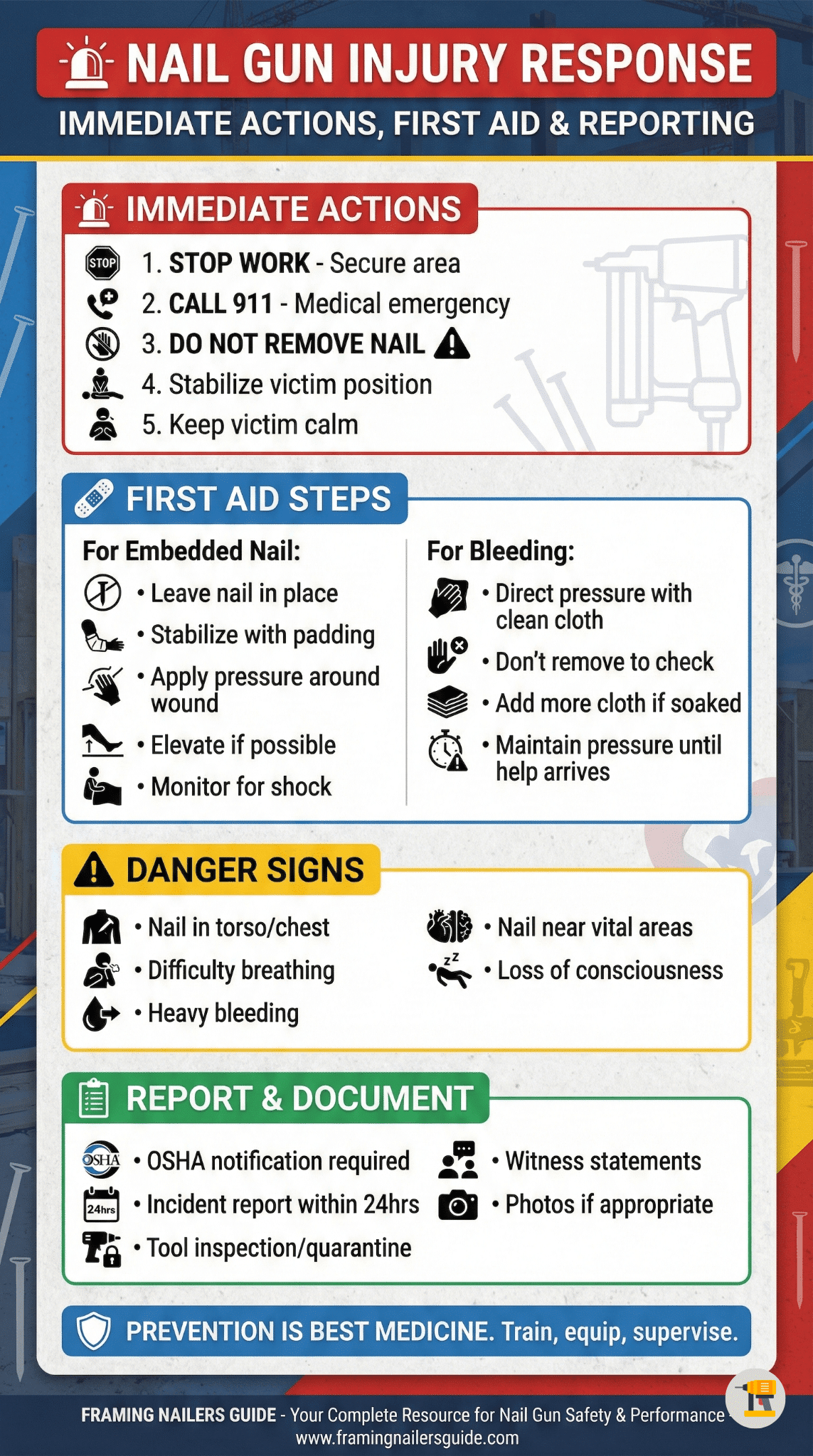
Modern nail guns incorporate multiple safety mechanisms. The most common is the contact trip safety (also called safety nose or work contact element)—a spring-loaded probe that must be depressed against the work surface before the trigger will activate. Some models use sequential actuation, requiring the safety tip to be pressed before the trigger is pulled (not simultaneously), which prevents bump-firing. Additionally, many cordless models have electronic safeties that disengage power after a period of inactivity. Anti-dry-fire mechanisms prevent operation when the magazine is empty, reducing wear on internal components.
How does the trigger interlock system work?
The trigger interlock system combines the trigger and the contact safety tip in an electrical or mechanical circuit. In a contact actuation (bump trigger) setup, depressing the safety tip and pulling the trigger in either order will fire the tool. In a sequential actuation system, you must press the safety tip against the work surface first, then pull and release the trigger, then lift the tool and reposition before the next shot. Sequential systems are slower but significantly safer, reducing accidental discharges by 40–60% according to some studies. OSHA and many construction firms now require sequential trigger systems for framing applications.
Are nail guns dangerous? What are the injury risks?
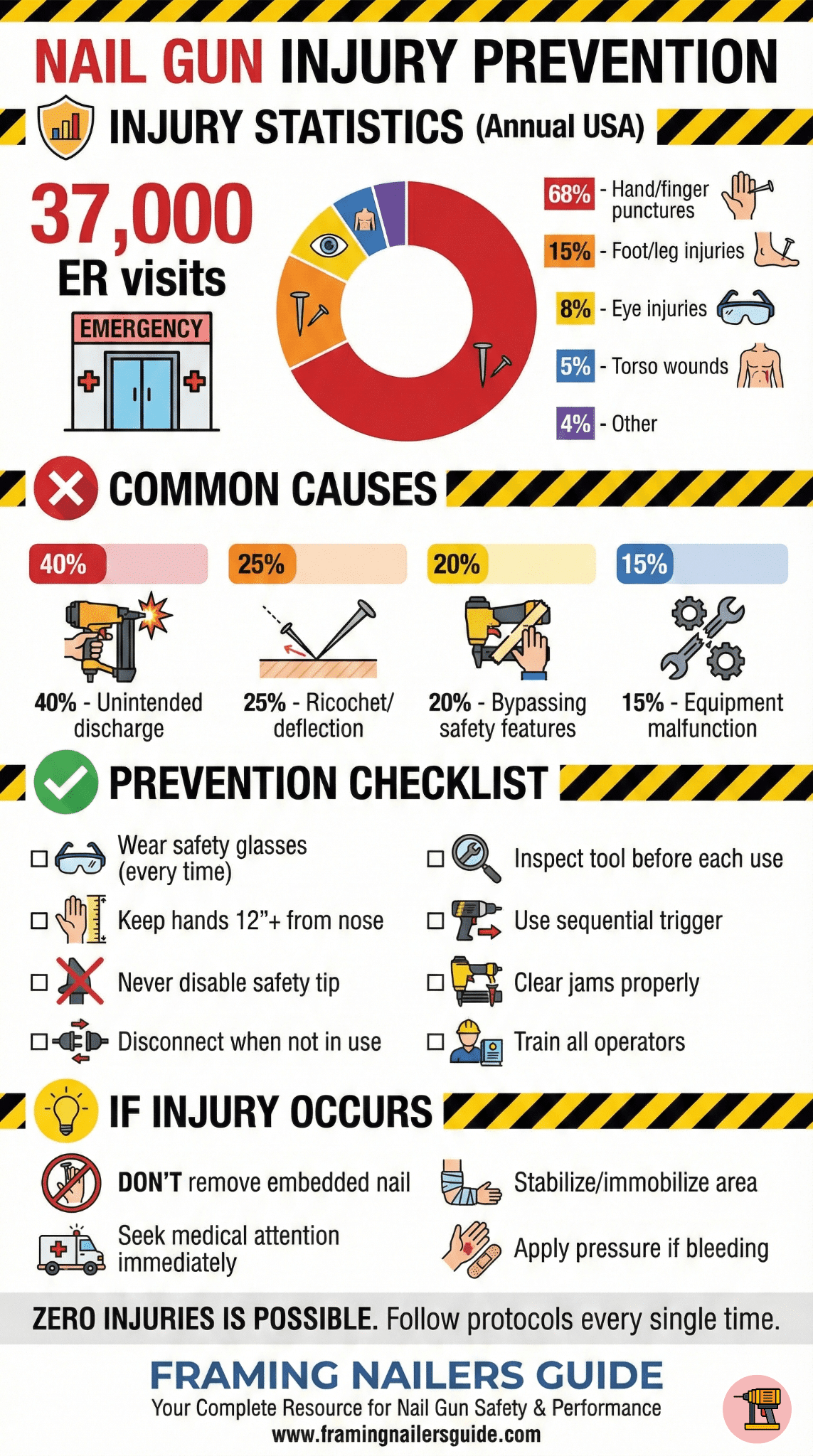
Yes, nail guns are dangerous. They’re responsible for tens of thousands of injuries annually in North America alone. Common injury types include puncture wounds to hands and fingers (most common), foot injuries from dropped tools or accidental discharge, eye injuries from flying debris, and in rare cases, life-threatening wounds to the torso or head. Fatal injuries, while uncommon, do occur—typically from direct contact discharge to vital areas. The key is treating nail guns with the same respect you’d give any power tool capable of inflicting serious harm. Proper training, safety equipment, and following manufacturer guidelines reduce injury risk dramatically.
Can nail guns work in cold weather?
Cold weather affects different nail gun types differently. Battery-powered nailers experience reduced runtime and power below 32°F (0°C) because lithium-ion battery chemistry slows down. Keep spare batteries warm in an interior pocket. Pneumatic nailers require winter-grade compressor oil and can experience moisture freezing in air lines, causing misfires. Use inline air dryers and drain moisture traps frequently. Gas-powered nailers generally perform well in cold but may require fuel cell warming in extreme cold (below 0°F / -18°C). Electric corded models are unaffected by temperature but cords become stiff and brittle, increasing trip hazards.
How long do nail guns last with proper maintenance?
A quality pneumatic nail gun with regular maintenance can easily last 10–15 years of professional use or 20+ years of DIY/homeowner use. Cordless battery-powered models typically last 5–8 years before battery technology advances make replacement more economical than repair. Gas-powered models fall in between, with 7–12 year lifespans. Key maintenance includes daily lubrication (pneumatic), cleaning after every use, replacing worn O-rings and seals annually, and storing tools in dry environments. Abuse (dropping, over-pressurizing, using incorrect fasteners) dramatically shortens lifespan.
Final Thoughts on Nail Gun Shooting Distance
So… how far can a nail gun shoot?
Technically? Potentially hundreds of feet.
Practically? It doesn’t matter. Because if you’re using a nail gun correctly, you’re never firing it at a distance. You’re pressed against the material, the safety tip is engaged, and the nail travels 2–3 inches (5–8 cm) into the work piece.
The danger of nail guns isn’t their maximum range—it’s the moment of inattention. The time you don’t engage the safety. The instant you reach across your body while holding a pressurized tool. The second you assume “just this once” won’t matter.
I’ve been lucky. In over ten years of professional carpentry and countless DIY projects, I’ve never injured myself or anyone else with a nail gun. But I’ve seen close calls. I’ve heard the stories from ER docs about the injuries they treat.
Respect these tools. Train properly. Use the right equipment for the job. And never, ever take shortcuts with safety.
Because at the end of the day? Getting the job done fifteen minutes faster isn’t worth a trip to the hospital.
Now get out there and build something. Safely.
