


Last Updated on August 23, 2026 by John Patterson
Look at the box.
Labels on framing nail cartons look like confusing technical shorthand. You will see markings like 21-degree, .131-gauge, paper tape, and clipped head.
Buy the wrong box, and your nailer locks up on the first shot. That stings on an active jobsite.
Framing nails look identical on the shelf. They are not.
Nails must match your tool’s magazine channel, driver clearance, feed angle, and regional building codes. A 3-1/4-inch 21-degree nail will never fire from a 30-degree paper tape gun.
FRAMING NAIL COMPATIBILITY FORMULA
Magazine Angle + Collation Binding + Wire Gauge + Head Profile = Zero Jams
Need exact nailing schedules for wall studs and floor joists? Check out our complete guide on what size nails for framing
Quick Answer: How to Match Nails to Your Framing Nailer
Check the tool’s magazine.
Never buy framing nails by length alone. Verify these 6 exact specifications on the box before buying:
Nail Length: Must sit within your tool’s approved range (commonly 2 inches to 3-1/2 inches).
Nail Diameter (Gauge): Must match driver channel clearance (standard sizes are .113″, .120″, .131″, and .148″).
Magazine Degree: Must match the exact magazine angle (21°, 28°, 30°-34°, or 15° coil).
Head Style: Full round head, clipped D-head, or offset round head based on magazine feed and building code.
Collation Material: Plastic strip, paper tape, wire weld, or coil wire.
Shank Texture: Smooth shank for interior framing; ring shank for high-withdrawal subflooring.
Mismatch any of these details, and the tool will jam, shear the driver blade, or fail structural inspection.
Are Framing Nails Universal?
Short answer? No.
Framing guns are built around strict internal tolerances. The feeding claw requires an exact strip pitch, head overlap, and collation angle to cycle properly.
21-Degree Plastic Strip Tools: Require 21° full round head nails joined by plastic strips.
30-Degree to 34-Degree Paper Tape Tools: Require 30°-34° paper-bound clipped or offset heads.
Coil Framing Nailers: Require 15° wire-collated coiled nails loaded into a round drum.
Positive Placement Nailers: Require exposed-tip metal hardware nails, not standard framing strips.
Unsure which magazine format suits your build? Compare both popular designs in our guide on 21 vs 30 degree framing nailer
Nail Size: Length and Diameter Requirements
Do not guess.
Framing nail sizing requires matching two numbers: length for lumber penetration depth, and diameter for lateral shear strength.
Standard framing fasteners must meet ASTM F1667 structural fastener standards to satisfy structural building officials.
STRUCTURAL CAPACITY FORMULA
Adequate Length + Proper Gauge = Certified Shear Strength
Common Framing Lengths and Uses
2-Inch to 2-3/8-Inch (6d / 8d): Roof sheathing, wall plywood, and subfloor fastening.
3-Inch (10d): Interior partition walls, stud-to-plate framing, and structural blocking.
3-1/4-Inch (12d): Standard structural exterior walls and corner post assemblies.
3-1/2-Inch (16d Common): Heavy load-bearing framing, headers, and laminated structural beams.
Standard Wire Diameters and Clearances
.113 Inch: Common for light wall sheathing and exterior ply.
.120 Inch: The residential framing standard for non-structural interior walls.
.131 Inch: Structural framing gauge required for primary weight-bearing stud walls.
.148 to .162 Inch: Heavy-duty common nails engineered for high seismic and shear zones.
Thick nails will bind inside the driver blade. Thin nails will double-feed and cause violent dry-fire jams.
Follow the official OSHA Nail Gun Safety Standards to avoid injuries caused by driver blade jams and ricochets.

Framing Nailer Angle Compatibility
Angles cause confusion.
The angle on the box does not mean the nail shoots into the stud sideways. It refers to the backward tilt of the magazine, allowing the tool nose to fit into tight stud bays.
21-Degree (Plastic Strip): Uses full round heads. Holds nails at a wider angle, making the tool taller between tight joists.
28-Degree (Wire Weld): Compact magazine footprint joined by twin micro-wires. Fits tighter cavities easily.
30-Degree to 34-Degree (Paper Tape): Steepest rake angle. Fits cleanly between 16-inch on-center studs and leaves zero plastic mess.
15-Degree (Coil System): Nails are arranged in a circular spool. Built for high-volume continuous fastening.
Can You Run 30-Degree Nails in a 34-Degree Tool?
Usually, yes.
Most paper-tape framing guns are engineered to feed any strip labeled between 30 and 34 degrees. Always check your tool manual’s approved fastener chart before buying bulk boxes.
Head Type Compatibility: Full Round, Clipped, and Offset
Head geometry matters.
The shape of the nail head dictates how tightly fasteners nest in the magazine and whether local building inspectors will approve your work.
Full Round Head: Complete circular head design. Provides maximum pull-through resistance and complies with all seismic and hurricane zones.
Clipped Head: Part of the head is cut into a distinct D-shape. Allows nails to pack tightly together for higher magazine capacity.
Offset Round Head: The full round head sits off-center on the shank. Provides tight magazine nesting while preserving full-circle surface contact.
Check compliance with IRC Table R602.3(1) Fastening Schedules before buying clipped head nails for structural jobs.

Shank Types: Smooth, Ring, and Screw
Hold counts most.
Shank texture rarely impacts whether a nail feeds through your gun, but it directly controls withdrawal resistance once driven into lumber.
Smooth Shank: Lowest driving resistance. Great for everyday wall framing, interior partitions, and temporary bracing.
Ring Shank: Covered in raised directional rings that bite into wood grain. Unbeatable holding power for subfloors, roof sheathing, and siding.
Screw Shank: Spiral flutes that rotate upon penetration. Engineered for hardwood, pallets, and extreme load structures.
Always use ring shanks on subfloor plywood. It prevents floor squeaks and saves costly tear-outs.
Learn foundational wood assembly methods in our deep dive on wood framing techniques
Collation Type: Plastic, Paper, Wire, and Coil
Collation binds fasteners.
Using the wrong collation material is the primary cause of feed jams, broken pushers, and skipped cycles.
Plastic Strip (21°): Rigid and water-resistant for wet-weather job sites. The plastic shatters during firing and scatters debris around the room.
Paper Tape (30°-34°): Clean cycling with zero flying fragments. Strips can soften and tear if left in heavy rain.
Wire Weld (28°): Welded with micro-wires for high durability in rough conditions. Can occasionally leave sharp metal burrs under the nail head.
Coil Wire (15°): Continuous flexible wire weld loaded into a drum. Designed for high-speed industrial fastening.
Fastener Coatings: Bright vs. Galvanized vs. Stainless
Weather destroys steel.
A nail can cycle through your magazine smoothly, but dissolve inside chemically treated lumber within months.
Bright (Uncoated): Plain carbon steel. Strictly for indoor, dry framing protected from weather.
Electro-Galvanized (EG): Thin zinc plating. Good for interior trim and brief humidity exposure, but unsafe for exterior builds.
Hot-Dipped Galvanized (HDG): Heavy zinc coating meeting ASTM A153 Class D standards. Required for exterior framing, decks, and pressure-treated sill plates.
Stainless Steel (304 / 316 Grade): Highest corrosion resistance. Required for coastal salt-air environments, cedar siding, and redwood framing.
Never use bright nails in ACQ pressure-treated lumber. The copper in treated wood causes galvanic corrosion and rapid structural failure.
7 Framing Nail Mistakes to Avoid
Avoid these pitfalls:
Buying Solely by Length: Overlooking magazine angle, collation type, and wire diameter guarantees tool jams.
Loading 21° Plastic in 30° Guns: Shards of plastic will wedge inside the nosepiece and damage the driver blade.
Ignoring Local Wind Codes: Installing clipped head nails in full round head jurisdictions leads to failed inspections.
Driving Smooth Shanks into Subflooring: Causes loose subfloor panels, popped floor tiles, and persistent squeaks.
Using Interior Bright Nails Outdoors: Uncoated nails corrode quickly, streak exterior finishes, and fail under load.
Using Framing Nails on Thin Finish Trim: Large framing heads split baseboards and casing instantly. Choose the proper tool using our brad nailer vs framing nailer guide.
Mixing Cordless and Pneumatic Specs: Battery-powered nailers often feature tighter shank diameter tolerances than pneumatic tools.
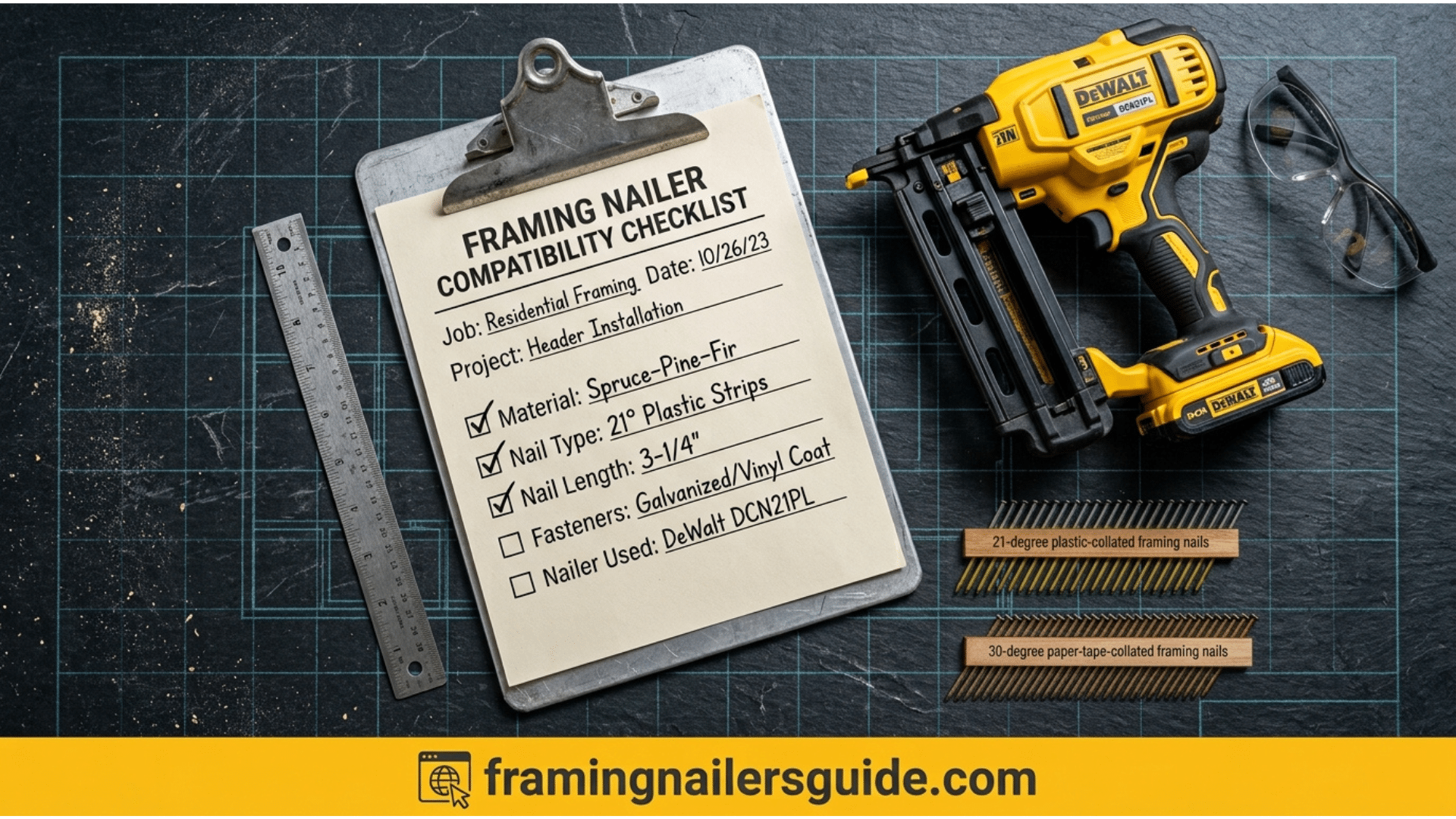
Pre-Purchase Compatibility Checklist
Run this check before purchasing or loading framing fasteners:
Magazine Angle: Does the box degree match your nailer’s magazine angle (21°, 28°, or 30°-34°)?
Collation Type: Does the collation material match your magazine feed system (plastic, paper, or wire)?
Length Clearance: Is the nail length within the tool’s accepted capacity?
Wire Diameter: Does the wire shank diameter match your tool’s nosepiece clearance?
Head Geometry: Does the head profile comply with local building department requirements?
Shank Profile: Is the shank design matched to the task (smooth for studs, ring for subfloors)?
Corrosion Coating: Is the steel coating rated for the environment (interior bright vs exterior HDG)?
Frequently Asked Questions
Are framing nails interchangeable between different tool brands?
Yes, provided the angle, collation material, length, diameter, and head type match your gun’s specifications.
Can you load 21-degree nails into a 30-degree framing gun?
No. The feed track angle and collation materials are incompatible and will cause immediate jams.
Why does my framing nailer keep jamming on paper tape strips?
Wet paper strips, incorrect strip angles, or running .131-gauge nails through a .120-rated nosepiece will cause feeding problems.
Are clipped head nails approved for structural framing?
It depends on your local building code. Many hurricane and seismic zones require full round head fasteners.
What is the best nail for plywood roof and subfloor decking?
Use 2-3/8-inch or 3-inch ring shank nails with an exterior-rated coating to lock into joists and resist pull-out forces.
In Conclusion
Match the tool first. Match the structural load second.
Framing nails are never one-size-fits-all hardware. Buying solely by length is the fastest route to a sheared driver blade, persistent feed jams, and a failed jobsite inspection.
Always verify the magazine angle, collation binding, wire gauge, and head geometry before leaving the supply yard. Once your nailer feeds reliably, choose the right shank texture and corrosion coating to ensure the framing stays rock-solid for decades.
