

Last Updated on November 24, 2025 by John Patterson
Nail guns are incredible tools for moving a project fast—but they’re also behind tens of thousands of emergency room visits every year, most of them in construction.
When you lead a crew, nail gun safety is not a “nice to have”; it’s a line between a profitable job and a life-changing injury, claim, or lawsuit.
Why Nail Gun Safety for Contractors Matters?
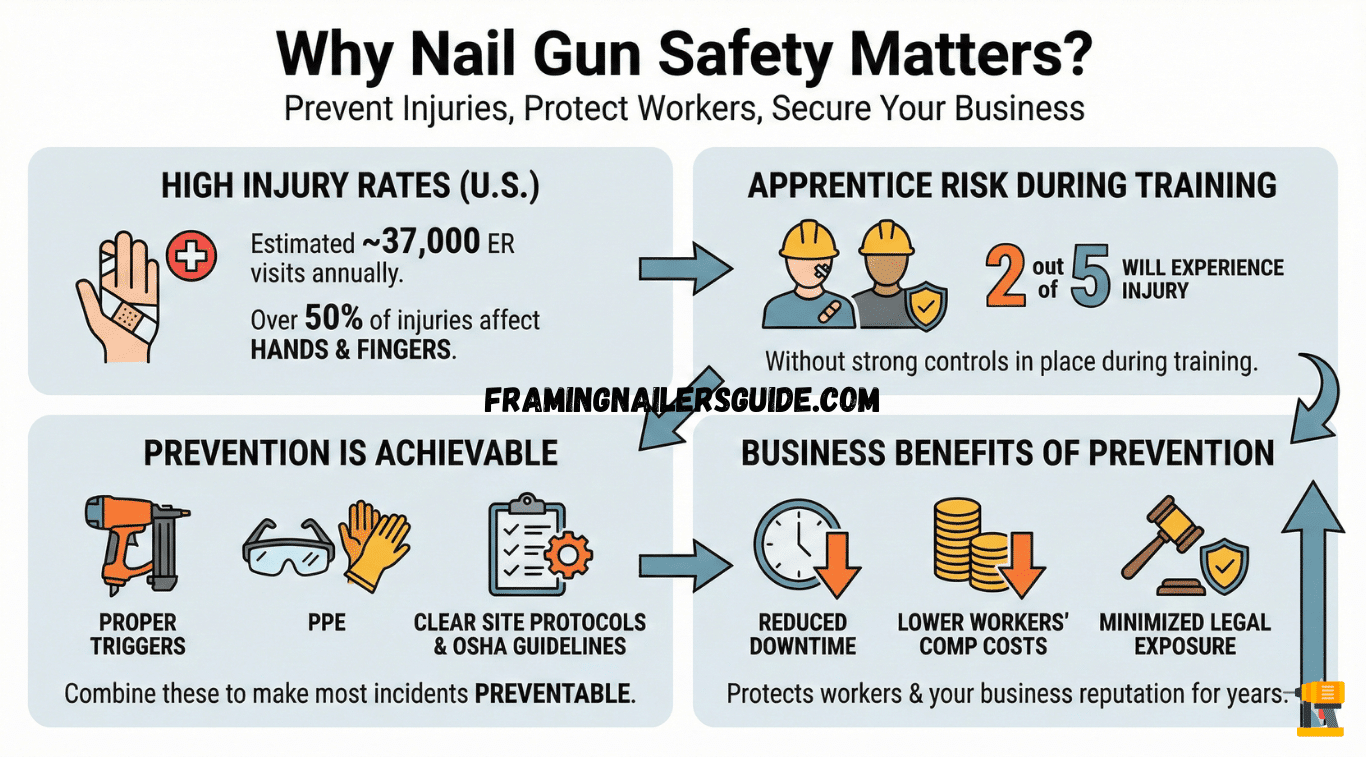
Across the U.S., nail guns are estimated to be involved in roughly 37,000 emergency department visits every year, and well over half of those injuries hit hands and fingers.
Studies on carpenter apprentices show that roughly 2 out of 5 will experience at least one nail gun injury during training if there are no strong controls in place.
Most of those incidents are preventable when contractors combine proper triggers, PPE, and clear site protocols that line up with OSHA nail gun guidelines and general workplace tool safety standards.
That prevention mindset doesn’t just protect workers; it cuts down on downtime, workers’ comp costs, and legal exposure that can shadow your business for years.
Common Nail Gun Injuries

Nail gun injuries cluster around a few predictable patterns, which is both the bad news and the opportunity.
If you know what usually goes wrong, you can design your systems and training around those exact failure points.
The most frequent issues on sites include:
- Puncture wounds to hands and fingers, often when holding material or working in tight framing and sheathing situations.
- Injuries to feet, legs, and sometimes head or torso when nails ricochet off metal hangers, knots, straps, or concrete, or when workers are in each other’s line of fire.
- Serious trauma (eye, face, chest, or even brain injuries) when tools are misused, modified, or fired in awkward positions, on ladders, or at height.
Why Nail Gun Injuries Happen?

Behind most nail gun injuries, investigators keep seeing the same root causes, especially with contact trip (bump-fire) tools.
Contact triggers are consistently associated with roughly double the risk of acute injury compared to sequential triggers, even when experience and training are factored in.
Key causes include:
- Double fires and unintended discharges when the nose “bounces” and the trigger is still held down.
- Working in awkward positions or tight spaces where recoil pushes the nose into another surface and fires a second nail.
- Bypassing or disabling safety features, or using modified tools that no longer meet manufacturer or OSHA expectations.
- Inadequate training, especially for new hires who jump straight to bump-fire with production pressure and very little coaching.
Speed vs Safety: Trigger Types
Contractors often stick with contact trip tools because they seem “faster,” but the real picture is more nuanced once you factor in misfires, rework, and injuries.
OSHA and multiple research groups strongly recommend full sequential triggers as the default for framing and general use, especially for less-experienced workers.
Trigger Type Comparison
| Trigger type | Injury risk profile | Practical speed & control |
|---|---|---|
| Contact trip (bump) | About twice the risk of acute injury vs sequential. | High burst speed, but more double fires, misaligned shots, and rework |
| Full sequential | Much lower rate of unintended discharge and double fire. | Slightly slower on paper, but more accurate, fewer mistakes, safer for new workers. |
| Single-shot variants | Similar control focus to sequential designs. | Best when precision and finish quality matter more than speed. |
For most residential and light commercial framing, full sequential triggers usually deliver the best overall productivity once you include downtime, incident investigations, and rework.
The “speed” of bump-fire can disappear quickly when the crew is dealing with near misses, tool damage, or someone in urgent care.
Best PPE and Safety Accessories
Personal protective equipment and tool features are your first visible line of defense in nail gun injury prevention.
While PPE alone won’t fix poor procedures, it significantly reduces the severity of injuries when something goes wrong.
Key PPE and accessories include:
- High-impact eye protection (ANSI Z87.1): Safety glasses or goggles protect against ricochets, flying fasteners, and fragments from lumber or concrete.
- Hard hats and hearing protection: Nailers, especially pneumatic and powder-actuated tools, create impact noise that can damage hearing over time and are often used around other overhead hazards.
- Cut-resistant or sturdy work gloves: These help reduce puncture depth and protect hands and fingers during framing, sheathing, and handling sharp materials.
- Boots with protective toe caps: Reduce damage when nails penetrate flooring or when misfires hit feet.
- Anti–dry-fire mechanisms and depth-of-drive controls: Modern nailers with anti–dry-fire and precise depth adjustments reduce blank shots, misfires, and overdriven nails that can bend, ricochet, or blow through thin material.
- Accessible first aid kits: OSHA expects employers to provide first aid and prompt medical care; a stocked kit (with dressings, antiseptic, and tools for stabilizing puncture wounds) is essential around any high-velocity fastening tool.
Site Protocols and OSHA Expectations
OSHA nail gun guidelines sit under broader hand and power tool and training standards, which require employers to maintain tools in a safe condition and provide hazard training that workers can actually understand.
As a contractor, this is where you turn generic “be careful” speeches into real, enforceable nail gun work procedures.
Practical site protocols should cover:
- Competency-based training before independent use of nail guns, including hands-on practice with actual models and clear explanation of trigger types.
- Written nail gun work rules: Control line-of-fire, restrict horseplay, prohibit firing from ladders or in unstable positions, and require finger off the trigger when walking or climbing.
- Lockout/tagout for repair and maintenance: While full LOTO rules are often discussed in industrial contexts, you still need clear rules to disconnect air, power, or gas and tag tools that are defective or under repair so no one picks them up in the meantime.
- Regular tool inspections and immediate tagging-out of tools with leaks, damaged hoses, missing guards, or unreliable triggers.
- A reporting culture for near misses and minor injuries, so patterns are caught early and addressed in toolbox talks instead of after a serious incident.
Model-Specific Safety Features to Prioritize
Not every nailer on the shelf is equal when it comes to workplace tool safety. Choosing models with the right safety engineering can do more for nail gun injury prevention than any poster on the trailer wall.
Features to prioritize when selecting nail guns:
- Full sequential trigger as the default configuration, or at least easily switchable sequential mode for all new and less-experienced crew members.
- Firm, responsive nose contact element that must be fully depressed before firing and does not allow “bump” behavior when set to sequential.
- Anti–dry-fire and jam-clearing mechanisms that reduce misfires and let workers clear jams without defeating guards or opening housings under pressure.
- Clear depth-of-drive adjustments to avoid over-penetration, blow-through, and bent or ricocheting fasteners on thin material.
- Robust exhaust and grip design to reduce recoil, twist, and fatigue during long runs, especially on roofs or overhead work.
Legal and Insurance Risks for Contractors
From a legal and insurance standpoint, nail gun safety is tightly connected to how you manage training, equipment, and documentation.
OSHA can cite employers for failing to maintain tools, provide appropriate PPE, or train workers on job-related hazards, including nail gun operation and trigger differences.
Common legal and insurance implications include:
- Workers’ compensation claims: Nail gun injuries frequently lead to workers’ comp claims, lost time, and higher experience modification rates that raise premiums across all jobs.
- Potential third-party or product liability: If an injury stems from a defective tool, there may be additional claims that bring in manufacturers or rental companies, complicating the case and the project.
- Negligence and contract exposure: If your contracts require compliance with OSHA standards and “industry best practices,” documented failures around nail gun safety can be used against you in disputes or litigation.
- Claims prevention: Written procedures, signed training records, regular toolbox talks, and documented inspections provide evidence that you acted reasonably and followed OSHA nail gun guidelines, which can significantly reduce exposure.
Speed, Accuracy, and Cost-Benefit in Real Jobs
Contractors sometimes see safety measures as something that slows down production, but research on nail gun triggers and injuries points in a different direction.
When crews use sequential triggers, good PPE, and clear rules, overall productivity often holds steady or improves because there is less rework, less downtime, and fewer disruptions from incidents.
Think about it in three dimensions:
- Speed: Contact trip can fire nails faster in straight-line sheathing or decking runs, but those gains vanish when nails double-fire, miss, or require removal and refastening.
- Accuracy: Sequential triggers significantly reduce misfires and misplaced nails, especially for new workers and in awkward positions, which means fewer callbacks and punch-list headaches.
- Cost: A single moderate injury (ER visit, light duty, lost time) can wipe out any “savings” from cheaper tools or skipped training on an entire project, not to mention the long-term impact on insurance and reputation.
Project Suitability: When to Use Which Setup
Different projects and phases call for different combinations of triggers, training levels, and supervision. Matching your nail gun strategy to the scope of work makes safety feel like part of productivity, not a barrier.
Examples of better-fit approaches:
- Framing and sheathing with mixed-experience crews: Use full sequential triggers for all workers until they demonstrate competence; keep contact trip tools limited, if used at all, and only with clear rules.
- Roofing and elevated work: Prioritize sequential triggers, fall protection, and strict line-of-fire rules since awkward positions and recoil make unintended discharge more likely.
- Finish work and trim: Accuracy and surface quality matter more than raw speed, so single-shot or sequential tools with fine depth adjustment are usually the best fit.
- Metal connectors or hard substrates: Use positive-placement or specialty tools (or even hand-nailing) in areas where ricochet or bending is common.
Training, Toolbox Talks, and Certifications
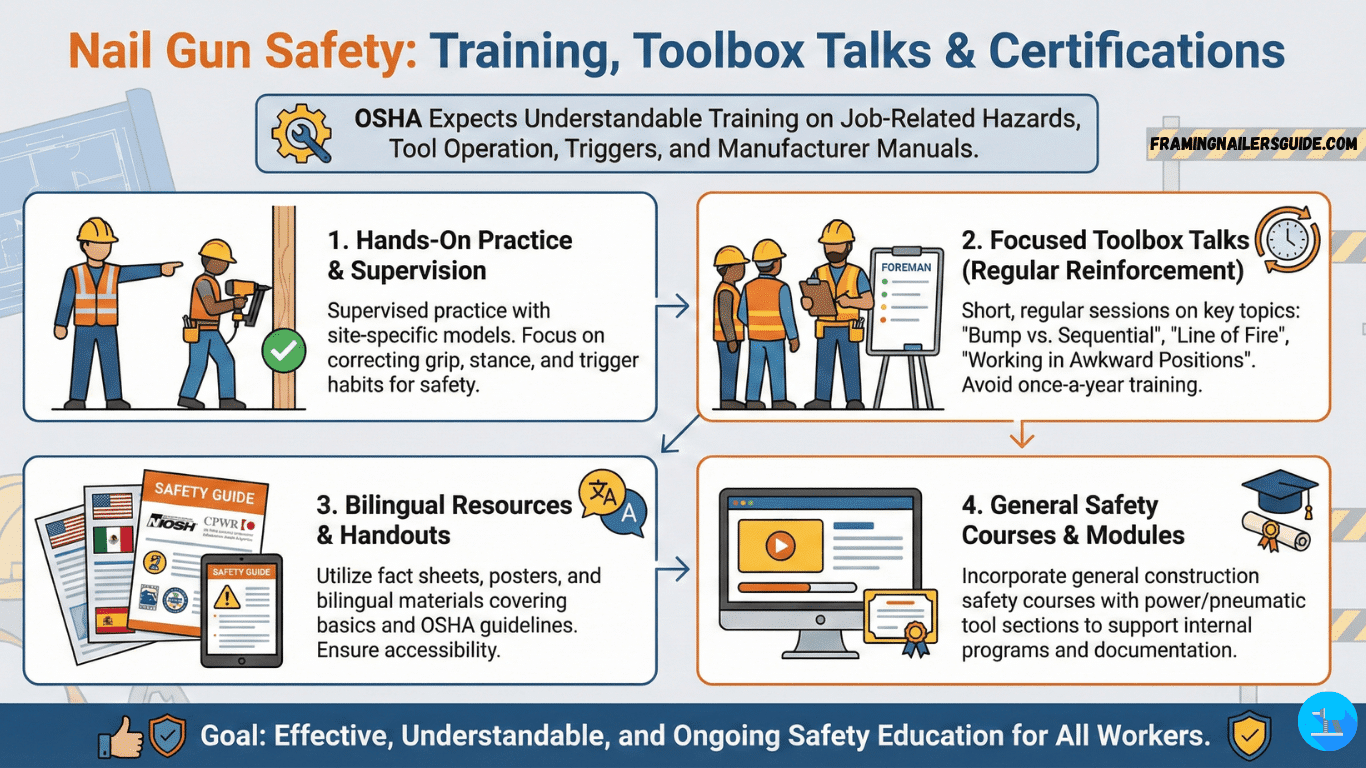
OSHA expects employers to provide training about all job-related hazards, including how nail guns work, how triggers differ, and how to read and follow the manufacturer’s manual.
That training should be in a language and format workers can understand, which might mean bilingual toolbox talks, demonstrations, and simple handouts.
Useful training approaches and resources:
- Hands-on practice with the actual models used on site, supervised by a competent person who can correct grip, stance, and trigger habits.
- Short, focused toolbox talks on topics like “bump vs sequential,” “line of fire,” and “working in awkward positions,” reinforced regularly instead of once per year.
- Fact sheets, posters, and bilingual handouts from organizations like NIOSH, CPWR, and state safety agencies that cover nail gun safety basics and OSHA nail gun guidelines.
- Courses and on-demand modules on general construction safety that include sections on power tools and pneumatic tools, which can support your internal program and documentation.
Pre-Shift Nail Gun Inspection Checklist
A structured pre-shift inspection can catch many issues before the tool ever hits a board. The table below gives a practical daily checklist you can adapt into a laminated card or digital form for your crew.
| Inspection item | What to check |
|---|---|
| Air hose / power cord | No cuts, kinks, exposed wire, or leaking fittings. |
| Trigger and safety nose | Moves smoothly, returns fully, no sticking or delay. |
| Fastener type and magazine | Correct nails for the tool and job; magazine loads smoothly. |
| Test fire in safe area | Single, controlled shots with full PPE on. |
| General condition | No cracks, loose parts, or non-factory modifications. |
| Anti–dry-fire function (if present) | Tool stops firing when nails are nearly depleted. |
| Guards and exhaust | All guards present; exhaust pointed safely away from face. |
| Depth-of-drive and pressure setting | Adjusted for material to avoid over-penetration or blow-through. |
Tools that fail any of these checks should be tagged out and removed from service until repaired or replaced.
Building this step into your start-of-day routine reinforces workplace tool safety as part of how the crew works—not an afterthought.
FAQs on Nail Gun Safety
Q. Are contact trip nail guns really that dangerous?
A. Yes, multiple studies and safety organizations have found that contact trip (bump-fire) nail guns are associated with roughly double the rate of acute injuries compared with full sequential triggers, especially among less-experienced workers. That does not mean they can never be used safely, but it does mean you should be very selective about who uses them and under what conditions.
Q. What does OSHA actually require around nail gun safety?
A. OSHA requires employers to maintain hand and power tools in safe condition, provide appropriate PPE at no cost, and train workers on tool hazards and safe operation. OSHA also promotes using safer trigger configurations and implementing clear nail gun work procedures, even where a specific trigger type is not explicitly mandated by regulation.
Q. How should a crew respond to a nail gun injury on site?
A. First, stop work in the immediate area and ensure the scene is safe; then provide first aid and seek medical care, especially for any puncture deeper than the skin, or injuries involving joints, eyes, head, chest, or abdomen. Document the incident, secure the tool, and review what happened in a later toolbox talk so the root causes can be addressed, not just the symptoms.
Q. Can I be held liable if a worker bypasses safety features on their own?
A. Even if a worker modifies a tool without permission, employers and contractors can still face scrutiny if there was no effective system for inspections, rule enforcement, and training on why such modifications are prohibited. Clear written rules, regular inspections, and prompt discipline or retraining when violations occur all help show you took reasonable steps to prevent that behavior.
Q. Are nail guns safe for new workers?
A. They can be, if you pair new workers with full sequential triggers, thorough hands-on training, close supervision, and firm rules about line-of-fire and trigger discipline. Letting inexperienced workers run bump-fire tools at production speed without that foundation is where many serious injuries occur.
Conclusion: Building for Tomorrow
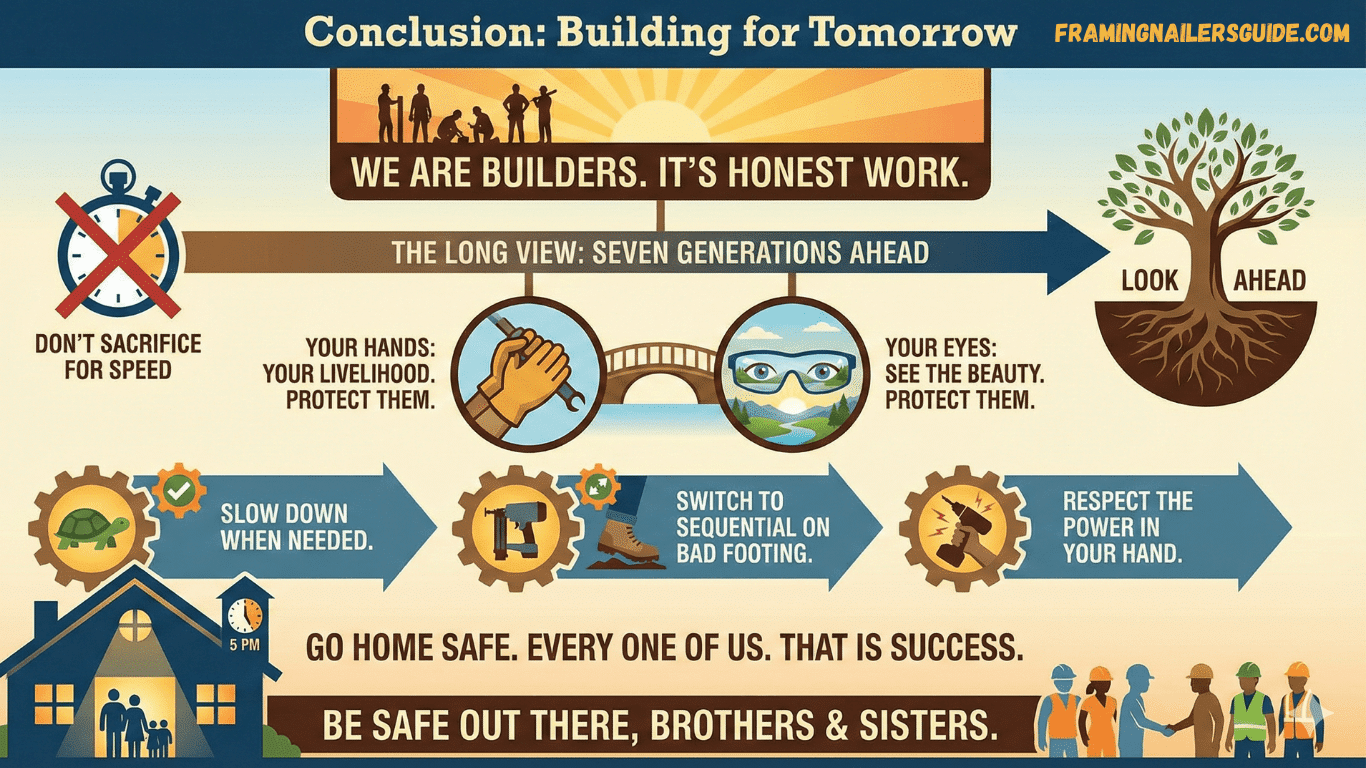
We are builders. It’s good work. It’s honest work.
But let’s not sacrifice our bodies for the sake of shaving an hour off a job. The old ways taught us to look seven generations ahead. When we look at our work today, we need that same long view.
Your hands are your livelihood. Your eyes let you see the beauty in the world. Protect them.
Slow down when you need to. Switch to that sequential trigger when the footing is bad. Respect the power you hold in your hand.
Let’s make sure every one of us goes home safe when the whistle blows. That is the true measure of a successful day on the job site.
Be safe out there, brothers and sisters.
