

Last Updated on August 23, 2026 by John Patterson
Brace for the storm.
When 120-mph hurricane winds hit a residential roof, atmospheric low pressure creates violent upward suction capable of lifting the entire roof assembly off the exterior walls.
Building inspectors in coastal hurricane zones check every single metal tie connecting your rafters or engineered trusses to the double top plate.
A single fastener mistake voids the structural chain.
Using 1-1/2-inch short connector nails where 2-1/2-inch common nails are legally required can slash your hurricane tie’s wind uplift load capacity by over 40%.
CONTINUOUS LOAD PATH FORMULA
Full-Length Common Nail (2.5″ x .131″ or .148″) + 100% Round Head Seating = 100% Rated Uplift Resistance
Before choosing fasteners for structural connectors, review our master guide on what size nails for framing.
For strict hardware nail gauge rules, read our breakdown on joist hanger nails vs framing nails.
Quick Answer: Simpson Hurricane Tie Nail Size Rules
Short version?
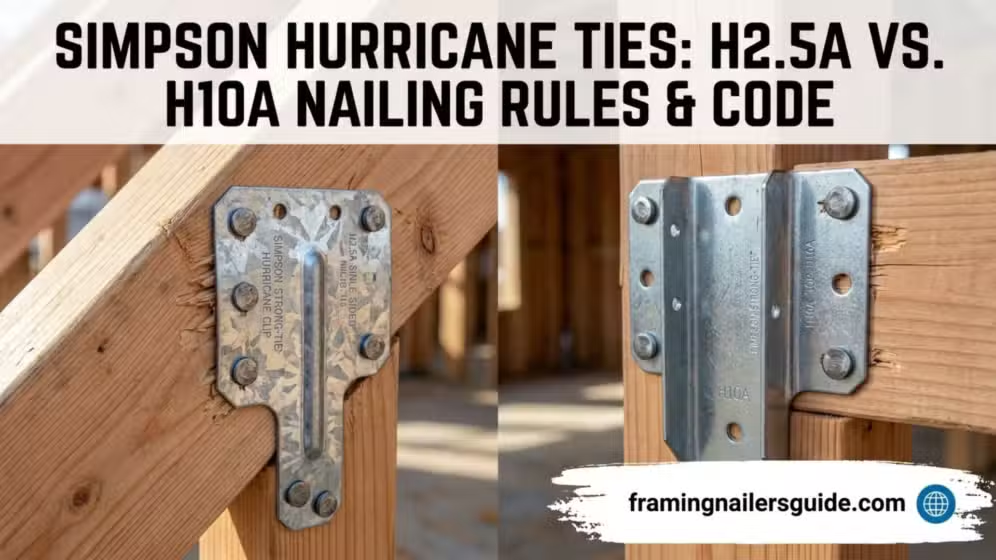
For standard Simpson Strong-Tie H2.5A clips, building codes require five 8d (1-1/2″ x .131″) or 10d (1-1/2″ x .148″) nails into the rafter/truss and five 8d or 10d nails into the double top plate, delivering up to 565 to 600 lbs of allowable wind uplift resistance.
For high-wind Simpson H10A ties, codes mandate eight 10d (1-1/2″ x .148″) or 10d common (3″ x .148″) nails into the rafter and eight 10d nails into the wall plate/stud, providing up to 1,200 to 1,340 lbs of uplift resistance.
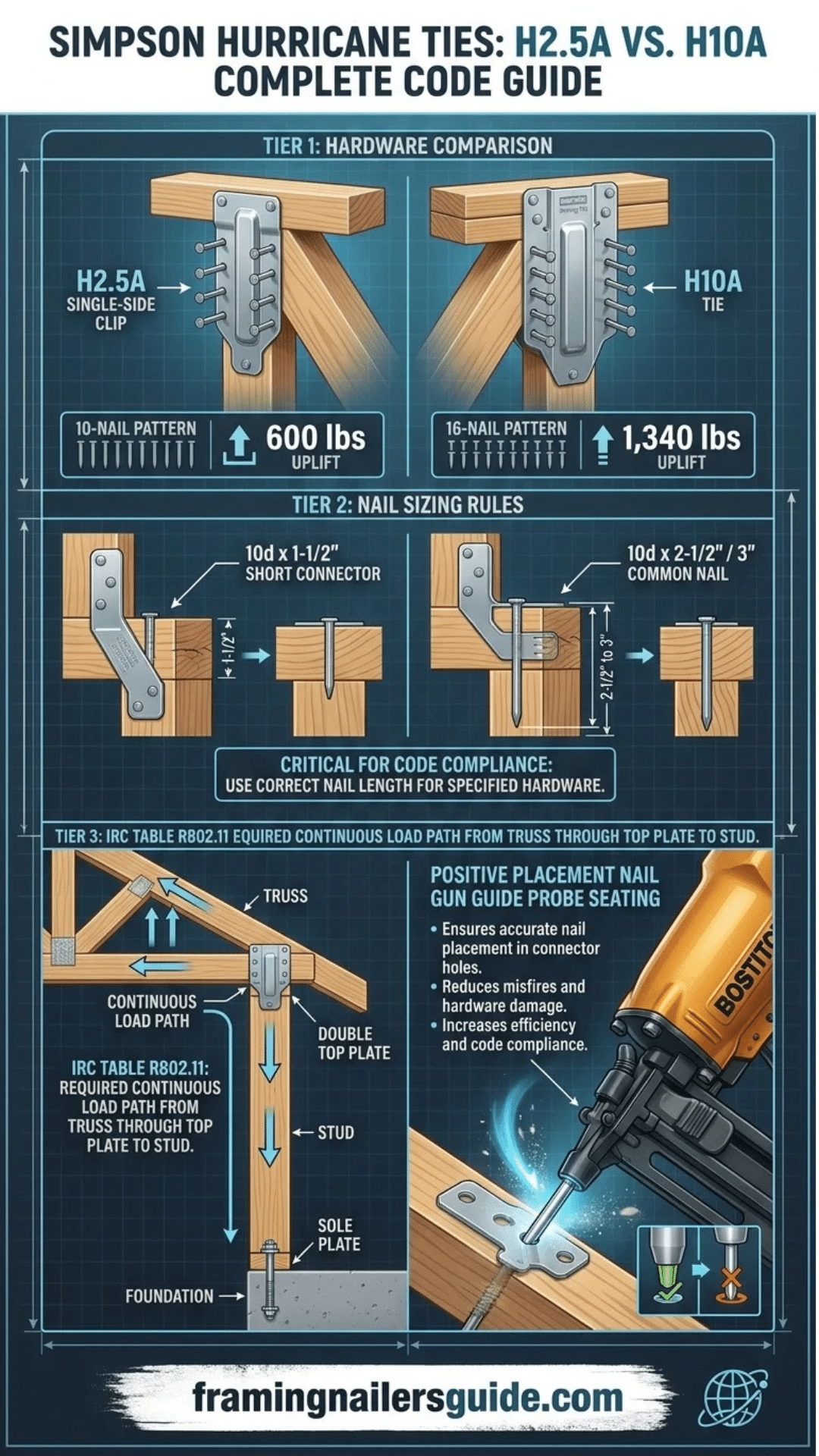
Simpson H2.5A Fastening: Requires 10 total nails (5 in truss, 5 in top plate). Ideal for standard residential roof uplift loads in inland and moderate-wind zones.
Simpson H10A Fastening: Requires 16 total nails (8 in truss, 8 in plate/stud). Engineered for high-velocity hurricane zones (HVHZ) requiring double the uplift holding power.
The Fastener Length Penalty: Using 1-1/2″ short nails in place of specified 2-1/2″ or 3″ common nails into wall plates reduces allowable uplift loads by up to 40%.
Corrosion Rating: All exterior hurricane clips must use Hot-Dipped Galvanized (ASTM A153 Class D) or 316 stainless steel to resist salt air and ACQ treated wood corrosion.
H2.5A vs. H10A: Engineering Differences & Wind Uplift Capacities
Engineering governs connection strength.
Hurricane ties form the critical link in the continuous load path, transferring uplift tension from roof sheathing down through trusses, wall studs, and into the foundation.
Choosing between the H2.5A and H10A depends entirely on the design wind speed and roof span calculations.
Simpson H2.5A Specifications: Single-sided 18-gauge galvanized steel bracket designed for rapid installation on one side of a truss or rafter. Delivers 565 lbs of allowable uplift in Spruce-Pine-Fir (SPF) and 600 lbs in Douglas Fir-Larch (DFL).
Simpson H10A Specifications: Heavy-duty 18-gauge connector engineered with extended flanges that attach directly into the top plate and down into the wall stud beneath. Delivers 1,200 lbs uplift in SPF and 1,340 lbs in DFL.
Dual Tie Rules: When high design wind loads exceed H2.5A capacity, engineers specify either dual H2.5A clips (one on each side of the truss) or upgrade directly to a single H10A connector.
UPLIFT RATING RATIO
H2.5A (Single Clip: ~600 lbs Uplift) vs. H10A (High-Capacity Tie: ~1,340 lbs Uplift)
Review official engineering load tables under the Simpson Strong-Tie High-Wind Fastening Guide.
The 1.5-Inch vs. 2.5-Inch Nail Mistake: Understanding Load Reductions

Fastener length dictates holding power.
A common jobsite error occurs when framers load 1-1/2-inch short connector nails (10d x 1-1/2″ / .148″) into every single hole of an H10A or H2.5A tie without checking the engineering schedule.
While 1-1/2-inch nails are approved for face nailing into single 1-1/2-inch thick rafters, driving short nails into a double 2x top plate reduces lateral penetration.
Double Plate Penetration: Driving a 1-1/2″ nail into a double top plate penetrates only the top 2x board, failing to engage the second plate and reducing uplift capacity by 23% to 40%.
Full-Length Commons: When the structural schedule specifies 8d or 10d commons (2-1/2″ or 3″ length), the fastener shank must penetrate through the first plate and seat deeply into the lower plate.
Thin Wire Substitution: Driving general construction wire nails (.120″ or .131″) into .148″ specified connector holes leads to instant hardware shear failure under dynamic wind gusts.
Reference continuous load path failure modes in the official FEMA Coastal Construction Manual (FEMA P-499).
IRC Building Code & Florida Building Code (FBC) Roof Tie-Down Standards
Codes enforce hurricane protection.
The International Residential Code (IRC Section R802.11 and Table R802.11) mandates that roof assemblies must be mechanically tied to exterior wall frames to resist calculated wind uplift forces.
In coastal High-Velocity Hurricane Zones (HVHZ) under the Florida Building Code (FBC), toe-nailing alone is strictly prohibited.
Toe-Nail Prohibition: Standard toe-nailing (three 8d commons) provides only 200 to 250 lbs of resistance, which fails minimum code requirements in regions with wind speeds exceeding 110 mph.
Mandatory Mechanical Ties: IRC Table R802.11 requires engineered metal tie-down straps on every single truss or rafter spaced 24 inches on-center in high-wind regions.
Stud Alignment Rules: Hurricane ties must align directly over wall studs beneath the top plate to transfer uplift directly into foundation anchor bolts.
All roof-to-wall connections must comply with the International Residential Code (IRC Section R802.11) and the
Florida Building Code (FBC Building Envelope Requirements).
Fastener Installation: Positive Placement Guns vs. Hand Nailing
Never guess the hole.
Hand-nailing dozens of hurricane ties overhead with a framing hammer leads to missed holes and hand fatigue.
Shooting a standard framing nailer blindly into stamped steel hardware is extremely dangerous and can cause fatal nail ricochets.
Positive Placement Nailers: Uses an exposed hardened probe tip that physically seats inside the hurricane tie’s round hole before the tool can cycle, guaranteeing 100% accurate nail placement.
Dedicated Magazines: Drives code-approved 1-1/2″ x .148″ (10d short) or 2-1/2″ x .148″ structural connector nails in less than one second with zero operator strain.
Hand Nailing Standards: When hand-nailing, use a 2-lb short-handle engineering hammer and verify that every stamped hole receives a specified fastener.
Always adhere to jobsite safety standards under official OSHA Nail Gun Safety Protocols.
Pre-Inspection Hurricane Tie Compliance Checklist
Run this check before the building inspector walks the roof framing:
Hardware Certification: Are all hurricane ties stamped and certified by an approved agency (e.g., Simpson Strong-Tie H2.5A or H10A)?
Hole Fill Rate: Are 100% of the stamped nail holes filled with code-approved fasteners (no skipped holes)?
Nail Shank Gauge: Are rafter and truss connection nails the exact diameter specified (.131″ or .148″ shank)?
Double Plate Penetration: Are full-length 2-1/2″ or 3″ commons used wherever specified into double top plates?
Screw Hazard Check: Are all general construction wood screws and drywall screws removed from metal ties?
Corrosion Protection: Are fasteners Hot-Dipped Galvanized (ASTM A153) or 316 stainless steel for coastal corrosion resistance?
Stud Alignment: Do hurricane ties align directly over wall studs beneath the top plate for load path continuity?

Frequently Asked Questions
What size nails go in a Simpson H2.5A hurricane tie?
A Simpson H2.5A requires ten total nails: five 8d (1-1/2″ x .131″) or 10d (1-1/2″ x .148″) nails into the rafter/truss, and five matching nails into the double top plate.
Can I use 1.5-inch nails in Simpson H10A ties?
You can use 1-1/2″ x .148″ connector nails into single 2x rafters, but connections into double top plates often require full-length 2-1/2″ or 3″ 10d commons to achieve 100% rated uplift capacity.
Can I use construction screws in hurricane ties?
No. Standard wood and deck screws are brittle and snap under hurricane uplift loads. Only use manufacturer-approved structural screws like Simpson Strong-Tie SD9 or SD10 Connector Screws.
Do hurricane ties go on the inside or outside of the wall?
Hurricane ties can be installed on either the exterior or interior face of the wall plate, provided they do not interfere with exterior sheathing or interior drywall.
How many hurricane ties do I need per roof truss?
Building codes require one hurricane tie on each end of every truss or rafter. In extreme high-wind zones, structural engineers may specify dual ties on both sides.
Final Summary & Key Takeaways
Protect the roof against wind uplift.
Install Simpson H2.5A clips for standard residential spans and upgrade to H10A ties in high-velocity hurricane zones.
Fill 100% of fastener holes with heavy-gauge connector nails, verify double top plate penetration, and build an unbroken continuous load path.
