

Last Updated on December 10, 2025 by John Patterson
I remember the exact moment I realized I needed a real tool kit.
It was 2 a.m. My kitchen faucet decided to turn into a miniature fountain… and all I had was a butter knife and some duct tape. Not exactly ideal. That night taught me something important: owning a home—or even just renting an apartment—means you need tools. Real ones.
But here’s where it gets tricky.
Walk into any hardware store and you’re bombarded with options. Hundreds of shiny tools promising to solve every problem. Pre-packaged kits with 200 pieces that somehow still don’t include what you actually need. It’s overwhelming, especially if you’re just starting out.
So let me save you some time, money, and frustration. I’ve spent years building, breaking, and rebuilding my tool collection. I’ve wasted money on junk that broke after one use. I’ve also discovered tools that have literally paid for themselves dozens of times over.
This isn’t about buying everything at once. It’s about understanding which DIY tool kit additions will actually serve you—whether you’re hanging your first picture frame or tackling weekend renovation projects.
Why Your Home Needs an Essential Tool Kit in 2026
Let’s talk numbers for a second.
The average homeowner spends between $1,500-3,000 annually on home repairs and maintenance. And here’s the kicker—about 40% of those costs are labor charges for simple fixes you could absolutely handle yourself with the right tools.
Tightening a loose cabinet hinge? Five-minute job with a screwdriver. Calling someone? $75-150 minimum service call. Mounting a TV? Fifteen minutes with a drill and level. Hiring it out? $100-200 depending on your market.
The math gets real simple, real fast.
The DIY Renaissance Is Exploding Right Now
Something shifted during the past few years. People want to understand their homes again. Pinterest searches for “DIY home decor tools” jumped significantly, and “easy DIY projects 2026” is trending across multiple platforms. It’s not just about saving money anymore—though that’s certainly part of it. It’s about self-sufficiency. About not being helpless when something breaks at the worst possible moment.
According to the CDC’s Healthy Home Guide, maintaining your home properly with appropriate tools helps prevent safety hazards like exposed electrical outlets, structural issues, and moisture problems that can affect your family’s health. Having the right equipment isn’t luxury—it’s responsible homeownership.
Tools That Pay for Themselves
I bought a quality cordless drill five years ago for $120. Since then, I’ve used it to:
- Install three ceiling fans (saved roughly $450 in labor)
- Mount eight different shelving units
- Build a deck railing
- Assemble approximately one million pieces of IKEA furniture
- Fix cabinet doors throughout my house
Cost per use? Probably down to about fifty cents at this point. And it’s still going strong.
The Essential 10: Tools Every Home Actually Needs
Forget those 200-piece kits filled with tools you’ll never touch. Let’s focus on what matters.
1. Cordless Drill/Driver: Your Workshop Workhorse
This is non-negotiable. Seriously.
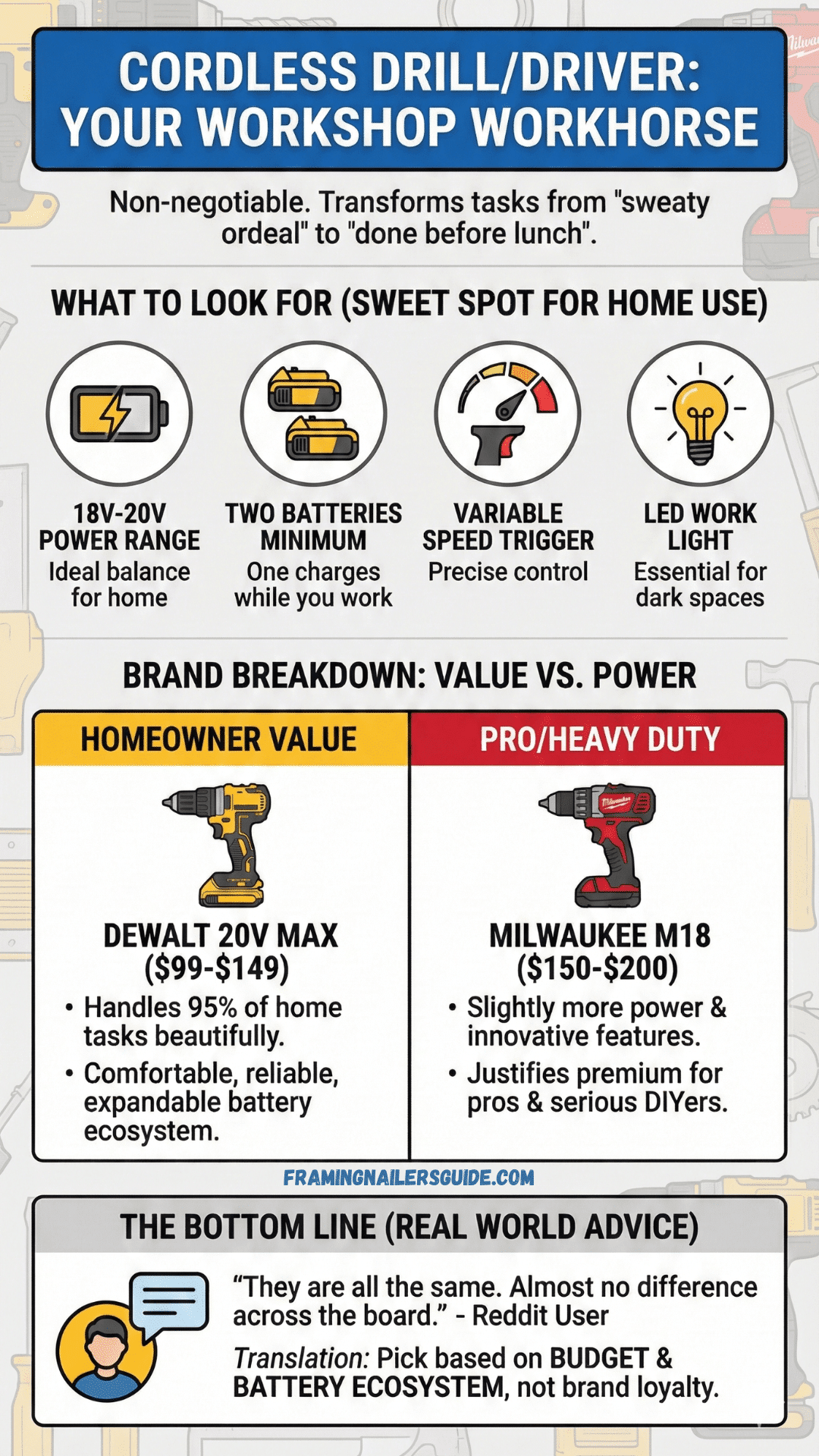
A quality cordless drill transforms how you interact with your space. Picture hanging becomes easy instead of a sweaty ordeal with a manual screwdriver. Furniture assembly shifts from “all-day torture session” to “done before lunch.”
What to look for:
- 18V-20V power range (sweet spot for home use)
- Two batteries minimum (one charges while you work)
- Variable speed trigger for control
- LED work light (you’ll use this more than you think)
The DeWalt 20V MAX runs about $99-149 for a basic kit and handles 95% of home tasks beautifully. It’s comfortable, reliable, and their battery ecosystem means you can expand into other tools later without buying new batteries every time.
Milwaukee’s M18 line offers slightly more power and innovative features, but typically costs $150-200 for comparable kits. For professional contractors or serious DIYers tackling heavy projects, Milwaukee’s raw power justifies the premium. For homeowners doing typical repairs and projects? DeWalt delivers better value.
One Reddit user perfectly summarized it: “They are all the same. Almost no difference across the board. I like Dewalt impacts a little more, Milwaukee drills a little more”. Translation: pick based on budget and battery ecosystem, not brand loyalty.
2. Tape Measure: Not All Measuring Tools Are Equal
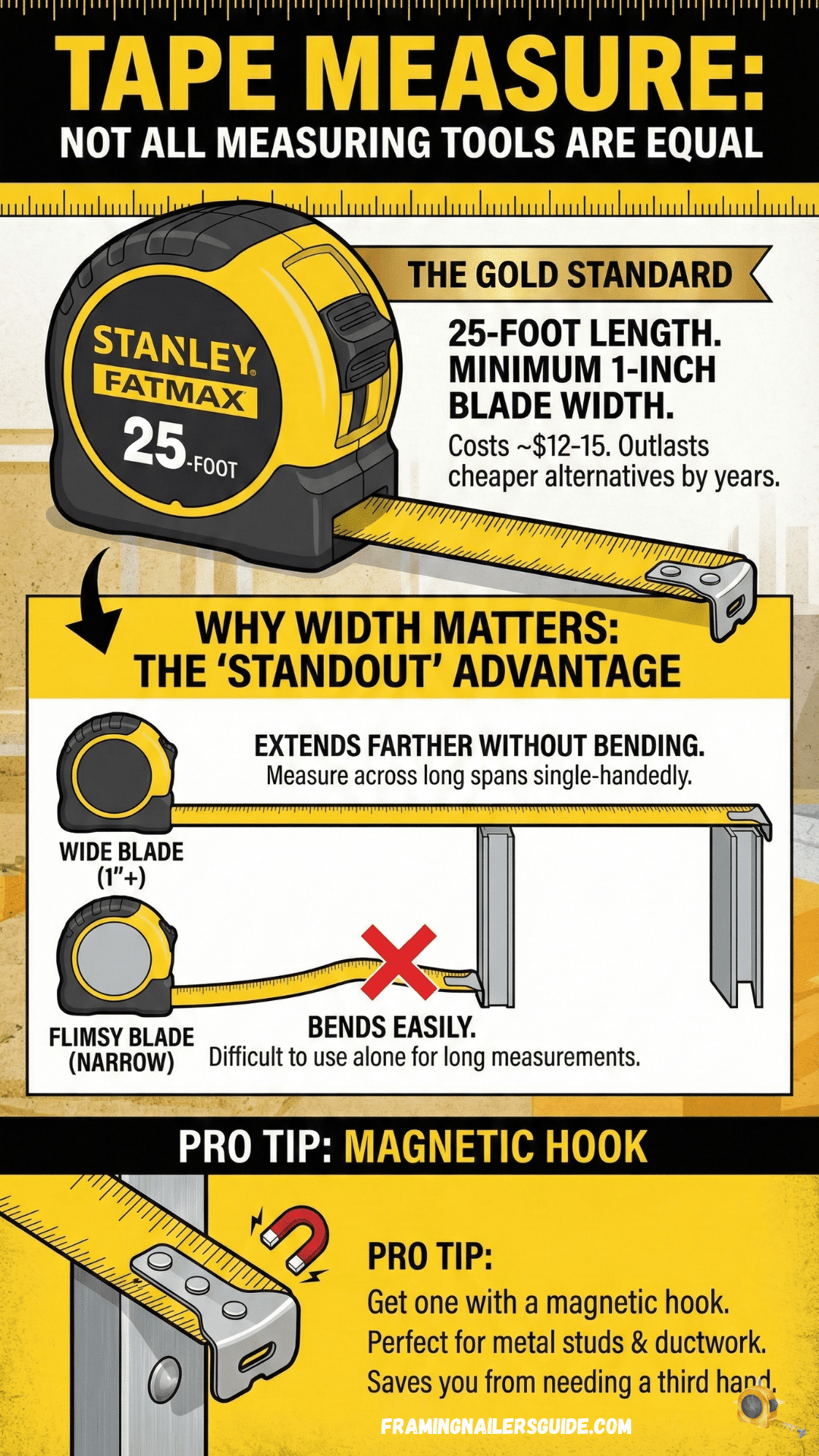
You need a 25-foot tape measure with a minimum 1-inch blade width. The Stanley FatMax is the gold standard—costs about $12-15 and will outlast cheaper alternatives by years.
Why does width matter? A wider blade extends farther without bending, which means you can measure across longer spans single-handedly. Try measuring a room with a flimsy tape and you’ll understand immediately.
Pro tip: Get one with a magnetic hook if you frequently measure metal studs or ductwork. Saves you from needing a third hand.
3. Adjustable Wrench and Pliers Set
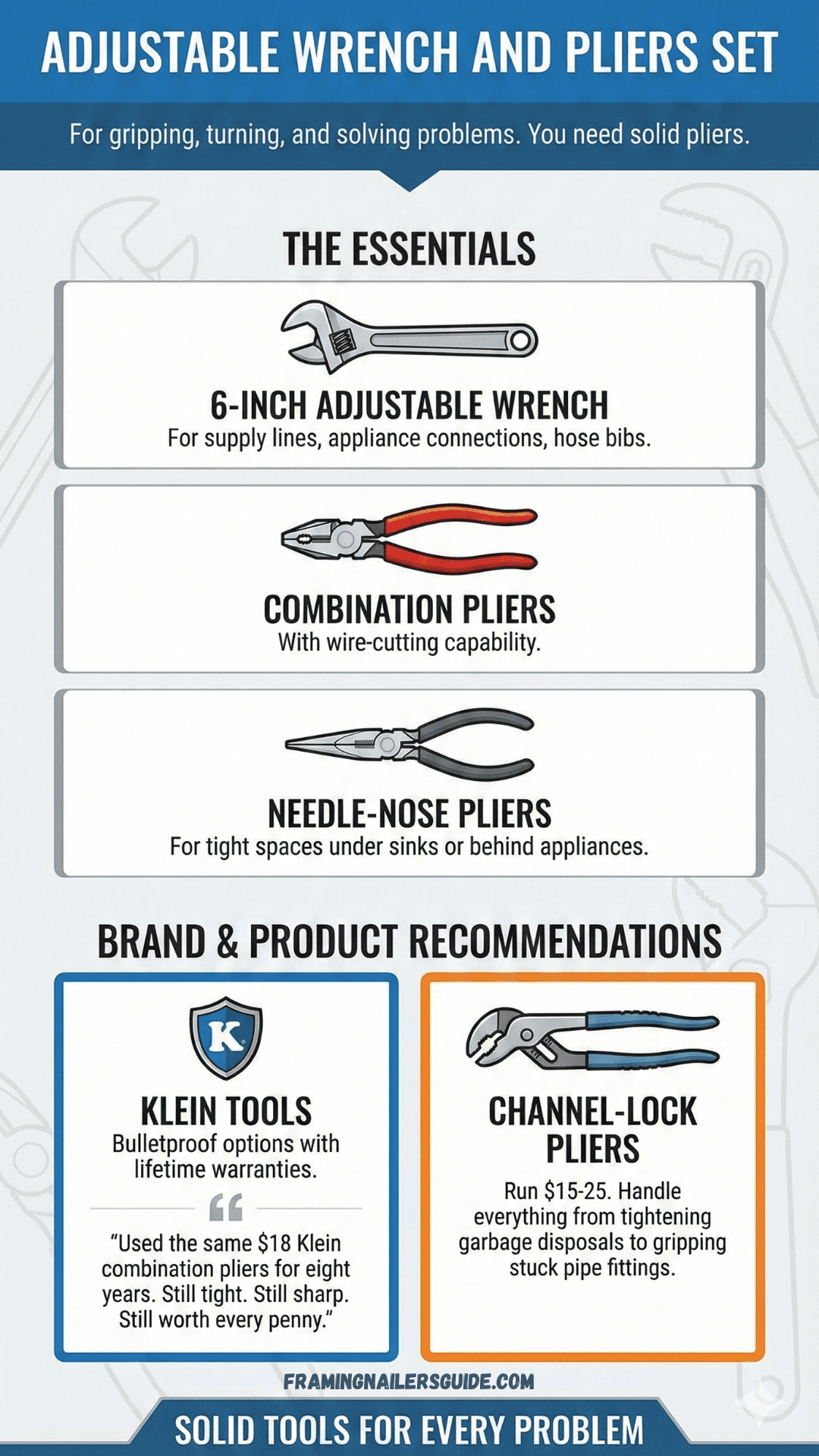
For gripping, turning, and solving problems, you need solid pliers.
The essentials:
- 6-inch adjustable wrench (for supply lines, appliance connections, hose bibs)
- Combination pliers with wire-cutting capability
- Needle-nose pliers for tight spaces under sinks or behind appliances
Klein Tools makes bulletproof options that come with lifetime warranties. Channel-lock pliers (those big ones that adjust to different widths) run $15-25 and handle everything from tightening garbage disposal connections to gripping stuck pipe fittings.
I’ve used the same $18 Klein combination pliers for eight years. Still tight. Still sharp. Still worth every penny.
4. Multi-Bit Screwdriver: Versatility in Your Pocket
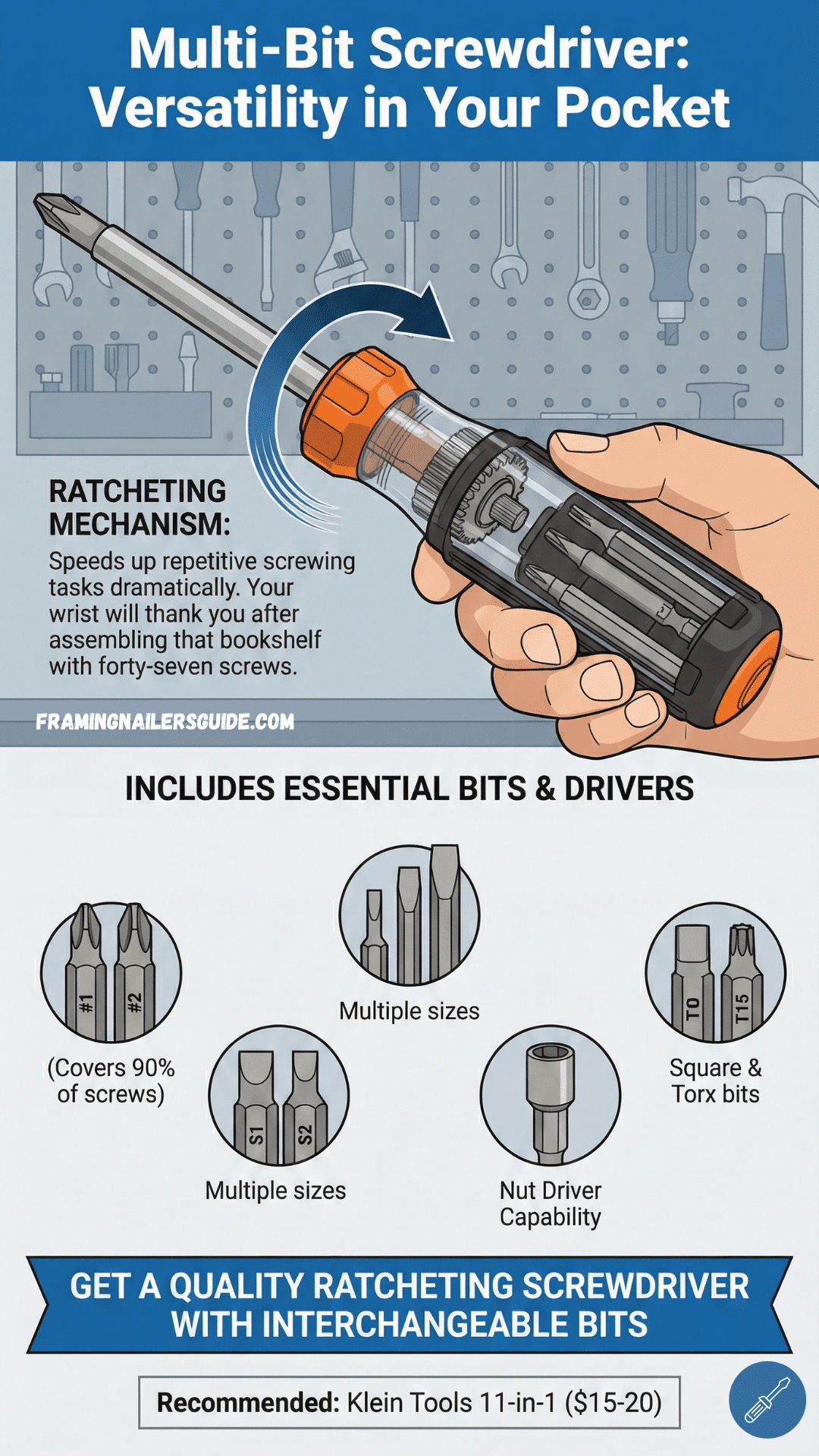
Get a quality ratcheting screwdriver with interchangeable bits. The Klein Tools 11-in-1 runs about $15-20 and includes:
- #1 and #2 Phillips (these cover 90% of screws you’ll encounter)
- Multiple flathead sizes
- Square and Torx bits
- Nut driver capability
The ratcheting mechanism speeds up repetitive screwing tasks dramatically. Your wrist will thank you after assembling that bookshelf with forty-seven screws.
5. Hammer: Simple, Essential, Irreplaceable
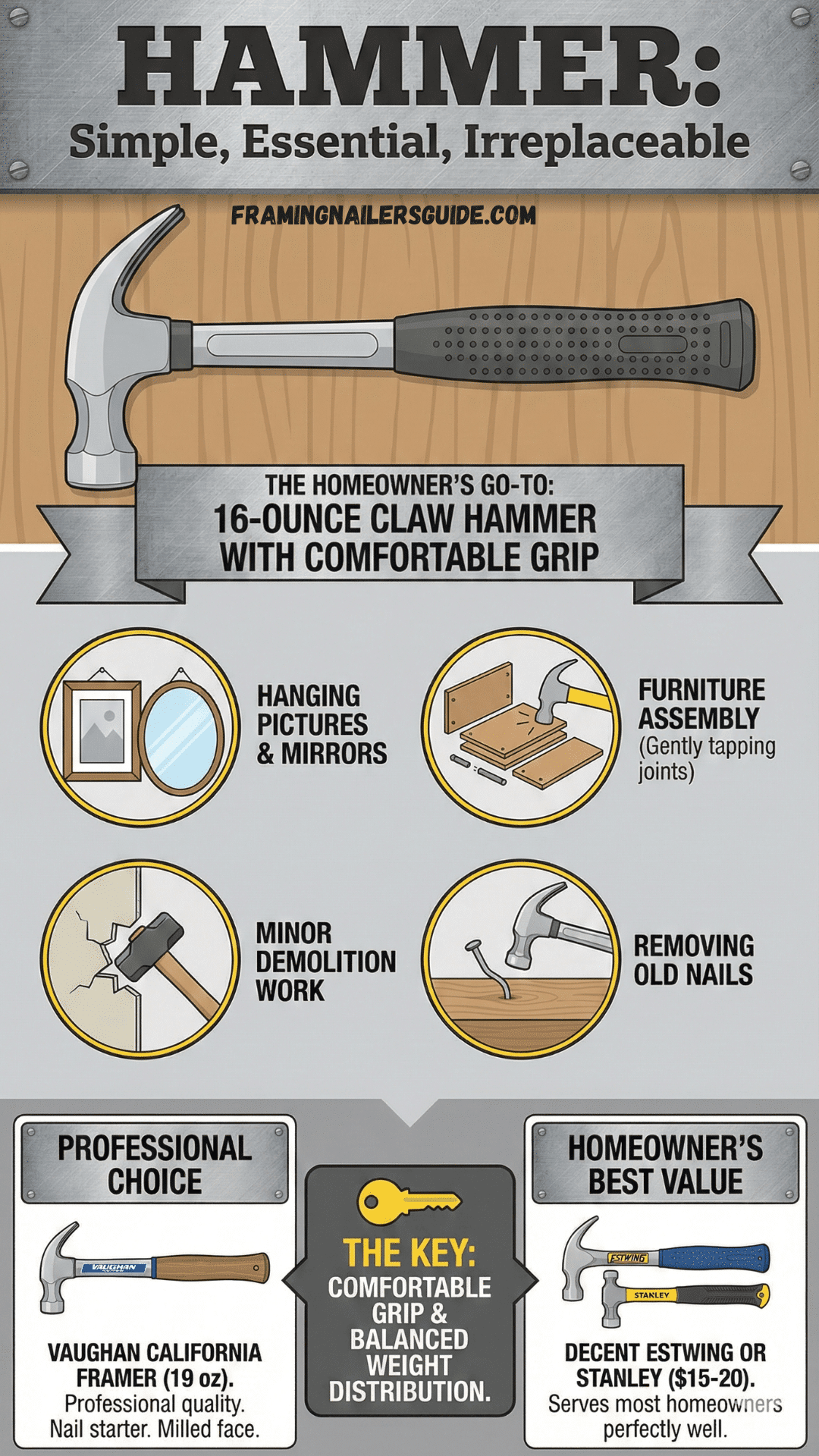
A 16-ounce claw hammer with a comfortable grip handles most home needs. You’ll use it for:
- Hanging pictures and mirrors
- Furniture assembly (gently tapping joints together)
- Minor demolition work
- Removing old nails
The Vaughan California Framer at 19 ounces offers professional quality with a nail starter and milled face. But honestly? A decent $15-20 Estwing or Stanley will serve most homeowners perfectly well. The key is comfortable grip and balanced weight distribution.
6. Utility Knife: Underrated Game-Changer
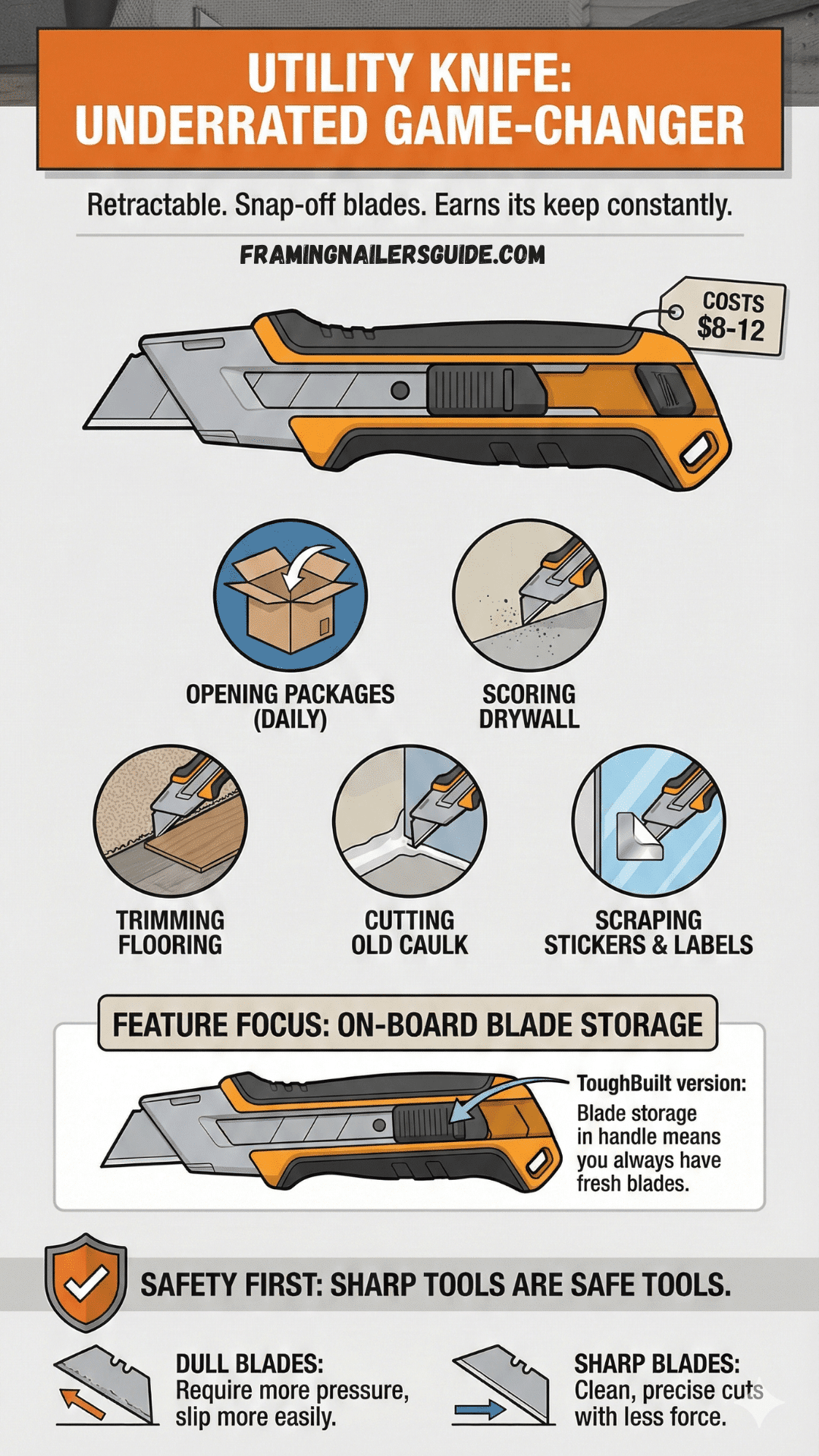
A retractable utility knife with snap-off blades costs $8-12 and earns its keep constantly. Opening packages (you’ll do this daily). Scoring drywall for cuts. Trimming carpet or vinyl flooring. Cutting through old caulk. Scraping off stickers and labels.
The ToughBuilt version with blade storage in the handle means you always have fresh blades. Sharp tools are safe tools—dull blades require more pressure and slip more easily.
7. Level: Because Crooked Shelves Haunt You Forever
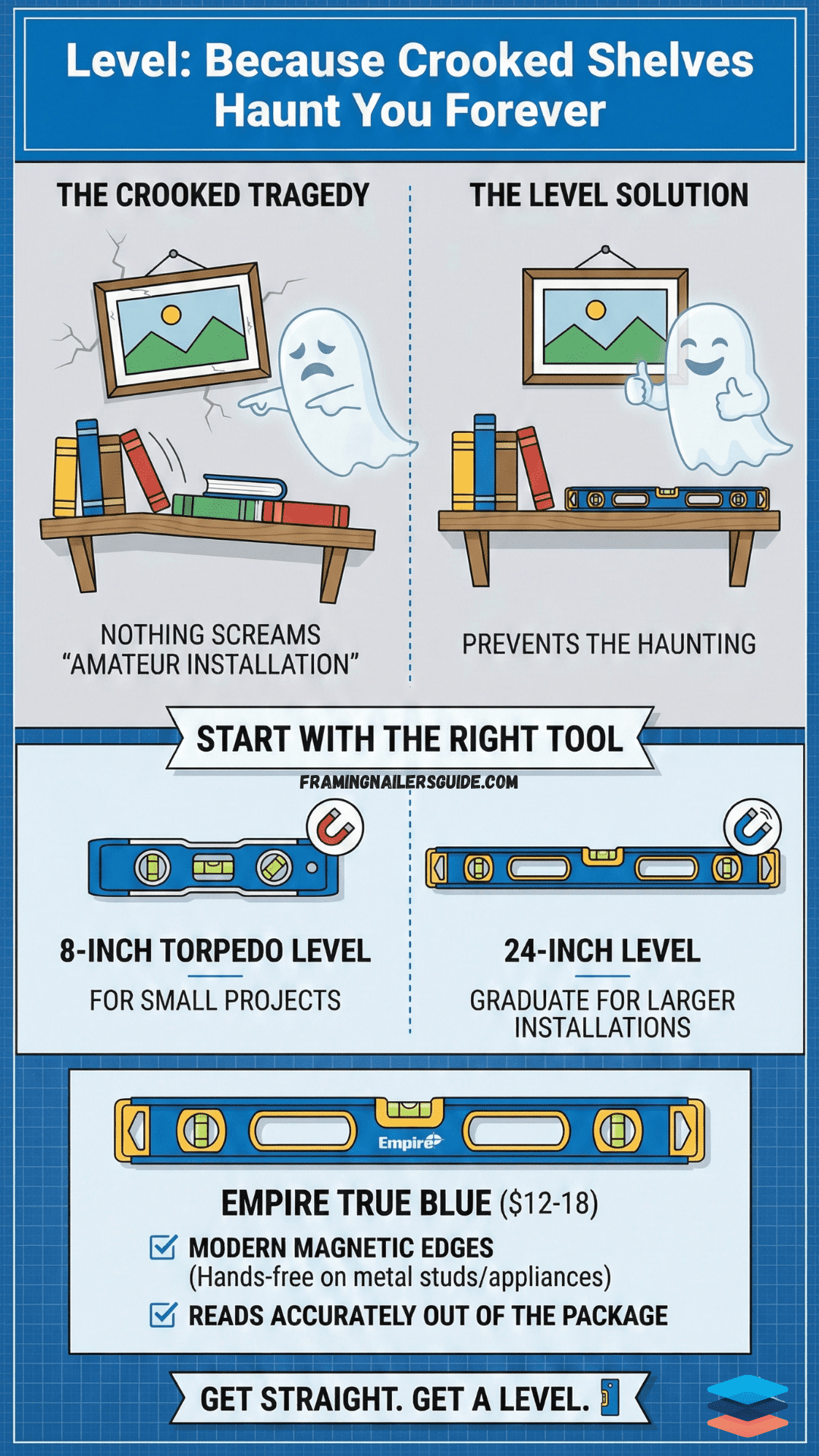
Start with an 8-inch torpedo level for small projects. Graduate to a 24-inch level when you’re ready for larger installations.
Modern levels include magnetic edges that stick to metal studs or appliances, keeping your hands free. The Empire True Blue runs $12-18 and reads accurately right out of the package.
Nothing screams “amateur installation” like a crooked shelf or picture frame. A level prevents that tragedy.
8. Stud Finder: Stop Playing Knock-Knock With Walls

A basic electronic stud finder costs $15-25 and saves enormous frustration. The Zircon StudSensor e30 reliably locates wall studs, helping you:
- Mount heavy items safely
- Avoid drilling into electrical wires
- Find solid anchoring points for shelves
According to OSHA’s woodworking safety guidelines, proper planning and preparation—including locating studs before drilling—prevents accidents and material waste. Safety starts before you ever pick up a power tool.
Old-school tip: After your stud finder locates something, confirm with a small finish nail tapped through the drywall. Digital sensors occasionally give false positives. A nail doesn’t lie.
9. Flashlight or Headlamp: Light Where You Need It
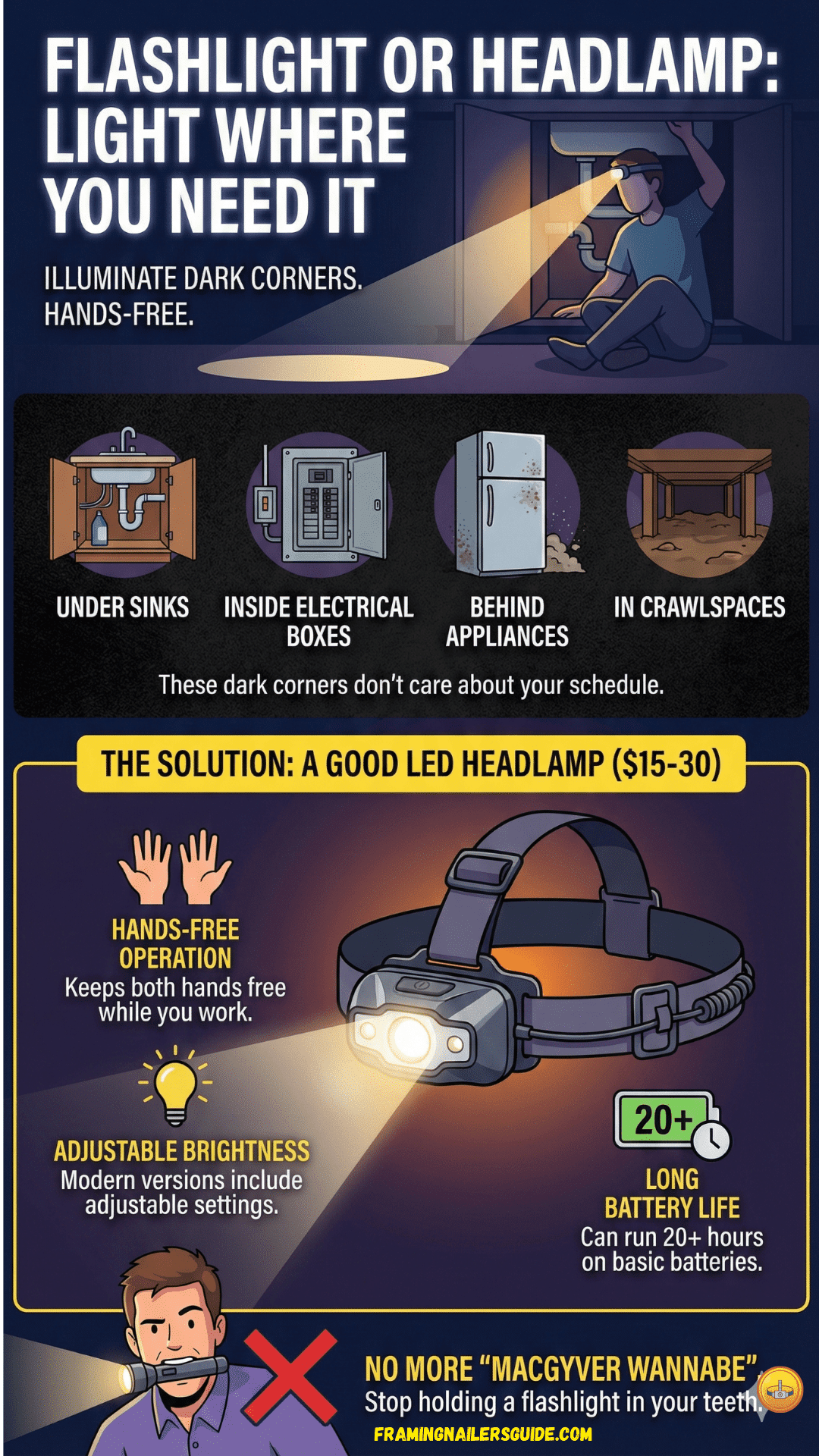
Under sinks. Inside electrical boxes. Behind appliances. In crawlspaces. These dark corners don’t care about your schedule.
A good LED headlamp ($15-30) keeps both hands free while you work. Modern versions include adjustable brightness and can run 20+ hours on basic batteries. No more holding a flashlight in your teeth like some kind of MacGyver wannabe.
10. Tool Storage: A Home for Everything

A basic toolbox with latches keeps everything organized and portable. You can start simple—a $20-30 plastic organizer with compartments. Or invest in a proper metal toolbox that’ll last decades.
The real secret? Keep frequently-used items in an easy-access spot. I keep a small caddy with screwdrivers, tape measure, and utility knife under my kitchen sink. For 80% of household fixes, I never need to visit my main toolbox.
Building Your Kit: Pros and Cons to Consider
Pros:
Saves hundreds to thousands annually on labor costs
Immediate response to household emergencies—no waiting for contractors
Builds practical skills and self-sufficiency confidence
Tools maintain value and longevity with proper care
Customizable to your specific needs (woodworking, auto repair, etc.)
Can tackle projects on your schedule, not contractor availability
Cons:
Initial investment of $200-400 for quality basics can feel steep
Requires storage space and organization system
Learning curve exists, especially for power tools
Maintenance needed—cleaning, battery charging, blade sharpening
Easy to overbuy tools you’ll rarely use
Safety considerations require education and attention
The 80/20 Rule Applies Here
About 20% of your tools will handle 80% of your projects. That’s why this list focuses on versatile essentials rather than specialty items. Once you’ve used these basics for six months, you’ll naturally discover which specific tools would enhance your particular needs.
Do you find yourself constantly needing to cut wood? Time for a circular saw. Lots of painting projects? Invest in quality brushes and maybe a paint sprayer. Working on automotive projects? Socket sets and jack stands move up the priority list.
Brand Showdown: Where Your Money Goes Furthest
Dewalt vs Milwaukee: The Eternal Debate
Both brands dominate the professional and serious DIY markets, but they take different approaches.
| Feature | DeWalt | Milwaukee |
|---|---|---|
| Battery Platform | 20V MAX system | M18/M12 systems |
| Best For | Budget-conscious homeowners, DIY enthusiasts | Frequent users, demanding projects |
| Build Quality | Robust construction, durable | Premium materials, advanced engineering |
| User Rating | 4.7/5 (Amazon) | 4.8/5 (Amazon) |
| Warranty | Typically 3 years | Typically 5 years on some lines |
| Best Known For | Reliability and user-friendly design | Raw power and innovative features |
| Price Range (Entry Kits) | $99-250 | $150-300 |
DeWalt delivers excellent value for homeowners. Their tools feel substantial without being unnecessarily heavy, and the ergonomics work well for extended use. The 20V MAX battery system is mature and reliable. When you eventually expand beyond basic tools, compatible batteries save money.
Milwaukee focuses on professional-grade performance. Their REDLINK PLUS™ intelligence prevents overheating and maximizes battery efficiency. The M18 FUEL line offers serious power, and their vibration-reducing technology makes extended use more comfortable. You’re paying premium prices for premium performance.
For most homeowners building their first important tool kit? DeWalt makes more financial sense. You get 90-95% of the performance at 60-70% of the cost.
Budget-Friendly Alternatives: Ryobi and Craftsman
Ryobi has quietly become the smart choice for casual DIYers. Their One+ battery system includes over 280 compatible tools—from drills to fans to Bluetooth speakers. A basic drill kit runs $50-80, and the tools handle typical home tasks without complaint.
The catch? They won’t survive daily professional abuse. But if you’re using your drill twice a month for home projects? Ryobi will serve you faithfully for years.
Craftsman rebuilt their reputation after being acquired by Stanley Black & Decker. Modern Craftsman tools offer decent quality with competitive pricing—typically $40-100 for starter kits. Their lifetime warranty on hand tools remains impressive. Power tools don’t match Milwaukee or DeWalt in refinement, but they’ll absolutely get the job done.
The Honest Reality
Reddit mechanic communities consistently confirm what professionals know: brand differences matter less than proper tool selection for your needs. A $100 DeWalt drill will last 15+ years in home use. A $300 Milwaukee drill will also last 15+ years in home use. The Milwaukee might drive screws slightly faster with marginally more torque, but will you actually notice during typical projects?
Probably not.
Pick based on battery ecosystem compatibility, ergonomics that feel good in your hands, and what’s available locally for warranty service.
Organizing Your Tool Kit Like a Pro
Here’s something nobody tells beginners: Tool organization saves more time than any individual tool upgrade.
Start With Functional Storage
A basic toolbox with compartments costs $20-40 and keeps essentials portable. For items you use constantly, consider:
- Under-sink caddy for quick fixes
- Pegboard wall mount for garage organization (trending heavily on Pinterest for “mechanic tool kit organization“)
- Rolling tool cabinet if you’re serious about growing your collection
The visibility rule: If you can see a tool without opening a drawer, you’re more likely to use it. Pegboards win here—everything at a glance.
Maintenance Zones Matter
Keep basic consumables stocked:
- Assorted screws and wall anchors
- Spare batteries (AA, 9V for smoke detectors)
- Painter’s tape and sandpaper
- Zip ties and adhesive cable clips
- PTFE plumber’s tape for threaded connections
These small items prevent project-stopping trips to the hardware store. Nothing kills motivation like discovering you can’t finish because you’re missing a $2 package of drywall anchors.
Safety Equipment Deserves Space Too
According to the CDC’s auto and home supply safety guidelines, proper personal protective equipment prevents the majority of home workshop injuries. Keep readily accessible:
- Safety glasses (wear them for drilling, cutting, grinding)
- Work gloves for handling rough materials
- Dust masks for sanding or insulation work
- Hearing protection for prolonged power tool use
The OSHA woodworking safety standards emphasize that safety equipment only works if it’s convenient enough to actually use. Buried in a box? You’ll skip it. Hanging next to your workspace? You’ll grab it automatically.
What Homeowners Across USA, Canada, and UK Are Saying
Scrolling through DIY forums and tool communities reveals consistent patterns.
From a UK first-time buyer on Reddit:
“I would say a starter kit would be as good a start as any. What you will find is the things that you use the most will naturally break first. This will then tell you what individual items may need a bit more money spent on them”.
This wisdom hits home. Start modestly. Upgrade based on actual use. Don’t buy professional-grade needle-nose pliers if you touch them once per year.
A mechanic from the US shared:
“I have a set of combination pliers and a decent battery drill. These ones are in regular use. The type of included tools looks good—it’s more a concern of their quality”.
Quality over quantity wins every time. Three excellent tools beat thirty mediocre ones.
Common Mistakes and How to Avoid Them
Buying pre-packaged kits blindly: That 200-piece set from the discount store? It includes twelve socket sizes you’ll never need and omits the two you’ll use constantly. Build your kit intentionally.
Neglecting battery care: Lithium batteries last longer when stored at 40-80% charge. Fully discharging them regularly shortens lifespan. Neither DeWalt nor Milwaukee batteries are cheap to replace.
Skipping safety equipment: I’ve met people who own $500 worth of power tools but won’t buy $8 safety glasses. Don’t be that person. Your eyesight is worth more than the cost of Chinese takeout.
Not reading manuals: Power tools include torque settings and speed recommendations for specific materials. Five minutes with the manual prevents stripped screws and cracked materials.
Where to Buy Your Must-have Tool Kit in 2026
United States: Multiple Options
Amazon: Convenience and competitive pricing make this the default for many buyers. Prime shipping means tools arrive fast when you need them. Watch for seasonal sales—Prime Day and Black Friday regularly feature 30-40% discounts on major tool brands.
Home Depot / Lowe’s: In-store shopping lets you handle tools before buying. Their tool rental programs ($20-80 per day) offer smart alternatives for specialty items you’ll rarely need. Both retailers price-match online competitors.
Direct from manufacturers: DeWalt, Milwaukee, and others offer rewards programs for repeat customers. If you’re building a collection within one battery ecosystem, manufacturer-direct sometimes provides better combo deals.
Canada: Similar Selection, Different Pricing
Home Depot and Lowe’s operate throughout Canada with similar selections to US stores. Canadian Tire offers good alternatives for budget-friendly options. Be aware that tool pricing runs 10-20% higher than US equivalents even after currency conversion.
Shipping consideration: Cross-border tool purchases sometimes trigger customs fees and extended shipping times. Calculate total landed cost before assuming US prices represent savings.
UK: Adapt and Overcome
Screwfix and Toolstation dominate the UK market with competitive pricing and widespread locations. Amazon UK stocks major brands but sometimes at premium pricing compared to US markets.
For power tools, voltage differs (230V in UK vs 120V in US). Cordless tools work universally, but corded tools require region-appropriate versions. Don’t try adapting US corded tools for UK outlets—fire hazards aren’t worth the savings.
Frequently Asked Questions
What is the best tool kit for beginners in 2026?
Start with the basic 10 tools outlined above, focusing on a quality cordless drill, measuring tools, basic hand tools, and proper storage. A beginner-friendly setup costs $200-400 depending on brand choices. DeWalt’s basic cordless drill kit ($99-129) combined with hand tools from Klein or Stanley provides excellent value for new homeowners.
How much does a basic home tool kit cost?
Budget $250-500 for quality basics that will last years. You can start smaller ($100-150) with absolute essentials and expand gradually. Avoid ultra-cheap pre-packaged kits under $50—they typically include low-quality tools that break quickly and need replacement. The initial investment pays for itself within the first year through avoided labor costs.
Are power tools necessary in an must-have tool kit?
One cordless drill/driver is virtually essential for modern home ownership. It handles tasks that would be exhausting or impossible with hand tools—driving dozens of screws, drilling through studs, mixing paint. Beyond that core power tool, hand tools can handle most needs. Add specialized power tools (saws, sanders, etc.) only when specific projects require them.
How do I maintain my tool kit properly?
Clean tools after use, especially if exposed to moisture or dust. Charge lithium batteries every 3-6 months if stored long-term. Oil moving parts on pliers and wrenches annually. Store tools in dry environments to prevent rust. Sharp tools (utility knives, saws) should be replaced or sharpened when performance declines—dull tools are dangerous tools. Most quality hand tools require minimal maintenance but reward basic care with decades of service.
What’s the difference between hand tools and power tools?
Hand tools require manual force (screwdrivers, hammers, wrenches) while power tools use electricity or batteries for mechanical advantage (drills, saws, sanders). Hand tools offer precision and control for delicate work. Power tools provide speed and capability for repetitive or demanding tasks. A balanced toolkit includes both—hand tools for finesse, power tools for efficiency.
Should I buy tools individually or as kits?
Buy core essentials individually from quality brands, building around a single battery platform for cordless tools. Pre-packaged kits work well for expanding within that ecosystem—many brands offer combo sets (drill + impact driver + two batteries) at better pricing than buying separately. Avoid generic “200-piece” kits that sacrifice quality for quantity.
What safety gear do I need with my tool kit?
Minimum safety equipment includes safety glasses (for drilling/cutting), work gloves (handling rough materials), and dust masks (sanding/drywall work). As you expand into more power tools, add hearing protection for extended use. The CDC emphasizes that proper safety equipment prevents common home workshop injuries. Total safety gear cost: $30-50 for quality basics that last years.
Which tools should I upgrade first as a beginner?
After using basic tools for 3-6 months, upgrade items you reach for most frequently. If you’re constantly drilling, invest in a better drill with brushless motor. Lots of cutting tasks? Add a quality circular saw. Focus on tools that bottleneck your projects or cause frustration. Don’t upgrade tools you barely touch—even bargain versions work fine for occasional use.
Build Your Essential Tool Kit Today: Your Home Will Thank You
Here’s what I wish someone had told me fifteen years ago…
You don’t need to buy everything at once. Start with the core ten tools. Use them. Learn what you reach for repeatedly and what sits unused. Let your actual projects guide your expansions.
That broken faucet incident? It hasn’t happened since. Not because things stopped breaking—they definitely still break. But now I’m equipped. Confident. Capable of handling the problems that homeownership throws at me.
A proper must-have tool kit doesn’t just save money on repairs. It changes your relationship with your living space. You stop being helpless. You start seeing potential instead of problems.
That crooked picture? You’ll fix it instead of ignoring it for months. That loose cabinet door? Five-minute job. That shelf you’ve been wanting to install? Weekend project, totally achievable.
Following proper safety practices recommended by OSHA and maintaining awareness of home health factors outlined by the CDC ensures your DIY projects enhance your home safely. Smart tool selection combined with responsible usage creates the foundation for years of successful home improvement.
The best time to build your toolkit was five years ago. The second best time? Right now.
What tools have been game-changers in your home? Drop a comment sharing your must-have additions—I’d love to hear what’s worked for you. And if this helped you plan your toolkit, share it with someone else who needs to stop using butter knives for home repairs.
