


Last Updated on August 22, 2026 by John Patterson
Cut your mowing time in half.
You sit in a high-back suspension seat facing a three-acre property filled with mature oak trees, fence perimeters, and garden beds.
Choosing between a commercial-grade zero-turn mower and a traditional lawn tractor is not just about price—it changes your weekend maintenance routine forever.
Let’s look at the mechanical differences.
Both machines cut grass cleanly, but their steering geometry, ground speed, and hillside traction serve completely different property terrain.
MOWER PLATFORM FORMULA
Zero-Turn (Dual Hydrostats / 360° Pivot / 8-12 MPH) vs. Lawn Tractor (Steering Wheel / 15° Slope Stability / Towing Versatility)
Maintaining outbuildings and outdoor work areas? Review our framing hardware guide on what size nails for framing.
Quick Answer: Zero Turn vs. Riding Mower Differences
Short version?
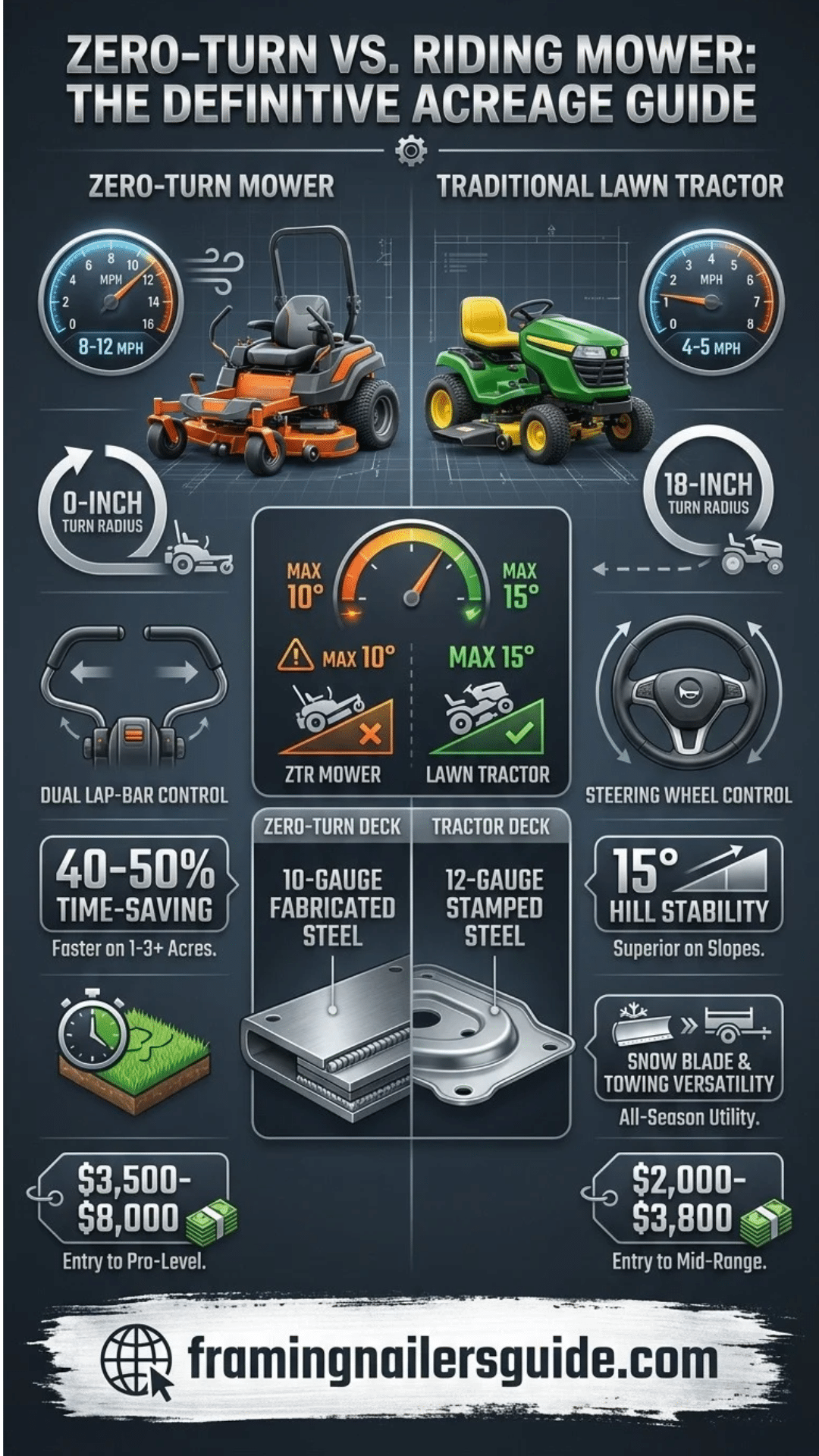
A zero-turn mower (ZTR) uses dual independent hydraulic wheel motors controlled by twin lap bars, cuts at 7 to 12 mph, turns 360 degrees on its own axis, and cuts mowing time by 40% to 50% on flat, obstacle-rich lawns over 1 acre.
A traditional riding mower (lawn tractor) uses an automotive steering wheel, cuts at 4 to 5.5 mph, maintains superior front-wheel steering control on rolling slopes and hills up to 15 degrees, and excels at towing ground-engaging attachments at a significantly lower initial cost.
- Zero-Turn Speed Advantage: 7 to 12+ mph forward cutting speed with zero-radius pivot turns, eliminating three-point turns at every row edge.
- Zero-Turn Slope Limit: Front caster wheels have no mechanical steering connection; on slopes over 10°–15°, the front end can slide downhill unexpectedly.
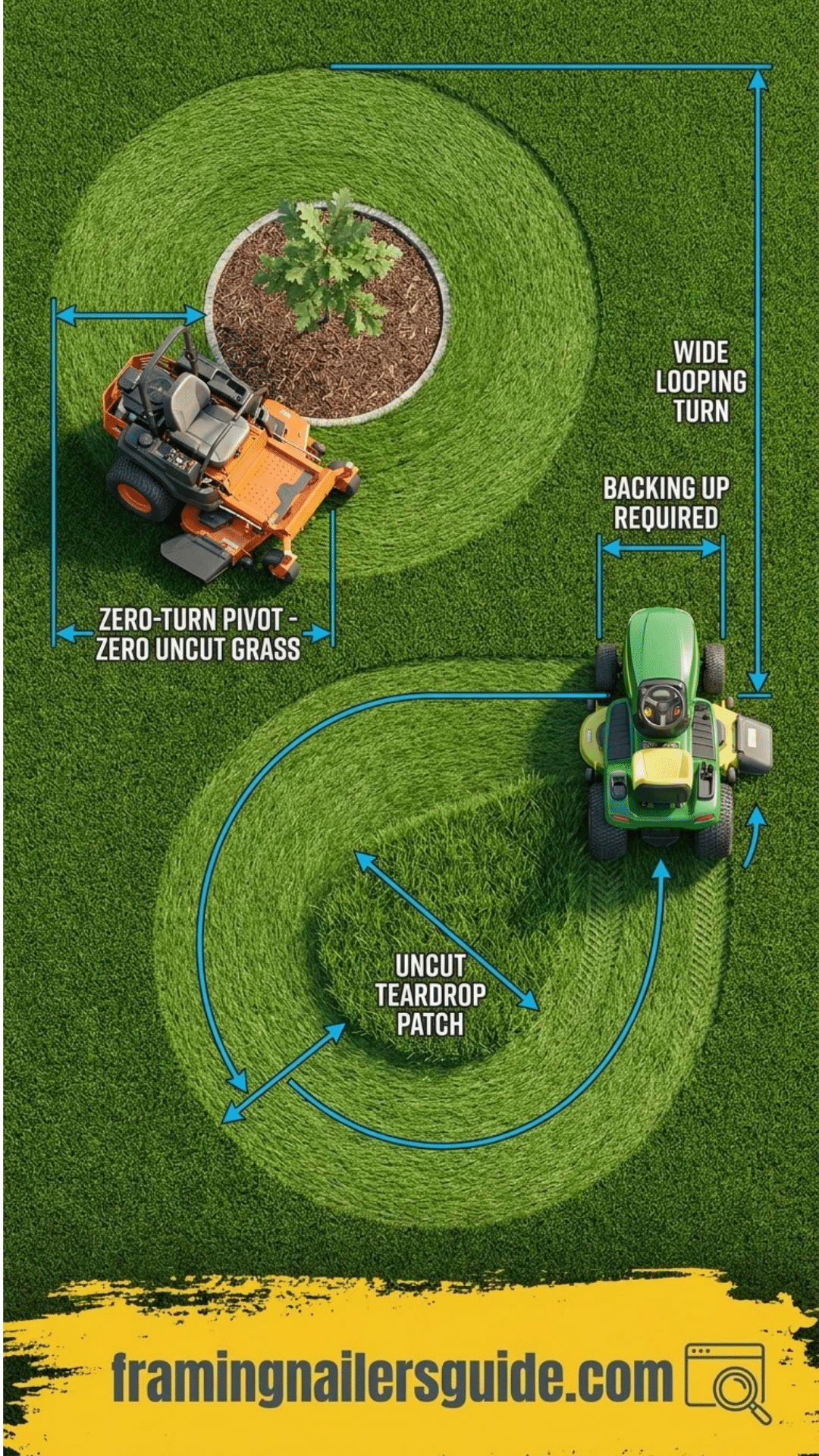
- Lawn Tractor Maneuverability: 4 to 5.5 mph cutting speed with an 18-inch turning radius that requires backing up around trees and garden beds.
- Lawn Tractor Hillside Stability: Fixed front steering axle and low center of gravity provide stable traction on rolling slopes up to 15 degrees.
- Price Range: Lawn tractors ($2,000–$3,800) cost significantly less than entry residential or commercial ZTRs ($3,500–$9,000+).
Steering Mechanics: Lap Bar Dual Hydrostats vs. Traditional Steering Wheels
Steering defines the machine.
A traditional riding mower operates just like a car: a single transaxle powers the rear wheels while a mechanical steering gear turns the front axle.
Zero-turn mowers eliminate the mechanical steering rack entirely.
- Dual Hydrostatic Transaxles: Each rear drive wheel is powered by its own independent hydrostatic pump and motor (or integrated transaxle such as Hydro-Gear ZT-2800). Pushing the left lap bar forward while pulling the right bar backward spins the machine in a perfect 360-degree circle without forward travel.
- Free Caster Wheels: Pivoting front caster wheels swivel freely 360 degrees like shopping cart wheels, offering zero mechanical resistance on flat turf.
- Lawn Tractor Turn Radius: Lawn tractors feature a minimum 16 to 18-inch turning radius, forcing operators to execute frequent three-point turns to complete clean cutting lines.
ZERO-TURN DRIVE FORMULA
Independent Hydrostatic Wheel Drive = 0-Inch Turning Radius + Instant 360° Maneuverability
Mowing Speed & Acreage Productivity: 8 MPH vs. 5 MPH
Speed saves weekend hours.
The productivity of any mower depends on cutting deck width, forward travel speed, and turn-around efficiency at the end of each pass.
Mowing a flat 3-acre yard with a 48-inch lawn tractor traveling at 4.5 mph takes roughly 2.5 to 3 hours.
- Acreage Production Rate: Traveling at 8.5 mph with a 54-inch fabricated deck, a residential zero-turn completes the exact same 3-acre lawn in under 1.2 hours.
- Obstacle Efficiency: On lawns with more than 10 obstacle points (trees, fence posts, flowerbeds), ZTRs trim cleanly in a single continuous pass, eliminating weed-trimmer cleanup.
Calculate cutting productivity using the standard USDA Agronomic Equipment Field Capacity Formula: (Deck Width in Inches × Speed in MPH) ÷ 100 = Acres Per Hour at 80% Field Efficiency.
Slope Stability & Hillside Safety: Rollover Physics and Caster Limitations
Slopes expose mechanical limits.
Operating mowers on steep embankments is one of the leading causes of outdoor power equipment injuries.
The exact feature that makes zero-turn mowers agile on flat ground—free-swiveling front casters—makes them hazardous on steep hills.
- The Zero-Turn Caster Hazard: Because the front wheels have no brakes and no steering link, gravity pulls the heavy rear end downhill on slopes over 10°–15°. If rear drive tires lose traction, the machine freewheels downhill without directional steering.
- Lawn Tractor Slope Stability: Traditional riding mowers connect steering linkages directly to front tires, maintaining directional control and braking grip across slopes up to 15 degrees.
- Mandatory ROPS Rules: Commercial ZTRs operating on slopes must be equipped with a certified Rollover Protection Structure (ROPS) and locked seatbelts to protect operators in rollover events.
Always adhere to outdoor power equipment safety guidelines established by the Outdoor Power Equipment Institute (ANSI/OPEI B71.1 Safety Standards) and OSHA Landscaping Equipment Operation Protocols.
Deck Construction: Fabricated 10-Gauge Welded Steel vs. Stamped 12-Gauge Decks
Steel thickness dictates lifespan.
Mower decks take brutal punishment from hidden tree roots, rocks, and thick brush.
How the cutting shell is manufactured determines whether your deck lasts five years or thirty.
- Fabricated (Welded) Decks: Constructed from heavy 10-gauge or 7-gauge plate steel cut with CNC lasers and reinforced with welded tubular steel bumpers. Resists cracking and bending when striking solid roots.
- Stamped Steel Decks: Manufactured by pressing a single sheet of lighter 12-gauge or 14-gauge steel into a mold. Stamped decks provide superior airflow for fine bagging and mulching, but can dent when striking heavy debris.
DECK LONGEVITY PRINCIPLE
Fabricated 10-Gauge Welded Steel = Commercial Impact Durability on Rough Acreage
Towing Capacity & Attachment Versatility: Ground Engagement vs. Pure Mowing
Consider year-round property chores.
A lawn tractor is a mini utility tractor designed to pull attachments all year long.
Zero-turn mowers are single-purpose machines engineered strictly for high-speed grass cutting.
- Lawn Tractor Utility: Heavy-duty cast-iron front axles accept front-mounted snow blowers, dozer blades, rear aerators, seeders, and utility dump carts up to 500 lbs.
- Zero-Turn Transmission Thermal Limits: Towing heavy loads behind an entry-level ZTR generates extreme heat inside residential hydrostatic transaxles (Hydro-Gear EZT), leading to premature transmission failure.
Pre-Purchase Mower Selection Checklist
Run this check before buying your next riding mower:
Acreage Size: Is your property larger than 1 acre of primarily flat or gently rolling turf? (Choose Zero-Turn).
Slope Steepness: Does your lawn have steep ditches, embankments, or slopes exceeding 15 degrees? (Choose Lawn Tractor).
Obstacle Density: Do you need to mow around dozens of trees, landscape beds, and fence posts? (Choose Zero-Turn).
Year-Round Utility: Do you need to plow snow, aerate soil, and tow heavy utility dump carts? (Choose Lawn Tractor).
Time Priority: Is cutting your weekly mowing time in half your #1 priority? (Choose Zero-Turn).
Initial Budget: Is your budget restricted to under $3,000 for a brand-new riding machine? (Choose Lawn Tractor).

Frequently Asked Questions
Is a zero-turn mower worth the extra money?
Yes, if you mow more than 1 acre with obstacles. Cutting mowing time by 40% to 50% saves dozens of hours every season, easily justifying the higher initial purchase price.
Can a zero-turn mower handle hills?
Zero-turn mowers handle gentle slopes up to 10–12 degrees safely. On slopes steeper than 15 degrees, free-swiveling front caster wheels can lose downhill steering control, creating rollover risks.
Why are lawn tractors better for towing?
Lawn tractors feature single heavy-duty transaxles with gear reductions designed for low-speed torque, allowing them to pull aerators and heavy utility trailers without overheating transmission fluid.
How long does a zero-turn mower last compared to a lawn tractor?
Residential lawn tractors typically last 500 to 800 operating hours. Quality zero-turn mowers with commercial-grade fabricated decks and serviceable hydro transaxles last 1,500 to 3,000+ hours with regular maintenance.
Are zero-turn mowers hard to learn to drive?
Most operators master the twin lap-bar controls within 30 to 45 minutes of practice in an open area. The steering feels intuitive, similar to operating a zero-radius shopping cart.
Final Summary & Key Takeaways
Match the machine to your property.
Choose a zero-turn mower for flat properties over 1 acre where cutting speed, obstacle agility, and saving time are your primary goals.
Choose a traditional lawn tractor for rolling slopes, tight budgets under $3,000, and year-round utility chores like plowing snow and towing.
