


Table of Contents
Last Updated on April 16, 2024 by John Patterson
There are four primary types of fertilizer spreaders. The different types come with specific benefits, demerits, and applications. Before buying the spreaders let’s know the types first.
4 Different Types of Fertilizer Spreaders
#1. Rotary or Broadcast Spreader
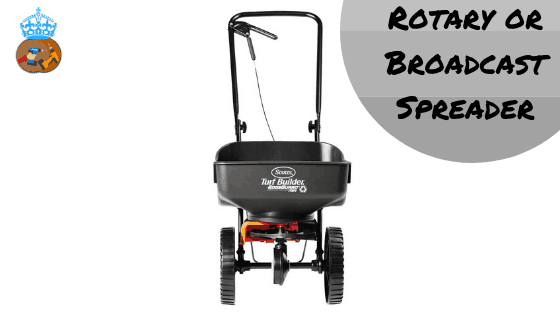
Rotary spreaders are used mostly by homeowners or gardeners managing large lawns. They are not recommended for use in places that require a precise application. With a broadcast spreader, you can dispense materials as far as 8ft from the start position. This way, you can easily reach vast areas of your lawn in a small time.
However, you may find it difficult to regulate the flow pattern and end up throwing fertilizers where they are not needed. This can increase the clean-up time when you are done.
Besides, you need to move steadily at a regulated pace to get a better result. It also entails going over the areas of your lawn two times for an even spread. Despite the inaccuracy of this type of spreader, it can save you a considerable amount of time in the garden.
#2. Hand-held Fertilizer Spreader
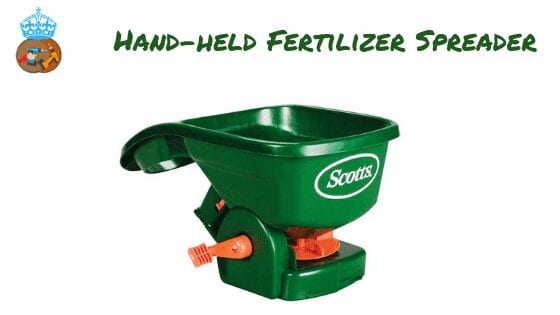
Handheld spreaders are very easy to use, the most cost-effective, and the handiest of fertilizer spreaders. Nonetheless, they have a small capacity and are unsuitable for big lawns. Handheld spreaders distribute fertilizer and other stuff frontways and sideways while you move across your lawn.
You operate them through the hand oddball or with a control knob that regulates the discharge. They help you to focus your spread on smaller parks. However, the range of coverage may be may less even compared to the other types.
These are commonly recommended for use in a smaller garden or smaller spot you can’t readily get to with the different types of fertilizer spreaders.
#3. Drop Fertilizer Spreader

Drop spreaders help you to get precise and even application. They are a fantastic choice if you have a smaller lawn. Drop spreaders dispense materials by dropping them straight out of the base of the spreader. This way, it helps you to get even coverage.
Nevertheless, to get the desired result, you need to carefully pass through every part of your lawn and try to cover your wheel path on every move partly. It also means you need to do a lot more passes to include the entire garden.
Drop spreaders feature a bucket-like fertilizer container and are commonly suspended on double-wheeled pushers.
Use drop spreaders for small lawns with areas below five thousand square feet and in places that require precise applications. They work great when you need to apply fertilizers and seeds near tree locations or places with obstacles.
#4. Liquid Fertilizer Spreader
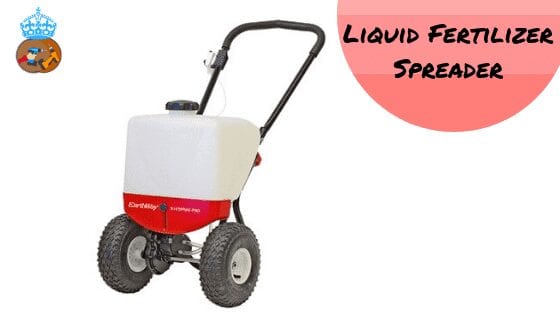
Liquid fertilizer spreader dispenses concentrated liquid fertilizer. The first thing you need to consider when choosing this type of spreader is the comparatively large application capacity. Thus, you need to check the filling position of the tending tank, and the volume of the pump dispenser, hosepipes, or plungers.
This has to be able to dispense high flow rates. For the pump to work more efficiently, the dispensing tank needs to distribute material from the store to the dispenser.
You need a properly maintained and up-to-date sprayer to get a good flow. Also, large sprayers need to have a pump capacity of more than forty gals/min on the applicator to work efficiently. The Distribution hose also needs to be more than a half-inch.
In Conclusion
It’s always good to know the types before buying anything. We hope you got a detailed idea after reading the kinds of fertilizer spreaders. If you have any comments or suggestions, don’t forget to contact us.
