


Last Updated on November 30, 2025 by John Patterson
I’ve been watching the forestry equipment industry for years now, and something interesting is happening.
The global forestry equipment market is on track to grow from $11.32 billion in 2025 to $14.85 billion by 2032—that’s a solid 3.9% compound annual growth rate.
And while everyone’s talking about mechanization, automation, and high-tech harvesting equipment, there’s a quiet story unfolding in the manual tools segment.
Cant hooks and peaveys—those seemingly simple hand tools that have been around for over a century—are experiencing their own renaissance.
Why Global Cant Hook Market Trends matter?
Because across four major markets (USA, UK, Canada, and China), we’re seeing a fascinating mix of old-world craftsmanship meeting modern consumer behavior.
DIY firewood processing is booming in North America and Europe. Massive reforestation programs are driving demand in China and India.
And sustainability certifications are changing how professional loggers in mature markets think about their tool investments.
This isn’t just about market data and growth percentages. It’s about understanding how different regions approach the same basic problem—moving heavy logs safely and efficiently—and why a $150 hand tool is still relevant in an age of million-dollar logging machinery.
Let me walk you through what’s actually happening in the cant hook market across these four regions, because the differences are more interesting than you’d think.
The Bigger Picture: Global Forestry Equipment Context
Before we dive into regional specifics, you need to understand where cant hooks fit in the broader forestry equipment landscape.
The global forestry equipment market hit $11.32 billion in 2025 and is projected to reach $14.85 billion by 2032. That’s a 3.9% CAGR driven primarily by mechanization, sustainable forestry practices, and reforestation initiatives across multiple continents.
But here’s what most market reports miss.
Manual tools—cant hooks, peaveys, log tongs—aren’t being replaced by machinery. They’re complementary to it. Even the most mechanized logging operation needs hand tools for positioning logs, working in tight spaces, and handling material around sawmills and staging areas.
And outside professional logging? The DIY firewood processing market is exploding. Rural homeowners, off-grid enthusiasts, and small-scale timber operators are driving retail demand for quality hand tools in ways that weren’t happening a decade ago.
Regional Growth Snapshot (2025-2035)
| Region | CAGR (2025-2035) | Key Growth Drivers |
|---|---|---|
| China | 6.3% | National reforestation programs, automation investment |
| India | 5.9% | Plantation forestry expansion, compact equipment demand |
| USA | 4.0% | Sustainability certifications, fleet modernization |
| UK | 4.5% | Rewilding initiatives, carbon offset programs |
| Germany | 5.4% | Precision forestry tech, hybrid machinery adoption |
What stands out immediately? China and India are growing faster because they’re still building out infrastructure and catching up on reforestation commitments.
Meanwhile, mature markets like the USA, UK, and Canada are growing more slowly but with higher per-unit spending on quality equipment.
The cant hook segment—estimated at $150-200 million globally within the manual tools category—is riding this wave but with its own unique dynamics in each region.
USA Cant Hook Market: Firewood, Homesteading, and Made-in-America Pride
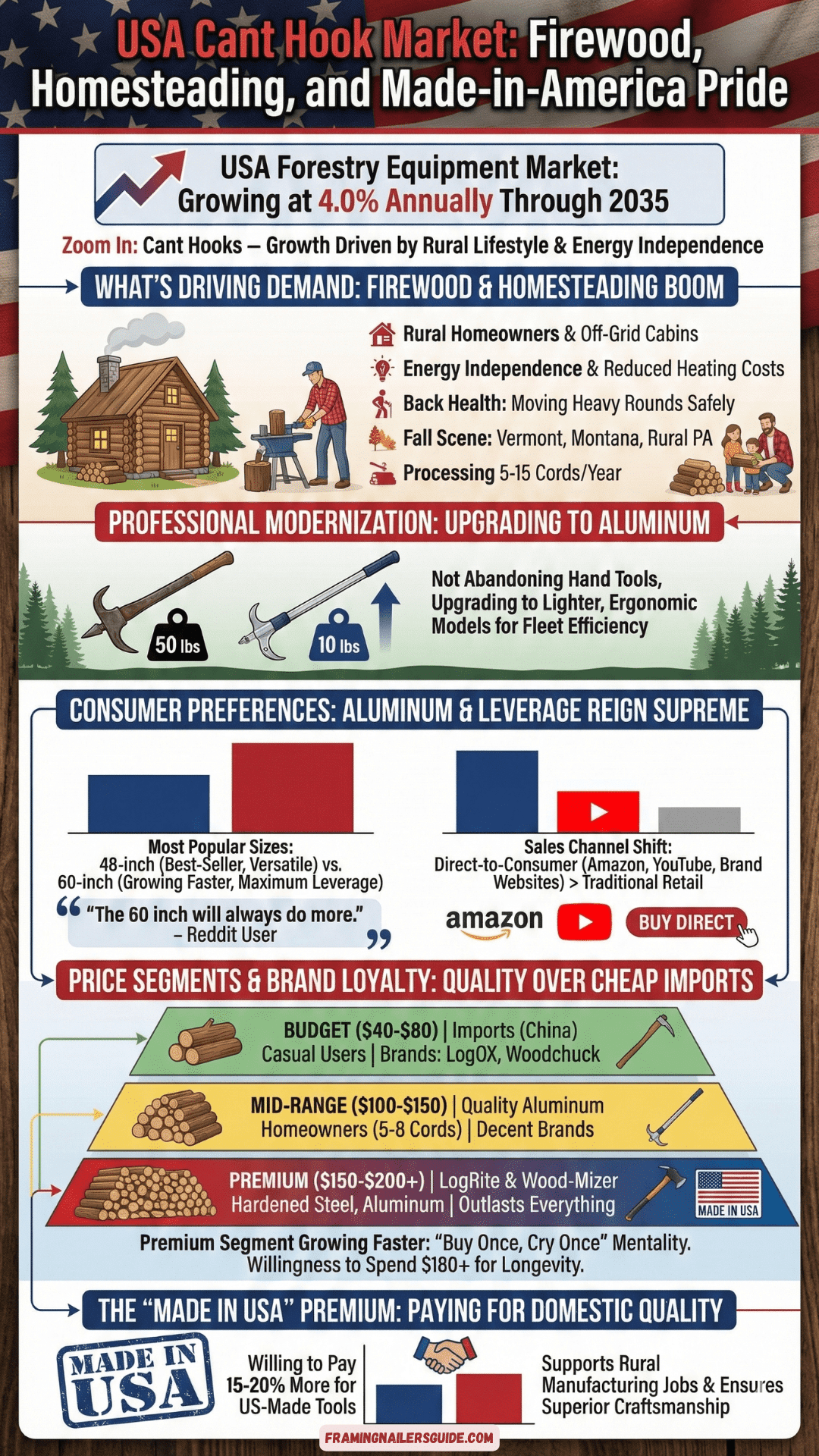
The USA forestry equipment market is growing at 4.0% annually through 2035. That’s steady but not spectacular compared to emerging markets. But when you zoom in on cant hooks specifically, there’s more happening beneath the surface.
What’s Driving Demand
The firewood processing boom is real. I’m talking about rural homeowners, people building off-grid cabins, and suburban families trying to reduce heating costs by cutting their own wood.
Energy independence isn’t just a political talking point anymore—it’s showing up in tool sales.
Drive through Vermont, Montana, or rural Pennsylvania in the fall, and you’ll see log splitters, chainsaws, and cant hooks everywhere.
People are processing 5, 10, sometimes 15 cords a year. And they’re learning the hard way that trying to move oak rounds without the right tool destroys your back.
Professional logging operations are also modernizing, but they’re not abandoning hand tools. They’re upgrading to lighter aluminum models with better ergonomics.
Fleet modernization doesn’t mean going 100% mechanical—it means replacing that old 50-pound steel peavey with a 10-pound aluminum cant hook that does the job faster and safer.
Consumer Preferences
American buyers overwhelmingly prefer 48-inch and 60-inch aluminum cant hooks. The 48-inch is the best-seller because it balances versatility and leverage for logs in the 8-18 inch diameter range—which covers most firewood and small timber work.
But the 60-inch market is growing faster. Why? Leverage. As one Reddit user put it perfectly: “The 60″ will always do more.” Older users, people with back issues, and anyone dealing with logs over 18 inches are choosing the longer handle because it reduces physical strain dramatically.
Direct-to-consumer sales are taking over. Amazon, manufacturer websites, and YouTube product reviews are driving purchasing decisions more than farm supply store recommendations.
People research online, watch how-to videos, read reviews, and buy direct. Traditional retail is still there, but it’s losing ground fast.
Price Segments and Brand Loyalty
The American market breaks into three clear tiers:
Budget segment ($40-$80): Imports, mostly from China. Brands like LogOX and Woodchuck. These work fine for casual users who move a few logs per season.
Mid-range ($100-$150): Quality aluminum construction, decent brands, good enough for most homeowners processing 5-8 cords annually.
Premium ($150-$200+): LogRite and Wood-Mizer dominate here. Both are made in the USA with hardened steel hooks, heat-treated components, and aluminum handles that outlast everything else.
Here’s what’s interesting: the premium segment is growing faster than budget. American buyers—especially those who’ve already bought and broken a cheap cant hook—are willing to spend $180 on a LogRite if it means buying once and keeping it for 20 years.
There’s also a “Made in USA” premium happening. Not massive, but real. People will pay 15-20% more for a domestic-made tool, especially in rural communities where manufacturing job losses have hit hard.
Canada Cant Hook Market: Forestry Tradition Meets E-Commerce Growth

Canada is a mature forestry market with deep roots in timber production, especially in British Columbia and Quebec. The cant hook market here shares similarities with the USA but with some unique characteristics worth noting.
Market Landscape
Cross-border e-commerce is changing everything. According to recent data, 62% of Canadians now buy products internationally, and 40% of e-commerce happens on mobile devices.
That means Canadian buyers aren’t just shopping domestically—they’re ordering LogRite cant hooks from US retailers, comparing prices across borders, and making purchasing decisions based on YouTube reviews from American creators.
This creates downward price pressure on Canadian retailers but also drives demand for quality tools. If you’re already paying for international shipping, you might as well get the best tool available.
M&A activity in Canada’s forestry and industrial sectors jumped significantly in Q3 2025, signaling industry consolidation and modernization efforts across the board. That trickles down to equipment purchasing—both at the professional and consumer level.
Regional Demand Patterns
Western Canada (British Columbia, Alberta): Professional logging operations dominate. These buyers need cant hooks and peaveys for sawmill work, log staging, and handling material in rugged terrain. Preference skews toward 60-inch models and peaveys with spikes for forest work.
Ontario and Quebec: More balanced mix. Professional forestry operations, yes, but also a huge DIY firewood market. French-speaking Quebec has its own distribution channels and brand preferences, but tool specifications remain similar to the rest of Canada.
Cold-weather considerations: This matters more than people realize. Aluminum handles don’t crack in sub-zero temperatures like wood can. Rubber grips stay somewhat pliable even when it’s -20°C. Canadian buyers care about this because they’re often using these tools in winter conditions.
Pricing and Availability
Pricing in Canada mirrors the USA, with one caveat: import duties and shipping.
A $150 USD LogRite cant hook might cost $180-200 CAD after conversion, shipping, and duties. That creates opportunity for Canadian-made alternatives, but honestly, the domestic manufacturing base is limited. Most quality tools are still imported from the USA.
Online retail is capturing 40% of tool sales, driven by mobile-first shopping behavior and the convenience of home delivery to rural areas. Farm supply stores still exist, but younger buyers (and even older ones now) are comfortable ordering a cant hook online and having it show up at their door.
UK Cant Hook Market: Rewilding, Scotland Timber, and Carbon Credits

The UK forestry equipment market is growing at 4.5% annually—slightly faster than the USA—driven by rewilding programs, Scotland’s timber modernization efforts, and carbon credit-linked forest expansion.
This is a smaller market in absolute terms, but it’s evolving in interesting ways.
Market Drivers
Rewilding is no longer fringe. Large estates, conservation organizations, and even some government programs are actively replanting forests and restoring degraded land. That creates demand for forestry equipment—including manual tools for precision work in sensitive areas where heavy machinery can’t go.
Scotland’s timber industry is modernizing. After decades of underinvestment, Scottish forestry operations are upgrading equipment, improving sustainability certifications, and expanding production. That means new tool purchases at both the professional and small-operator level.
Carbon credits are changing procurement behavior. Companies investing in forest management for carbon offset programs need equipment, and they’re buying quality tools that meet sustainability standards and last for years.
Consumer Preferences
Metric sizing matters. British buyers think in centimeters and meters, not inches and feet. A 48-inch cant hook gets marketed as “122cm,” and a 60-inch model becomes “152cm.” Small detail, but it affects marketing and product listings.
Forest Master Log Jack is a uniquely UK innovation gaining traction. It’s a cant hook/log lifter hybrid that combines multiple functions into one tool. British buyers—especially those with smaller properties and limited storage—love multi-functional equipment.
Lightweight aluminum is emphasized more in the UK than elsewhere. Why? The workforce is aging. British forestry workers are older on average than their North American counterparts, and ergonomic, lightweight tools reduce injury risk and extend working years.
Distribution Channels
Traditional farm supply stores still dominate, but online sales are growing. British buyers tend to be more cautious about online tool purchases than Americans—they prefer seeing and handling equipment before buying. But that’s changing, especially among younger users.
EU regulations still influence product standards even post-Brexit. Safety certifications, material standards, and environmental regulations shape what gets sold in the UK market.
Pricing (2026 Estimates)
- Budget: £35-£60 (imports, basic steel construction)
- Mid-range: £85-£130 (quality aluminum, reliable brands)
- Premium: £140-£180+ (LogRite imports, Forest Master premium models)
Price sensitivity is higher in the UK than North America. VAT adds 20% to every purchase, and disposable income for rural/forestry workers hasn’t kept pace with inflation. That pushes some buyers toward mid-range options instead of premium.
China Cant Hook Market: Reforestation at Scale and Export Manufacturing
Here’s where things get really interesting.
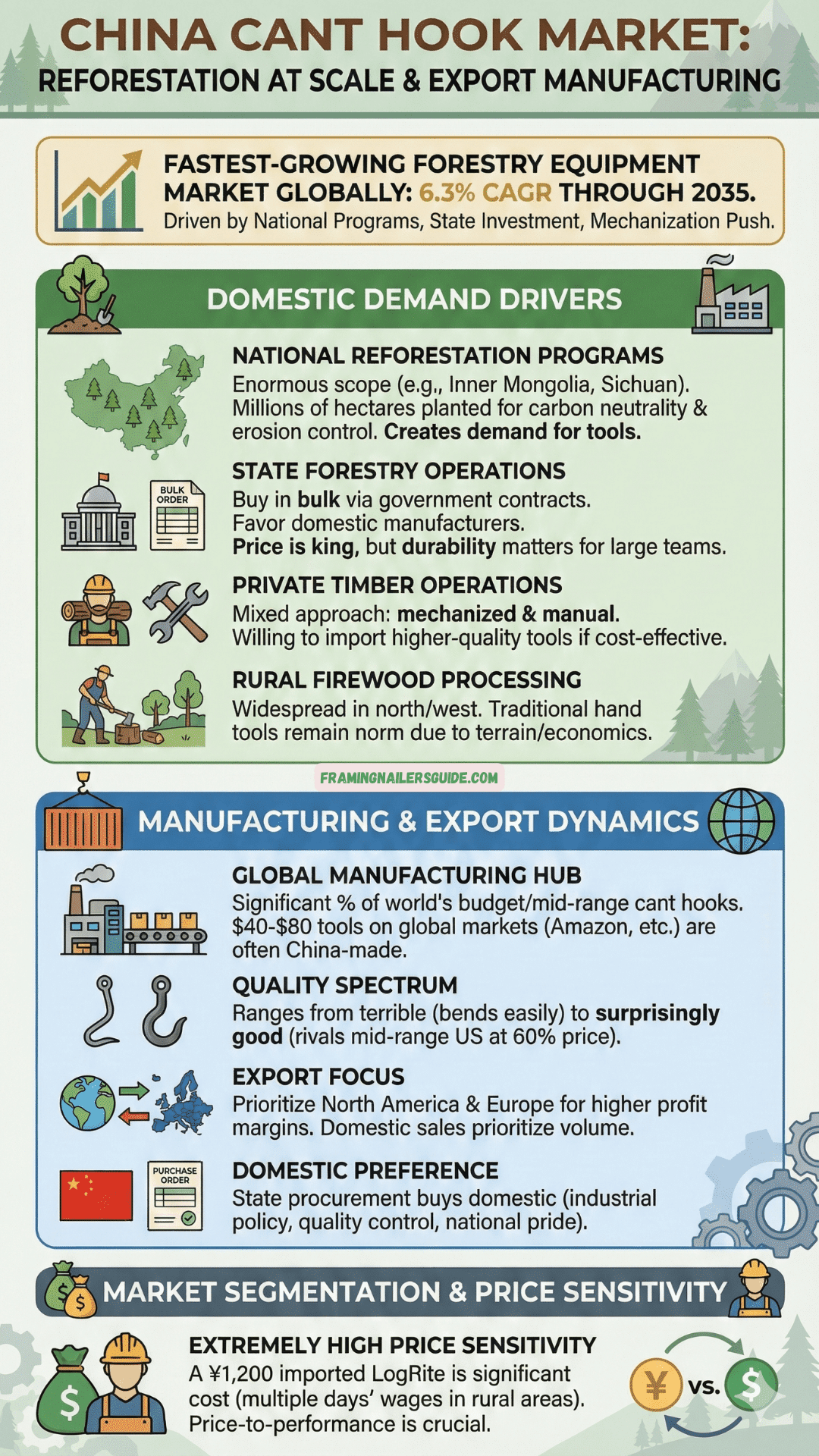
China has the fastest-growing forestry equipment market globally: 6.3% CAGR through 2035. That’s 50% faster than the USA and driven by massive national reforestation programs, state investment in forest management, and a push toward mechanization across rural industries.
But China is also a major manufacturer of cant hooks and peaveys for export. So you have to think about this market in two parts: domestic consumption and global supply chain.
Domestic Demand Drivers
National reforestation programs are enormous in scope. Provinces like Inner Mongolia, Sichuan, and Heilongjiang are planting millions of hectares of new forest as part of China’s carbon neutrality goals and erosion control efforts.
That creates demand for forestry equipment at every level—from massive harvesters down to hand tools for planting, maintenance, and selective harvesting.
State forestry operations buy in bulk. Government contracts for equipment procurement favor domestic manufacturers, which means Chinese-made cant hooks and peaveys dominate this segment. Price is king. Durability matters, but cost per unit matters more when you’re outfitting hundreds of forestry teams.
Private timber operations use a mixed approach—mechanized harvesting where possible, manual tools for everything else. These buyers are more willing to import higher-quality tools if the price-to-performance ratio makes sense.
Rural firewood processing is still widespread in northern and western China. Traditional hand tools remain the norm because mechanization hasn’t reached these areas yet—and may never fully replace manual methods given the terrain and economics.
Manufacturing and Export Dynamics
China manufactures a significant percentage of the world’s budget and mid-range cant hooks. Those $40-$80 tools flooding Amazon and farm supply stores in North America? Many are made in China.
Quality ranges from terrible to surprisingly good. The best Chinese-made tools rival mid-range American products at 60% of the price. The worst bend on first use.
Export brands focus on North America and Europe because that’s where the profit margins are. Domestic sales in China prioritize volume over margin.
Domestic preference for Chinese tools in government procurement: When the state is buying, they buy domestic. It’s part industrial policy, part quality control (easier to manage warranties and replacements), and part national pride.
Market Segmentation
| Segment | Tool Type | Price Range (CNY) | Buyer Profile |
|---|---|---|---|
| State forestry | Basic steel peaveys/cant hooks | ¥200-¥400 | Bulk government contracts |
| Private operations | Mixed quality, aluminum & steel | ¥500-¥800 | Cost-conscious professionals |
| Premium/Import | LogRite, Wood-Mizer imports | ¥900-¥1,500+ | Quality-focused buyers, expats |
| Export market | Variable quality | Precision forestry tech, hybrid machinery adoption ¥300-¥1,000 | North American/European retailers |
Price sensitivity is extremely high. A ¥1,200 imported LogRite cant hook represents serious money for most Chinese forestry workers—equivalent to multiple days’ wages in rural areas.
Regional Market Comparison: What the Differences Tell Us
When you lay these four markets side by side, patterns emerge that go beyond simple growth percentages.
| Factor | USA | Canada | UK | China |
|---|---|---|---|---|
| Market Maturity | Mature | Mature | Mature | Rapidly Growing |
| Primary Use | Firewood, small sawmills | Professional logging, firewood | Rewilding, forestry | State reforestation |
| Growth Driver | DIY firewood boom | Forestry modernization | Rewilding, carbon credits | National reforestation |
| Material Preference | Aluminum | Aluminum | Aluminum | Steel (cost), some aluminum |
| Top Brands | LogRite, Wood-Mizer | LogRite, imports | Forest Master, imports | Domestic manufacturers |
| E-commerce Share | High | Growing (40%+) | Moderate | Mixed (urban high, rural low) |
| Price Sensitivity | LogRite, Wood-Mizer imports | ¥900-¥1,500+ | Quality-focused buyers, expats | |
| Preferred Length | Moderate | Moderate | High | Very High |
Mature markets (USA, Canada, UK) prioritize quality, durability, and ergonomics. Buyers in these regions are willing to pay more for tools that reduce injury risk and last decades. Brand loyalty is strong, especially for American-made products in North America.
China prioritizes scale, cost-effectiveness, and mechanization integration. Hand tools are important but viewed as transitional—useful now, but eventually to be replaced by machinery where possible. Exception: rural areas where mechanization isn’t economically viable.
All regions are seeing sustainability-driven growth, but it manifests differently. In the West, it’s carbon neutrality pledges and rewilding. In China, it’s state-directed reforestation and erosion control. Same macro trend, different execution.
Key Market Drivers Across All Four Regions
Certain forces are reshaping the cant hook market globally, regardless of regional differences.
Sustainability and Reforestation
The global push for carbon neutrality is real, and it’s driving forest management investment across continents.
In the UK, rewilding programs are bringing back native forests. In China, Inner Mongolia is being reforested to combat desertification. In North America, sustainable logging certifications are changing procurement standards for professional operations.
All of this creates demand for forestry equipment—including hand tools. You can’t run a sustainable forestry operation without the right tools to handle timber carefully and efficiently.
DIY and Homesteading Trends
This is huge in North America and growing in Europe.
Off-grid living, energy independence, and rural homesteading aren’t just lifestyle trends—they’re economic decisions. When heating oil costs $4+ per gallon, cutting your own firewood makes financial sense.
YouTube and social media have democratized forestry knowledge. Ten years ago, if you wanted to learn how to process firewood efficiently, you needed a neighbor or family member to teach you. Now you watch a 15-minute YouTube video, order a cant hook on Amazon, and you’re rolling 24-inch oak rounds like a pro within a weekend.
That’s driving retail demand for quality hand tools in ways that traditional farm supply stores didn’t anticipate.
Aging Workforce and Ergonomics
Forestry work is physically demanding, and the workforce is aging in mature markets.
Lightweight aluminum cant hooks aren’t just nice to have—they’re essential for keeping older workers productive and reducing injury rates.
A 60-year-old logger can still roll logs effectively with a 10-pound aluminum cant hook. Ask that same person to use a 15-pound steel peavey for eight hours, and you’re looking at back injuries, fatigue, and lost productivity.
Tools are being marketed explicitly toward older, safety-conscious users. Ergonomic grips, reduced weight, better leverage—these aren’t luxury features anymore. They’re requirements.
E-Commerce and Direct Sales
The shift from physical retail to online sales is accelerating everywhere except the most rural parts of China.
In Canada, 40% of e-commerce is now mobile-driven, and cross-border purchases are growing. In the USA, Amazon is often the first place people look for cant hooks. In the UK, online forestry equipment retailers are gaining market share from traditional farm supply stores.
Manufacturers are responding with direct-to-consumer models. LogRite and Wood-Mizer both sell directly through their websites, cutting out distributors and offering better prices.
This changes everything about how tools are discovered, researched, purchased, and reviewed. Brand reputation now lives in Amazon star ratings and YouTube comments as much as it does in word-of-mouth recommendations at the local hardware store.
Price Trends and Consumer Spending Patterns
Let’s talk real numbers.
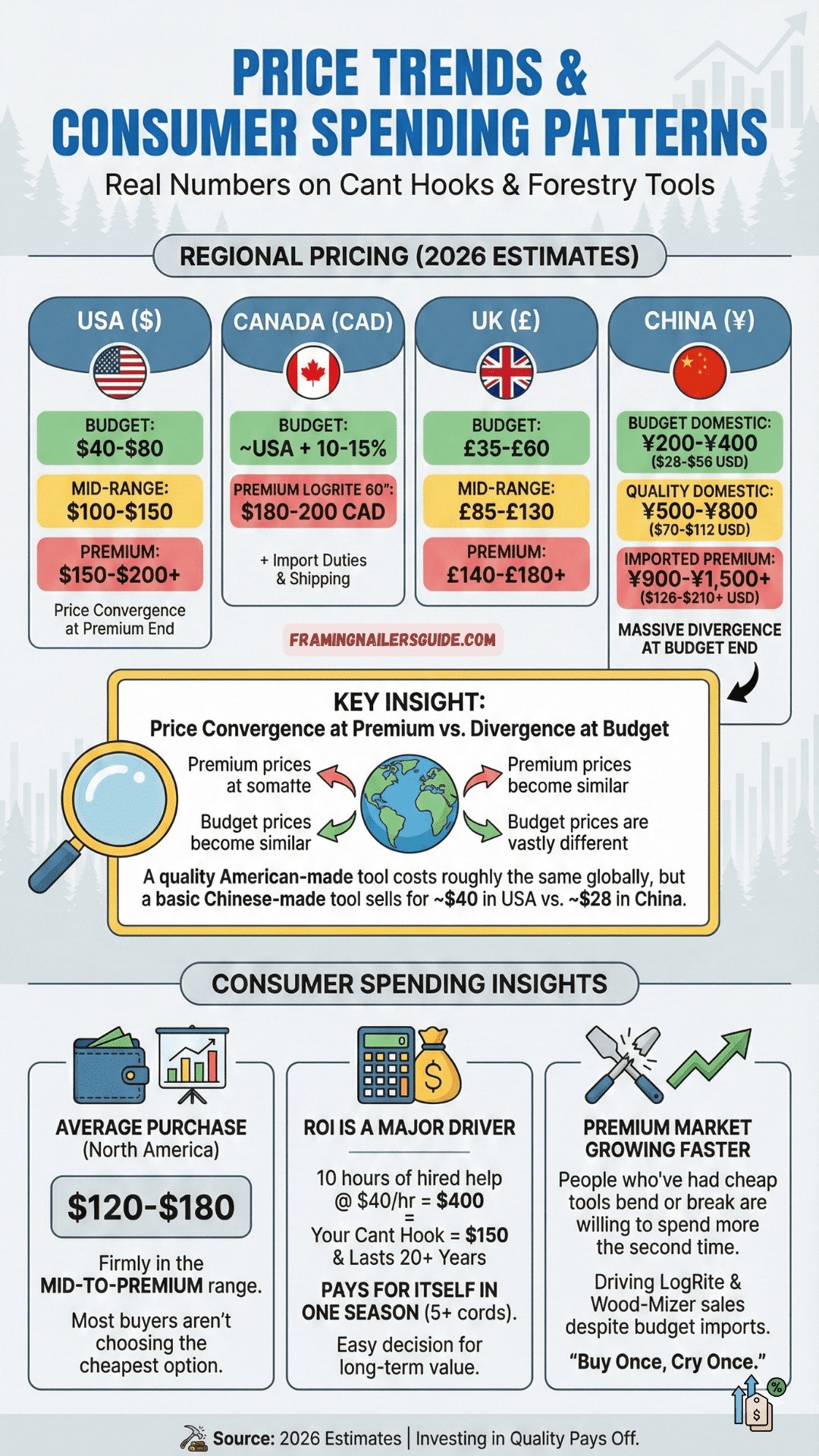
Regional Pricing (2026 Estimates)
USA:
- Budget: $40-$80
- Mid-range: $100-$150
- Premium: $150-$200+
Canada:
- Similar to USA pricing + 10-15% for import duties/shipping
- Premium LogRite 60″: $180-200 CAD
UK:
- Budget: £35-£60
- Mid-range: £85-£130
- Premium: £140-£180+
China:
- Budget domestic: ¥200-¥400 ($28-$56 USD)
- Quality domestic: ¥500-¥800 ($70-$112 USD)
- Imported premium: ¥900-¥1,500+ ($126-$210+ USD)
What jumps out? Price convergence at the premium end but massive divergence at the budget end.
A quality American-made cant hook costs roughly the same everywhere (accounting for currency and import costs). But a basic Chinese-made tool sells for $40 in the USA and ¥200 ($28) in China.
Consumer Spending Insights
The average cant hook purchase in North America is $120-$180. That’s firmly in the mid-to-premium range, which tells you most buyers aren’t going for the cheapest option.
ROI is a major driver. A $150 cant hook pays for itself in one season if you’re processing 5+ cords of firewood and you’d otherwise pay someone $30-50/hour to help you move logs.
Run that math: 10 hours of hired help at $40/hour = $400. Your cant hook costs $150 and lasts 20+ years. Easy decision.
The premium market is growing faster than budget. People who’ve bought cheap tools and had them bend or break are willing to spend more the second time. That’s driving LogRite and Wood-Mizer sales even as budget imports flood the market.
Top Brands by Region: Who’s Winning and Why
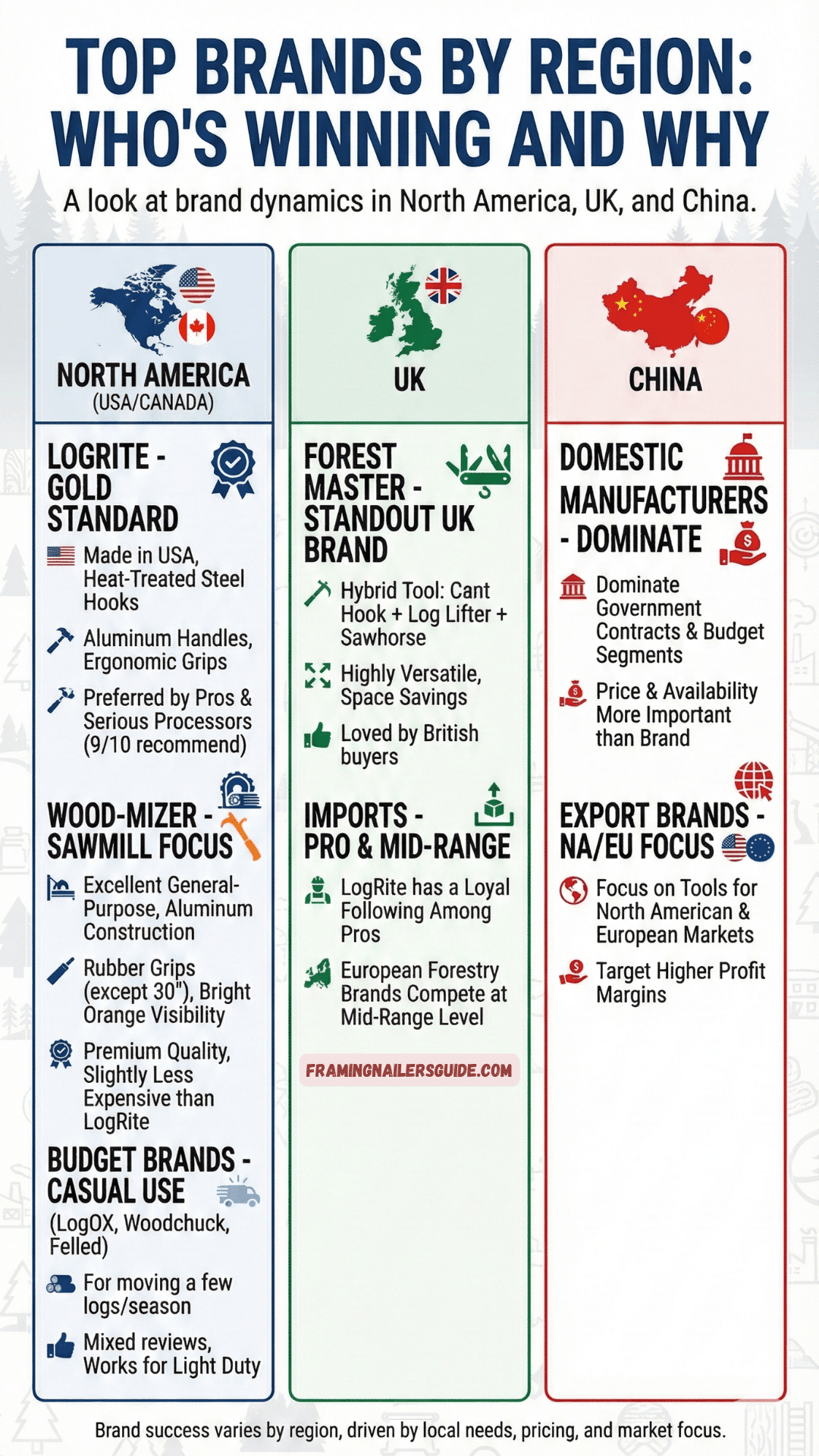
Brand dynamics vary significantly by region.
North America (USA/Canada)
LogRite is the gold standard. Made in the USA, heat-treated steel hooks, aluminum handles, ergonomic grips. If you ask a professional logger or serious firewood processor what to buy, they’ll say LogRite nine times out of ten.
Wood-Mizer focuses on the sawmill market but makes excellent general-purpose cant hooks. Aluminum construction, rubber grips (except on the 30″ model), bright orange paint for visibility. Slightly less expensive than LogRite but still premium quality.
Budget brands (LogOX, Woodchuck, Felled) serve casual users who move a few logs per season. Mixed reviews, but they work for light duty.
UK
Forest Master is the standout UK brand, especially with their log jack hybrid tool that combines cant hook, log lifter, and sawhorse functions into one. British buyers love the versatility and space savings.
Imports fill the rest of the market. LogRite has a loyal following among UK pros who want the best. European forestry brands compete at the mid-range level.
China
Domestic manufacturers dominate government contracts and budget segments. Brands are less important than price and availability in most cases.
Export brands focus on producing tools for North American and European markets, where profit margins are higher.
Future Market Projections: 2026-2030 and Beyond
Let’s look forward.
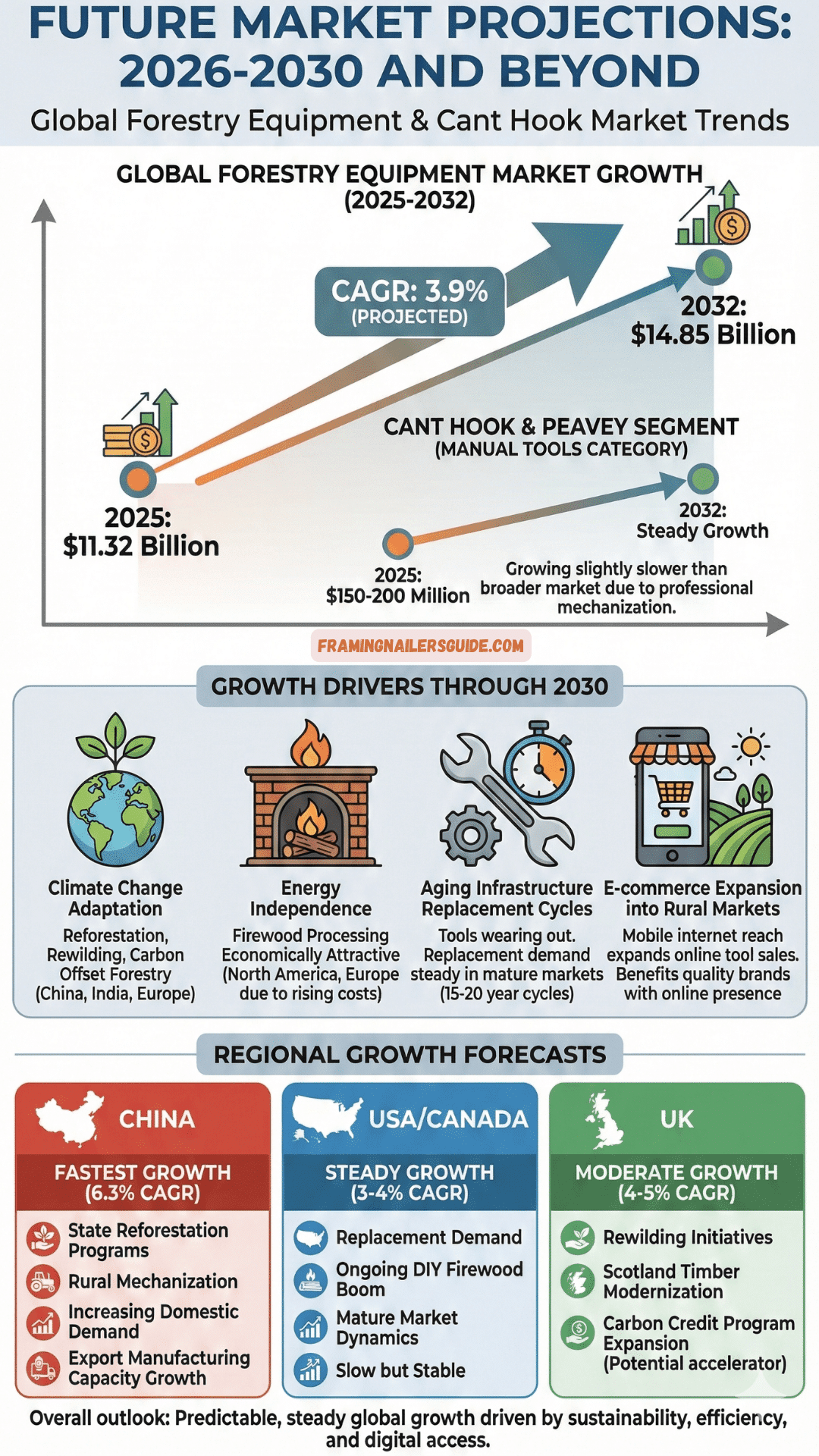
The global forestry equipment market is projected to grow from $11.32 billion (2025) to $14.85 billion by 2032. That’s steady, predictable growth driven by mechanization, sustainability, and infrastructure investment.
The cant hook and peavey segment—estimated at $150-200 million globally within the manual tools category—will grow roughly in line with the broader market, maybe slightly slower as mechanization continues in professional logging.
Growth Drivers Through 2030
Climate change adaptation: Reforestation programs, rewilding, and carbon offset forestry will continue expanding, especially in China, India, and Europe.
Energy independence: Rising energy costs make firewood processing economically attractive in North America and parts of Europe. As long as heating fuel stays expensive, people will keep cutting their own wood.
Aging infrastructure replacement cycles: Tools wear out. The wave of cant hooks sold 15-20 years ago are reaching end-of-life. Replacement demand will stay steady in mature markets.
E-commerce expansion into rural markets: As mobile internet reaches more rural areas globally, online tool sales will keep growing. That benefits quality brands with strong online presence and customer reviews.
Regional Growth Forecasts
China: Fastest growth (6.3% CAGR) driven by state reforestation programs and rural mechanization. Domestic demand will keep climbing, but so will export manufacturing capacity.
USA/Canada: Steady 3-4% growth, driven mostly by replacement demand and the ongoing DIY firewood boom. Mature market dynamics—slow but stable.
UK: Moderate 4-5% growth tied directly to rewilding initiatives and Scotland timber modernization. If carbon credit programs expand significantly, growth could accelerate.
Frequently Asked Questions
Q1: What is the global cant hook market size in 2026?
The broader forestry equipment market is valued at $11.32 billion in 2025, projected to reach $14.85 billion by 2032. Manual hand tools like cant hooks and peaveys represent an estimated $150-200 million segment globally—a small but stable portion of the overall market.
Q2: Which country has the fastest-growing cant hook market?
China leads with a 6.3% CAGR in forestry equipment (2025-2035), driven by massive national reforestation programs in Inner Mongolia, Sichuan, and Heilongjiang provinces, plus state investment in forest management infrastructure.
Q3: Are cant hook sales growing in the USA?
Yes. USA forestry equipment is growing at 4.0% CAGR, with cant hooks benefiting specifically from the DIY firewood processing boom, homesteading trends, and sustainable logging certification requirements driving equipment upgrades.
Q4: What’s driving cant hook demand in the UK?
Rewilding programs across Scotland and England, Scotland’s timber industry modernization efforts, and carbon credit-linked forest expansion are fueling 4.5% annual growth in forestry equipment.
Q5: How much does a quality cant hook cost in 2026?
Prices vary by region:
- USA/Canada: $100-$200 for quality aluminum models (LogRite, Wood-Mizer)
- UK: £85-£180 depending on brand and features
- China: ¥500-¥1,500 depending on domestic vs imported premium brands
Q6: Are aluminum cant hooks better than steel?
Yes, for most users. Aluminum is lighter (8-10 lbs vs 13+ lbs for steel), won’t rust or corrode, and doesn’t crack in extreme cold like wood handles can. Brands like LogRite and Wood-Mizer use hardened aluminum that’s as strong as steel but with significant weight savings that reduce user fatigue.
Q7: What size cant hook is most popular globally?
The 48-inch model is the global best-seller, balancing versatility and leverage for logs 8-18 inches in diameter—the sweet spot for firewood processing and general sawmill work. The 60-inch is growing faster among users dealing with larger logs or those with back issues who need extra leverage.
Q8: Is the cant hook market shifting to e-commerce?
Absolutely. In Canada, 40% of e-commerce is now mobile-driven, and 62% of Canadians buy products internationally. The USA and UK are showing similar trends, with Amazon, manufacturer websites, and online forestry retailers capturing increasing market share from traditional farm supply stores.
Q9: What’s the ROI on buying a cant hook vs hiring labor?
A $150 cant hook pays for itself in one season if you process 5+ cords of firewood annually. If you’d otherwise pay $30-50/hour for help moving logs, even just 10 hours of hired labor costs $300-500—double or triple the tool cost. The cant hook lasts 20+ years with basic maintenance.
Q10: Which brands dominate the North American cant hook market?
LogRite and Wood-Mizer lead the premium segment with USA-made, professional-grade tools featuring heat-treated steel hooks and aluminum handles. Budget brands like LogOX and Woodchuck serve casual users, but the premium segment is growing faster as buyers prioritize quality and longevity.
Wrapping It Up: What This All Means
The global cant hook market in 2026 is tied directly to broader forestry equipment growth—ranging from 3.9% to 6.3% CAGR depending on region.
Regional winners: China has the fastest growth trajectory (6.3% CAGR) driven by state programs and infrastructure investment. USA and Canada represent the largest mature markets with steady replacement demand and DIY firewood boom driving retail sales. The UK is seeing sustainability-driven growth through rewilding and carbon credit forestry programs.
Consumer trends reshaping the market:
- Aluminum over steel (lighter, more ergonomic, doesn’t rust)
- 48″ and 60″ lengths dominating sales globally
- Premium quality preference growing faster than budget segment
- E-commerce and direct-to-consumer sales replacing traditional retail
- Mobile-first shopping behavior, especially in Canada and USA
Looking ahead through 2030: Sustainable forestry practices, DIY firewood processing economics, and aging workforce ergonomics will continue driving demand across all four regions. The tools themselves haven’t changed much in 100 years—but how people buy them, what materials they’re made from, and why people need them is evolving fast.
If you’re in the market for a cant hook, check out our detailed buying guide covering brand comparisons, sizing recommendations, and hands-on reviews of top models from LogRite, Wood-Mizer, and Forest Master.
