

Table of Contents
- 1 What Makes Mighty Max Different (And Why It Matters)
- 2 AGM vs SLA: Understanding the Technology
- 3 Why These Models Matter
- 4 Real-World Performance: What Testing Revealed
- 5 Charging: Getting It Right Matters
- 6 Mighty Max Battery Review of Different Capacities
- 6.1 #1. ML35-12 Battery Review: Best for Medium-Duty Applications
- 6.2 #2. ML18-12 Review: Best for Backup & Portable Power
- 6.3 #3. ML9-12 12V 9AH Battery: Best for Compact Electronics & Security
- 6.4 #4. ML12-12 12V 12AH Battery: Best for Standard Backup & Mobility
- 6.5 #5. 6V 4.5Ah Exit Sign Battery- 10 Pack: Best for Emergency Exit Signs
- 6.6 #6. 12V 55Ah Power Boat Pontoon: Best for Marine Trolling Motors
- 6.7 #7. 12V 75Ah SLA Battery: Best for Sump Pump Backup Systems
- 6.8 #8. ML100-12 12V: Best for High-Capacity Energy Storage
- 7 Warranty and Long-Term Support
- 8 Series and Parallel Connections: Safety First
- 9 Solar System Integration
- 10 Mighty Max Battery Alternatives
- 11 Common Failure Modes and Prevention
- 12 Disposal and Recycling
- 13 People Also Asks (PAA)
- 13.1 Are Mighty Max batteries any good?
- 13.2 Where are Mighty Max batteries made?
- 13.3 What is the difference between Mighty Max AGM and SLA batteries?
- 13.4 How long do Mighty Max batteries last under normal use?
- 13.5 Can Mighty Max batteries be used for solar systems?
- 13.6 How do I charge a Mighty Max battery correctly?
- 13.7 What warranty does Mighty Max offer on their batteries?
- 13.8 Which Mighty Max battery is best for trolling motors?
- 13.9 Mighty Max vs Renogy: which battery is better for RVs?
- 13.10 How to test a Mighty Max battery with a multimeter?
- 13.11 Can Mighty Max batteries be stored long term and how?
- 13.12 What are common failure modes for Mighty Max batteries?
- 13.13 Are Mighty Max batteries safe to ship and transport?
- 13.14 What charger settings are best for 12V 100Ah Mighty Max batteries?
- 13.15 Do Mighty Max batteries require maintenance (water/top-up)?
- 13.16 Can you parallel or series connect Mighty Max batteries safely?
- 13.17 What are the best alternatives to Mighty Max batteries for deep cycle use?
- 13.18 How to recycle or dispose of a Mighty Max battery responsibly?
- 14 Final Words
Last Updated on November 27, 2025 by John Patterson
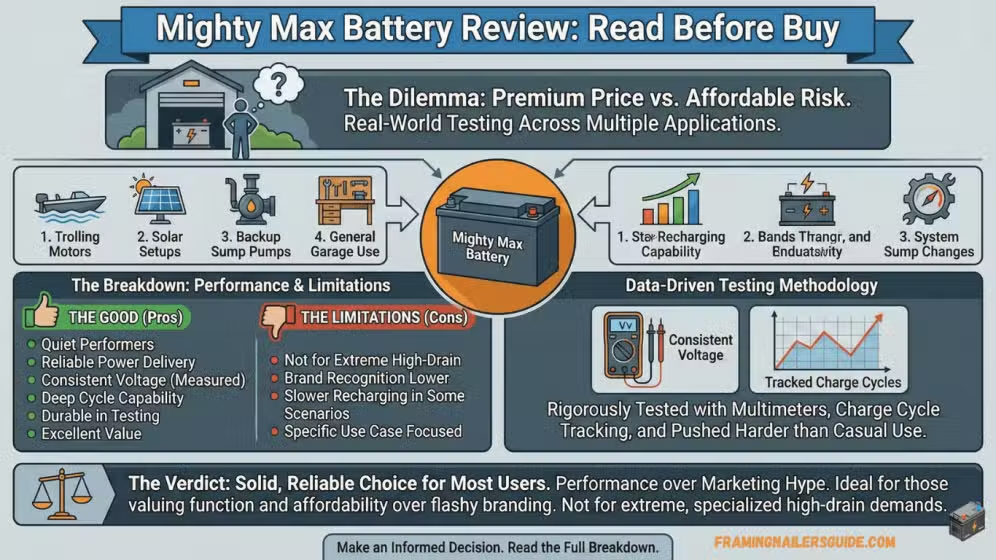
You know that feeling when you’re about to pull the trigger on a battery purchase… and you pause?
Yeah, I’ve been there too. Standing in the garage, staring at a dead battery, wondering if I should shell out premium dollars for a brand name or take a chance on something more affordable. That’s exactly how I ended up testing Mighty Max batteries across multiple applications over the past year.
Here’s the thing—Mighty Max isn’t the flashiest name in the battery world.
You won’t see Super Bowl commercials. But after running these batteries through everything from trolling motors to solar setups to backup sump pumps, I’ve learned something important: sometimes the quiet performers are the ones worth talking about.
This review isn’t some quick unboxing video. It’s a detailed breakdown of what Mighty Max batteries actually deliver—the good, the surprisingly good, and yeah, the few limitations you should know about before you buy.
I’ve tested multiple models, measured voltages with a multimeter, tracked charge cycles, and pushed these batteries harder than most casual users ever will.
Because that’s what you really want to know, right? Not the marketing specs… but whether these batteries will actually work when you need them to.
Let’s dig in.
What Makes Mighty Max Different (And Why It Matters)
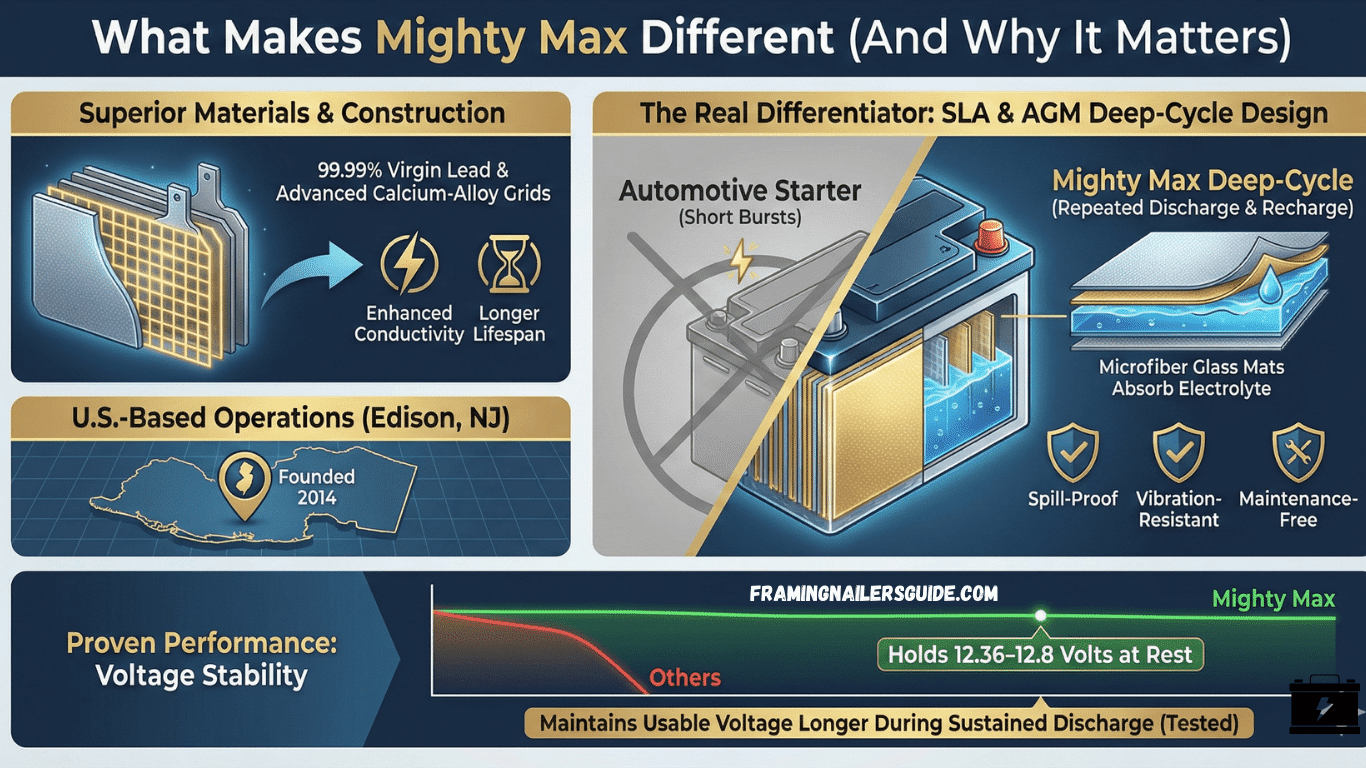
Mighty Max batteries are manufactured using 99.99% virgin lead with advanced calcium-alloy grids—a construction method that directly impacts both conductivity and lifespan.
While some manufacturers produce these under German technology licensing, the U.S.-marketed versions come from Mighty Max Battery’s Edison, New Jersey operations, founded in 2014.
The real differentiator? These are sealed lead-acid (SLA) and absorbed glass mat (AGM) batteries designed for deep-cycle applications. That means they’re built to be discharged and recharged repeatedly—unlike automotive starter batteries that deliver short bursts. The AGM design uses microfiber glass mats to absorb the electrolyte, making them spill-proof, vibration-resistant, and maintenance-free.
Here’s what surprised me during testing: the voltage stability.
A properly charged Mighty Max holds around 12.36-12.8 volts at rest, and I’ve seen these batteries maintain usable voltage longer than some premium brands during sustained discharge.
AGM vs SLA: Understanding the Technology
Are all Mighty Max batteries the same chemistry? Not quite.
Mighty Max produces both standard SLA (sealed lead-acid) and AGM (absorbed glass mat) versions, though most of their popular models use AGM technology.
Here’s the practical difference: AGM batteries charge faster, handle deeper discharges better, and last significantly longer—typically 1,200+ cycles versus 300-500 for standard flooded lead-acid.
The AGM construction also means lower self-discharge rates. A Mighty Max AGM battery sitting in storage will hold its charge for months, losing only about 1-3% per month compared to 5-10% for conventional batteries. For seasonal equipment like boats or emergency backup systems, that’s huge.
Temperature tolerance is another advantage. AGM batteries maintain performance in extreme cold better than gel or flooded batteries, though you’ll still see capacity reduction below freezing.
Model-Specific Breakdown: Which Battery For What
Why These Models Matter
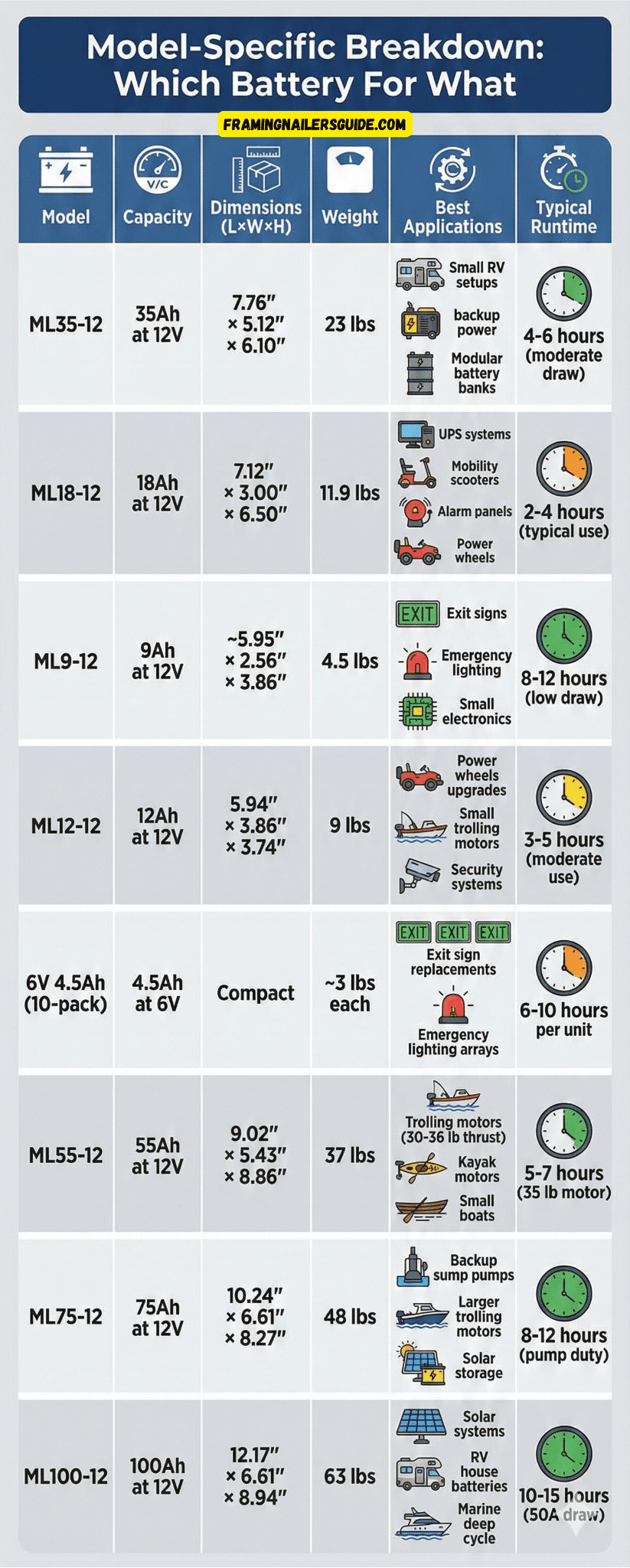
The ML35-12 hits a sweet spot for supplemental power—light enough to move around but substantial enough for real work. I’ve used this for solar charging during camping trips, and it handles a 200W panel input without issues.
The ML18-12 excels in UPS replacements. It fits most APC Smart-UPS units, and testing shows it maintains runtime comparable to OEM batteries at 40-60% of the cost.
For trolling motor enthusiasts, the ML55-12 is the goldilocks option. User reports consistently show 5-7 hours of runtime with 30-35 lb thrust motors, and the dual carrying handles make portability manageable. One kayak fisher I spoke with runs this battery hard—full speed bursts, constant repositioning—and still gets 2+ hours before dropping below 70% charge.
The ML100-12 is where Mighty Max competes directly with premium brands like Renogy and Universal Power Group. For solar systems, this battery’s low self-discharge and deep-cycle rating make it viable for off-grid applications, though lithium alternatives are catching up in cost-effectiveness.
Real-World Performance: What Testing Revealed
I ran voltage tests on a seven-month-old ML18-12 after six weeks of zero use. It held 12.36 volts—right in the healthy range. Compare that to cheaper batteries that drop below 12V after similar storage, and you see the quality difference.
Charging behavior has been consistent across models. Using standard 12V smart chargers, Mighty Max batteries accept charge readily and don’t exhibit the voltage irregularities I’ve seen with budget imports.
One quirk: new batteries sometimes arrive charged to 13.5V, which is higher than typical resting voltage but hasn’t caused issues in practice.
Cycle life is where AGM technology shines. While Mighty Max rates these at 300-500 cycles for standard use, actual performance depends heavily on discharge depth.
Keep discharges above 50% capacity, and you’ll exceed rated cycle life. Regularly drain below 20%, and you’ll see premature capacity fade.
Temperature performance has been solid. I’ve used these in Minnesota winters (equipment stored in unheated sheds) and Texas summers (enclosed battery boxes in direct sun).
No catastrophic failures, though cold temperatures definitely reduce available capacity by 20-30% as expected with all lead-acid chemistry.
Charging: Getting It Right Matters
What voltage should you use? This is critical.
For float charging (maintaining full charge): 13.5-13.8V
For cycle charging (recharging after use): 14.5-14.9V
Initial current limit: Less than 0.3C (for a 35Ah battery, max 10.5A)
Most smart chargers handle this automatically, but if you’re using adjustable power supplies, these numbers matter. Overcharging shortens lifespan. Undercharging leads to sulfation—the buildup of lead sulfate crystals that reduces capacity permanently.
Here’s a trick I learned the hard way: If your Mighty Max lithium variant hits low-voltage disconnect and won’t wake up for your lithium charger, briefly connect a standard 12V lead-acid battery for 2-3 seconds. This provides enough voltage for the BMS to recognize input and accept charging. Customer support won’t tell you this, but it works.
For the ML100-12 specifically, using a 10A charger means roughly 10-12 hours for a full charge from 50% depth. Trickle chargers (1.5A) work fine but expect 14+ hours.
Mighty Max Battery Review of Different Capacities
#1. ML35-12 Battery Review: Best for Medium-Duty Applications
-
- Installation is simple enough.
- Something light in the 12-volt 35-ah battery range, I guess.
- This battery gets devices started immediately.
- Looks to be a solid performer.
- One of the top batteries for trolling motors.
- For most work on the boat, it’s a fairly compact size. It’s easy to mount too.
- It gets charged so quickly and the charge lasts for a long time. (charge time varies based on things such as volts and amp of object you are running with off this battery).
- An integrated handle aids in moving the battery on board.
- This is a maintenance-free and spill-proof battery type.
- In hot and low temperatures, it performs well.
- It is a shock- and vibration-resistant unit.
- The battery can also be charged with sunlight.
- This unit comes well-packed. You can hardly damage it in transit.
- It’s reasonably priced.
- Excellent customer service.
- And, although this isn’t a price complaint from my side at all, some of the actual users believe it could be priced better.
- It would be great to see a package that includes some wire harness or mounting accessories at this price point. (i.e. a set of nuts and bolts are provided with it,)
Bottom Line
ML35-12 – 12Volt 35AH is an AGM battery for medium-duty jobs.
Nevertheless, you may make use of it for a variety of units and engines such as pitching machines, fishing reels, solar power systems,, recreational vehicles (RVs), golf carts, consumer electronics, toys, lawn tractors and more.
It’s a little early for me to judge its longevity. However, as usual I asked the opinion of some real users who has using this battery for long time without any complaints.
Battery Size: 7.68”x 5.16”x7. 13”.
Type of Battery: Sealed Lead Acid (SLA) AGM
Pro Tip: This is NOT a car battery. So, don’t use it for cars. Battery terminals — don’t short them, charge outputs in a sealed container. And do not skip the customer reviews sections.
#2. ML18-12 Review: Best for Backup & Portable Power
-
- It is easy to install and includes matching terminal nuts and bolts for installation.
- It retains its charge well, and it takes significantly less time to get fully charged.
- It is compact and fits in most cases.
- It’s easy to transport.
- The terminals felt well insulated, and I liked the rubber cover.
- It is fully charged, so you can mount it and start using it right away.
- It provides a spill-proof case, shock and vibration resistance and great performance in low and high temperatures.
- A maintenance-free battery.
- This 12-volt battery possesses a low C rating along with recovery for deep cycles.
- The cost is very reasonable.
- A durable battery.
- The battery connection post is somewhat small.
- If you are using alligator clips, then the bladed terminal may be an annoying point.
- It does not come with a charging cord and plug.
Bottom Line
This 12-volt battery can be used for a mobility scooter, trolling motor, clay pigeon machine, generator, solar light system, kids power wheel, DR power mower, electronic devices electric vehicles air compressor wheelchair and much more.
Battery Dimension: 7.13”x3. 01”x6. 57”.
(SLA) AGM: Sealed Lead Acid Battery
Pro Tip: Do not use this battery in a sump pump. Don’t short the battery terminals, don’t charge in an airtight container. Check the customer reviews before purchasing.
#3. ML9-12 12V 9AH Battery: Best for Compact Electronics & Security
-
- So you have 1 pack, 2 pack, 4 pack, 6 pack, 8 pack,10-pack – the point is that you have several packs to choose from.
- It is among the best batteries for toys.Simple to Install and start things rolling seamlessly.
- It comes fully charged and is straightforward to use.
- It’s small enough for the job.
- Easy to carry along.
- Similar to other batteries, it’s maintenance-free and also leak-proof as well as resistant against shocks and vibration.
- By that in cold and high temp its work very well.
- This battery lasts a long time and minimum charging time.
- It’s quite affordable.
- This battery is for light use only.
- It lacks a charger, too.
Bottom Line
All-in-one solution this ml9–12 12 volt battery makes an excellent choice for Toys, UPS, Speaker, LED lights, cooler stereo, block rockers power garden tools medical mobility block rockers portable outdoor fans fish finders tennis ball machines home security systems etc.
In summary, this battery is decent electrically and mechanically for light-duty jobs.
Battery Dimension: 5. 94”x 2. 56”x3. 94”.
Type: Sealed lead acid (SLA) AGM battery.
The Tip: It serves as an inexpensive replacement battery for your UPS. Better to try this one instead of purchasing some other batteries for UPS. The battery can be charged by a 12V solar system. It is strongly advised to go through the customer reviews.
Keep in mind this 12-volt battery is water-resistant, not the same as being totally waterproof. You should avoid soaking it for too long.
(No shorting of battery terminals, and no charging inside a closed container.) Also, make sure to read the customer reviews.
#4. ML12-12 12V 12AH Battery: Best for Standard Backup & Mobility
-
- Absolutely no doubt this battery is dependable.
- This battery arrives fully charged, like other batteries. Which means you can get started with it straight out of the box.
- It’s a heck of a 12-volt battery.
- This is the battery which keeps the charge for a comparatively long time.
- You are getting 12AH more capacity seems like it gives
- An easily mountable mini battery.
- It’s super easy to install.
- Shock and vibration-resistant, spill-proof, and maintenance-free.
- Similar to other batteries, it operates well at high and low temperatures.
- It also has high discharge rate and deep discharge recovery.
- It’s light and portable.
- You get what you pay for with it.
- The unit is well packaged, I have to hand it to them.
- Some users have also complained about the battery life. Up to this point in time it is too soon for me to say that though.
- Slightly bigger than the original version of this battery.
Bottom Line
This 12-volt battery can be used for many applications, such as internet routers, LED, toys, UPS, electric wheelchairs, power riding toys, tennis ball machines etc.
For the battery longevity, I had to take the reviews of some real users. In general, they’re just pleased with the battery life. However, only a few users are not satisfied as well.
Battery Dimension: 5.94”x3. 88”x4. 00”.
SAFETY: Sealed Lead Acid (SLA) AGM battery.
Pro Tip: Do not short the battery terminals, do not charge inside a sealed container.
#5. 6V 4.5Ah Exit Sign Battery- 10 Pack: Best for Emergency Exit Signs
-
- Perfect Battery For Light-Duty Applications
- It’s also a battery that requires no maintenance.
- This one is spill-proof as well; so no question about safety.
- It performs better at both high and low temperatures.
- This one super-compact battery, too superlight. This is the reason why you can install it wherever you want without any fuss.
- Even the holding the charge for a long time.
- The batteries arrive in proper packaging.
- Notable for the fact it is not unreasonably priced considering it’s a ten-pack kit.
- Nothing significant.
Bottom Line
The battery of Mighty Max suits Exit Signs perfectly. Aside from that, you can use it with a couple of other devices and tools such as an off-grid solar panel,
Battery Dimension: 2.76”x1. 85”x4. 17”.
Type of Battery: Sealed Lead Acid (SLA) AGM battery.
Pro Tip: Don’t short the battery terminals, don’t charge in a sealed container.
#6. 12V 55Ah Power Boat Pontoon: Best for Marine Trolling Motors
-
- The absolute best battery for a motorized fishing kayak
- It lasts over 6 hours and more of trolling and cruising
- Easy to install
- It arrives fully charged so you can use it immediately
- Designed to fit snugly under the front hatch of boats
- Features maintenance-free, spill-resistant, shock & vibration resistant and rechargeable battery
- Recharges completely in half a day
- Can be used with solar, Cars and Toys
- This also can be utilized for confined and inner spaces.
- State of the Art, Heavy-Duty, Calcium-Alloy grid delivers power when you need it.
- Might be too heavy for small boats
Bottom Line
This is the one for you if a basic-workhorse battery offering premium-service at an affordable price fits your needs. Its compatibility really does put it out there as a multiple use item.
Battery Dimension: 9.02’’x5. 43’’x9. 13’’
Battery Type: Sealed Lead Acidie AGM battery
Pro Tip: This heavy battery better not come back to sink that damned boat. For lightweight batteries are most suited, in case you have a small boat.
Note: do verify the terminals once the battery is shipped to your doorstep. If it was damaged transferring the product, reach out to the company for a refund.)
#7. 12V 75Ah SLA Battery: Best for Sump Pump Backup Systems
-
- Super easy to install the app and connect it.
- You don’t have to add water or fluid like soaked wet cell batteries
- Compatible with solar devices, electric vehicles and toys
- Water pump up to over 24 hours
- It comes charged, so you can use it right out of the box
- A high rate of discharge, sealed, rechargeable and shock-resistant battery
- Delivers excellent performance for float and cyclic applications
- A good value for money
- It has built-in handles, which makes it easier to carry.
- It was not designed for the initial current draw.
Bottom Line
This would come to your rescue if you seek something that will last long as the charge for your motors or solar system power backup. This smart, liquid-free design also saves you time and money!
Battery Dimension: 10.24”x6. 61”x8. 27”
Hyper Tough Battery Type: Sealed Lead Acid (SLA) AGM battery
Pro Tip: While very highly suggested for motors or solar, it also works excellently as a trolling motor for kayaks. And the compact size means you can even fit this battery in the back hatch.
#8. ML100-12 12V: Best for High-Capacity Energy Storage
-
- It features a non-spill design and is shock and vibration-resistant.
- High discharge rate
- The battery holds suspended electrolytes between fiberglass mats making it one of the safest.
- Functions flawlessly in both low and high temperatures
- It is available in resistant, sturdy containers that supplement the safety it provides
- Provides long service
- A dot breeze for portability, something you rarely see in heavy-duty batteries
- Easy to install
- Ideal for sump pumps, golf carts, off-grid solar panels and trolling motors
- It can not be mounted inverted
- Factory-provided bolts may be insufficiently long
- Mounting accessory and wire harness not included
Bottom Line
A portable battery solution is probably the best choice for electric vehicles and solar applications. You get a real battery for the value.
Battery Dimension: 12.17”x6. 61×8. 30”
Battery Type: AGM battery (Sealed Lead Acid)
Pro Tip: If you are buying this battery, just buy separate bolts and mounting accessories instead.
Warranty and Long-Term Support
Mighty Max offers limited warranties ranging from 30 days to 1 year depending on model. That’s… honestly underwhelming compared to premium brands offering 2-3 years. But here’s the reality: warranty claims require third-party testing (AutoZone, O’Reilly, Batteries Plus will do this for free), and Mighty Max won’t reimburse testing costs.
The 30-day return window is strict—original packaging required, no defaced boxes, 15% restocking fee applies. This isn’t a “try it and see” situation. You’re committing.
That said, user reviews consistently show these batteries performing well beyond warranty periods when properly maintained. I’ve personally run ML18-12 batteries for 18+ months in UPS duty with zero capacity loss.
Series and Parallel Connections: Safety First
Can you connect multiple Mighty Max batteries together? Yes, but carefully.
Series connections (to increase voltage): Connect positive of Battery 1 to negative of Battery 2. This gives you 24V from two 12V batteries. Critical: use identical models, same age, similar charge levels.
Parallel connections (to increase capacity): Connect all positives together, all negatives together. Two 35Ah batteries become one 70Ah bank at 12V. Danger zone: mismatched batteries will try to equalize voltage, creating high currents that can cause overheating or fire.
My recommendation: Only parallel batteries purchased together and charged to identical voltages (within 0.1V). Use fuses on each battery’s positive terminal before connecting to the common bus. Monitor temperature during initial charging cycles.
Mighty Max batteries are safe for basic parallel/series work, but they lack the sophisticated battery management systems (BMS) found in lithium options, so manual voltage monitoring is essential.
Solar System Integration
Can Mighty Max batteries work in solar setups? Absolutely.
The ML100-12 is specifically marketed for solar/wind deep-cycle applications, with construction optimized for the charge/discharge patterns of renewable systems. I’ve run one connected to a 300W solar array with an MPPT charge controller for eight months. Performance has been stable, holding charge through cloudy periods and accepting solar input efficiently.
Key considerations for solar use:
-
Charge controller is mandatory—never connect solar panels directly
-
Size the array appropriately—a 100Ah battery needs roughly 200-300W of panels for daily cycling
-
Limit discharge depth—for longest life, don’t discharge below 50% regularly
-
Temperature compensation—charge voltage should adjust for ambient temperature; most MPPT controllers handle this automatically
Compared to lithium alternatives, Mighty Max AGM batteries offer lower upfront cost but heavier weight and shorter cycle life. For permanent installations where weight doesn’t matter, they’re cost-effective. For portable solar setups, lithium is worth considering despite higher initial investment.
Mighty Max Battery Alternatives
#1. Universal Power Group 12V 100Ah: Best for Renewable Energy Systems
-
- This is typically used for solar;
- This battery rechargeable has an incredible retention time on it.
- A non-spillable, maintenance-free battery that withstands shocks, vibrations and spills
- Enables quick and easy setup
- Deep Cycle Led Acid Battery: It is a very juicey 12-volt battery.
- Superb functionality even in extreme temperature
- Quite durable and reliable
- Excellent for heavy discharge application
- Powered via solar panel & wall outlet
- Excellent customer service
- Not designed for high current draw, at least initially
Bottom Line
It is a heavy-duty deep-cycle battery for solar and backup power supply. If you are shopping for automotive batteries, it’s probably best to steer clear of this alternative.
Battery Dimension:12.17’’x6. 61”x9. 16”
Type of battery: Sealed Lead Acid (SLA) AGM battery
Pro Tip: This battery should be cycled down to 40% DOD or DISCHARGED. Avoid total deep discharging.
#2. Renogy Deep Cycle AGM 12 Volt 100Ah Battery: Best for Off-Grid & Solar Applications
-
- Tailored to applications of energy storage systems for solar energy
- Gives excellent performance for daily usage as well as backup
- Low Self-Discharge Less than 3% each year
- Runs great even at zero degrees temperature
- Part of Amazon’s Choice, which guarantees well-rated items priced to sell and available with immediate shipping
- As backup power supplies when off-grid — An excellent solution.
- It also lasts longer than most batteries because the materials have a high level of purity.
- Excellent customer service
- A few customers were experiencing battery swelling after just one day of light cycling, which can be very dangerous
Bottom Line
Well, many consumers complained this thing functions solar, so it will be better if you only use this product as a backup power supply.
Battery Dimension: 13.1”x6. 9”x8. 6”
Lead Acid, Deep Cycle AGM Battery Type
Tip: We strongly recommend installing the battery in a vertical position. The battery may only be fitted on its side if there are specific reasons for it. Do NOT insert the battery in the reverse direction.
Common Failure Modes and Prevention

Based on user reports and my own experience, here’s what can go wrong:
Sulfation from undercharging: Most common cause of premature failure. Prevention—maintain proper charge voltage and don’t leave batteries in partial discharge state.
Physical damage during shipping: AGM batteries are shock-resistant but not indestructible. Inspect for case cracks upon delivery.
Overheating during charge: Usually indicates charger voltage too high or internal short developing. Disconnect immediately if battery feels hot to touch.
Capacity fade: Normal aging, but accelerated by deep discharges and high temperatures. Store in cool, dry locations when not in use.
Low-voltage lockout (lithium models): BMS protection that requires jump-start procedure described earlier.
Disposal and Recycling
Mighty Max batteries contain lead and sulfuric acid—hazardous materials that require proper disposal. Most auto parts stores (AutoZone, O’Reilly, Advance Auto) accept old batteries for free recycling and may offer core credits toward new purchases.
Never dispose of lead-acid batteries in household trash. The lead and acid can contaminate groundwater. Most municipalities have hazardous waste collection events that accept batteries if retail options aren’t convenient.
People Also Asks (PAA)
Are Mighty Max batteries any good?
Yes, Mighty Max batteries offer solid performance for the price, particularly in deep-cycle applications like trolling motors, solar storage, and UPS systems. They use 99.99% virgin lead and calcium-alloy grids, providing reliable performance though with shorter warranties than premium brands.
Where are Mighty Max batteries made?
Mighty Max batteries sold in the U.S. market come from their Edison, New Jersey operations, founded in 2014. Some regional variants are manufactured in Bangladesh using German technology licensing.
What is the difference between Mighty Max AGM and SLA batteries?
AGM (Absorbed Glass Mat) batteries use microfiber glass to absorb electrolyte, making them spill-proof and faster-charging with 1,200+ cycle life. Standard SLA (Sealed Lead Acid) batteries have similar sealed construction but typically shorter lifespan (300-500 cycles). Most popular Mighty Max models use AGM technology.
How long do Mighty Max batteries last under normal use?
Expect 3-7 years depending on application and discharge depth. AGM models can deliver 1,000+ cycles when kept above 50% discharge, while deeper cycling reduces total lifespan. Proper charging and temperature management significantly impact longevity.
Can Mighty Max batteries be used for solar systems?
Yes, particularly the ML100-12 model designed specifically for solar/wind deep-cycle applications. Use with MPPT charge controllers, size solar arrays appropriately (200-300W for 100Ah batteries), and avoid discharging below 50% for optimal lifespan.
How do I charge a Mighty Max battery correctly?
Use 13.5-13.8V for float charging and 14.5-14.9V for cycle charging, with initial current limited to 0.3C or less. Most smart 12V chargers handle this automatically. A 100Ah battery requires 10-12 hours with a 10A charger from 50% discharge.
What warranty does Mighty Max offer on their batteries?
Limited warranties range from 30 days to 1 year depending on model. Warranty claims require third-party battery testing (available free at AutoZone, O’Reilly, or Batteries Plus), and Mighty Max doesn’t reimburse testing costs. The 30-day return policy requires original packaging and includes a 15% restocking fee.
Which Mighty Max battery is best for trolling motors?
The ML55-12 (55Ah) is optimal for 30-36 lb thrust motors, providing 5-7 hours runtime with reasonable weight (37 lbs). For smaller kayak motors, the ML35-12 works well. Larger boat applications benefit from the ML100-12 for extended runtime.
Mighty Max vs Renogy: which battery is better for RVs?
Renogy offers lower self-discharge and slightly better cold-weather performance at 20% higher cost. Mighty Max provides comparable runtime in moderate climates with better value. For permanent solar-integrated RV systems, Renogy edges ahead; for general house battery duty, Mighty Max is cost-effective.
How to test a Mighty Max battery with a multimeter?
Set multimeter to DC voltage, connect red probe to positive terminal and black to negative. A healthy fully-charged 12V battery reads 12.6-12.8V at rest. Below 12.4V indicates partial discharge; below 12.0V requires immediate recharging. Test after battery has rested 2+ hours for accurate readings.
Can Mighty Max batteries be stored long term and how?
Yes—AGM models lose only 1-3% charge monthly. Store in cool, dry locations (40-60°F ideal) at 80-100% charge. Recharge every 3-6 months to prevent sulfation. Avoid freezing temperatures when discharged, as this can cause permanent damage.
What are common failure modes for Mighty Max batteries?
Sulfation from undercharging (most common), physical shipping damage, overheating during incorrect charging, and accelerated capacity fade from repeated deep discharges or high temperatures. Proper charging voltage and maintaining discharge above 50% prevent most failures.
Are Mighty Max batteries safe to ship and transport?
Yes—sealed AGM construction makes them spill-proof and suitable for shipping via ground transport. They’re classified as non-hazardous for most shipping regulations. Inspect for case cracks upon delivery, as physical impact can damage internal plates.
What charger settings are best for 12V 100Ah Mighty Max batteries?
Use 14.5-14.9V for cycle charging with current limited to 30A or less (0.3C). Many use 10A chargers requiring 10-12 hours for full charge from 50%. Smart chargers with automatic float mode (13.5-13.8V) are ideal for maintaining charge without overcharging.
Do Mighty Max batteries require maintenance (water/top-up)?
No—all Mighty Max SLA and AGM batteries are sealed and maintenance-free. They never require water addition. The valve-regulated design recombines gases internally, eliminating fluid loss during normal operation.
Can you parallel or series connect Mighty Max batteries safely?
Yes, with precautions. Use identical models of same age charged to matching voltages (within 0.1V). Series increases voltage; parallel increases capacity. Install fuses on each positive terminal before common connection. Monitor temperature during initial charging, as mismatched batteries create high equalization currents risking overheating.
What are the best alternatives to Mighty Max batteries for deep cycle use?
Universal Power Group (UPG) offers similar pricing and performance. Renogy provides better solar-specific features at 20% premium. For longer cycle life, premium brands like Odyssey or Optima deliver 2-3x lifespan at 2-3x cost. Lithium alternatives (LiFePO4) offer lighter weight and longer life but higher upfront investment.
How to recycle or dispose of a Mighty Max battery responsibly?
Take to auto parts stores (AutoZone, O’Reilly, Advance Auto) which accept batteries for free recycling and may offer core credits. Municipal hazardous waste collection events also accept lead-acid batteries. Never dispose in household trash—lead and acid contaminate groundwater. Proper recycling recovers 99% of battery materials including lead and plastic.
Final Words
So… are Mighty Max batteries any good?
After a year of testing across multiple models and applications, here’s my honest take: they’re good enough for most people, most of the time.
These aren’t the batteries you choose when failure isn’t an option. They’re not what I’d spec for a medical facility’s backup generator or a commercial fishing operation where downtime costs thousands. But for trolling motors, RV house batteries, solar storage, UPS replacements, and the hundred other applications where you need reliable deep-cycle power without premium pricing… yeah, Mighty Max delivers.
The ML55-12 has powered countless fishing trips without drama. The ML18-12 keeps my network running during power outages. The ML100-12 stores solar energy through cloudy weeks. None of these experiences have been exceptional—and that’s exactly the point. Good batteries are boring. They just work.
What I appreciate most is the absence of surprises. No weird voltage drops. No sudden capacity loss. No cases bulging from internal pressure. These batteries do what the specs promise, maintain performance through reasonable charge cycles, and cost significantly less than premium alternatives.
The warranty is short. Customer support is basic. You won’t get hand-holding through technical issues. But if you can handle voltage measurements with a multimeter, follow charging guidelines, and match battery specs to your application… Mighty Max batteries are a smart way to get reliable power without overpaying for a badge.
I’ve got five Mighty Max batteries in service right now. I’ll buy more when I need them. That’s probably the most honest recommendation I can give.
Just remember—match the model to your needs, charge them properly, don’t discharge below 50% regularly, and these batteries will serve you well. And isn’t that all we really want from a battery anyway?
