


Last Updated on December 9, 2025 by John Patterson
Listen. I’ve spent more winters than I care to count battling the kind of snow that makes you question your life choices. You know the type—wet, heavy, relentless. The kind that laughs at shovels.
And through all those years, I’ve learned something important about snow removal equipment: not all machines are created equal. Some are built to endure. Others… well, they promise a lot and deliver just enough to frustrate you by mid-January.
Today, we’re talking about two heavy hitters in the snow blower world—Ariens and Husqvarna. Both brands command respect. Both have loyal followers who’ll defend their choice like it’s family. But which one actually deserves a spot in your garage?
Let me share what I’ve discovered through real-world experience, countless hours of research, and conversations with folks who’ve pushed these machines to their limits.
Ariens vs Husqvarna Snow Blowers Reviews: Brand Overview
Before we dive into the nitty-gritty details, let’s get something straight.
Both Ariens and Husqvarna build quality equipment. Nobody’s arguing that. But they approach snow removal from slightly different angles, and understanding those differences can save you hundreds of dollars and years of regret.
Ariens Snow Blower Features and Specifications
Ariens has been in the game since 1933. That’s nearly a century of Wisconsin winters informing their design philosophy. And it shows.
Their professional series machines are absolute beasts. We’re talking 28 to 36-inch clearing widths that can move up to 102 tons of snow per hour. Think about that for a second. 102 tons. That’s not clearing your driveway—that’s moving a small mountain.
The throwing distance? Up to 60 feet with their robust 223cc engines. I’ve watched these machines launch snow so far it feels like you’re launching projectiles into next week. When you’ve got a long driveway and nowhere to pile the white stuff, that matters.
Here’s what caught my attention: two reverse speed settings for enhanced maneuverability. Sounds simple, right? But when you’re backing out of a tight corner with three feet of snow on either side, having control over your reverse speed isn’t just convenient—it’s essential. It prevents that jerky, panicked feeling when you need to reposition quickly.
And those belt systems? Ariens builds them for longevity. They understand that replacing belts in the middle of a snowstorm is nobody’s idea of a good time.
Husqvarna Snow Blower Features and Specifications
Now, Husqvarna takes a different approach. Swedish engineering with a focus on operator comfort and modern conveniences.
Their 300 Series models cover 24 to 30-inch clearing capacities —a bit narrower than Ariens’ widest offerings, but still substantial for most residential needs. Where Husqvarna really shines is in the details that make early morning snow clearing less miserable.
Electric start mechanisms designed specifically for extreme cold weather. I can’t stress enough how valuable this becomes when it’s 10 below zero and your gas-powered machine decides to be temperamental. Husqvarna’s electric start systems are specifically engineered for extreme cold reliability.
But here’s the feature I genuinely appreciate: heated hand grips. Some folks call this luxury. I call it practical engineering. When you’re out there for 45 minutes clearing a large driveway in sub-zero temperatures, feeling returns to your fingers around the 20-minute mark with heated grips. Without them? You’re basically working with frozen clubs attached to your wrists by the time you finish.
LED lighting systems for low-light conditions mean you can tackle that 5 AM snowfall before heading to work without fumbling in darkness. Trust me—once you’ve tried to operate a snow blower by porch light alone, you understand why integrated LED systems matter.
Head-to-Head Performance Metrics
Let’s break down the real performance differences in a way that matters to your daily experience:
| Performance Factor | Ariens | Husqvarna |
|---|---|---|
| Engine Power (typical) | 223cc - 420cc | 208cc - 369cc |
| Heated Grips | Select models | Standard on 300 Series |
| Maximum Clearing Width | 36 inches | 30 inches |
| Reverse Speed Options | Two-speed settings | Single reverse speed |
| Snow Removal Capacity | Up to 102 tons/hour | Competitive but slightly lower |
| Throwing Distance | Up to 60 feet | Approximately 55 feet |
Clearing efficiency really comes down to engine power matched against auger design. Ariens tends to favor raw power—their engines are often slightly larger, which translates to better performance in exceptionally heavy, wet snow conditions.
Husqvarna balances power with fuel efficiency and operational features. Their chute rotation systems are smooth and responsive, though they don’t quite match Ariens’ maximum throwing distance.
Here’s something interesting about fuel capacity and operational runtime: both brands offer similar tank sizes (typically 2.5 to 3 quarts), but fuel consumption varies based on how hard you’re pushing the machine.
In light, powdery snow, either brand will run for hours on a single tank. In heavy, wet conditions? Expect to refuel more frequently, especially with Ariens’ higher-powered models working at maximum capacity.
Real User Reviews and Common Complaints

Alright, let’s get honest here. Every machine has its quirks and frustrations. People who tell you otherwise are either lying or haven’t used their equipment long enough.
Top Ariens Snow Blower Complaints
The most consistent complaint I’ve heard about Ariens? Limited engine-to-capability ratio in their smaller models.
Basically, some of their compact units promise more than they can consistently deliver when snow conditions get tough. It’s not that they fail completely—they just struggle more than you’d expect from the Ariens name.
Clutch models requiring an adjustment period. This one’s real. If you’re switching from a friction disc drive to Ariens’ disc-o-matic clutch system, there’s a learning curve.
Some users find it smooth and intuitive. Others struggle with the engagement timing for the first few uses.
Belt tension requiring regular adjustments. Yep. Ariens belts are durable, but they need periodic attention.
I check mine monthly during winter, and usually need to adjust tension at least once per season. It’s not difficult—just time you’d rather spend doing something else.
Shipping and assembly challenges. Multiple users report receiving machines with minor shipping damage or discovering that assembly requires more time and patience than anticipated. Not a dealbreaker, but worth knowing before that big box arrives at your doorstep.
Top Husqvarna Snow Blower Complaints
Belt wear and durability issues. This is the big one for Husqvarna. Their belts simply don’t last as long as Ariens’ in comparable models.
Several users report needing belt replacements within the first two seasons, which is frustrating given the price point of these machines.
Assembly requiring personal tools for optimal setup. Husqvarna’s assembly instructions are decent, but achieving truly optimal performance often requires adjustments beyond the basic setup. You’ll want a good wrench set and maybe a torque wrench handy.
Limited throwing distance compared to competitors. While Husqvarna’s throwing distance is respectable at around 55 feet, it doesn’t match Ariens’ 60-foot capability.
For most residential driveways, this 5-foot difference won’t matter. But if you’re clearing large areas or need to throw snow over obstacles, it becomes noticeable.
Narrower model selection than Ariens. Husqvarna’s lineup is more focused, which can be both good and bad. Good because it simplifies decision-making. Bad because if none of their models hit your sweet spot, you’re out of options within the brand.
Customer Satisfaction and Reliability Ratings
Long-term durability feedback splits interestingly between these brands.
Ariens owners consistently report machines lasting 10+ years with proper maintenance. Their commercial-grade models hold up exceptionally well under heavy use.
However, entry-level Ariens models receive more mixed reviews, with some users feeling they don’t quite live up to the brand’s premium reputation.
Husqvarna’s residential performance reviews are generally positive, with users praising the comfort features and ease of operation. But commercial applications reveal more durability concerns, particularly with belt systems under sustained heavy use.
Warranty coverage? Both brands offer limited warranties. Husqvarna provides warranty service covering defects in material or workmanship under normal use.
Ariens customer support emphasizes long-term relationships and accessible service networks. In my experience, both honor their warranties fairly, though dealer networks vary significantly by region.
Customer service experiences depend heavily on your local dealer. Both brands rely on authorized service centers, so your actual support quality often comes down to who’s representing the brand in your area.
Expert Maintenance Guide for Maximum Performance
Here’s where we get practical. Because the best snow blower in the world becomes useless if you don’t maintain it properly.
Pre-Season Snow Blower Preparation
Essential Inspection Checklist
Start with the obvious: remove obstacles and debris from your clearing areas. Walk your driveway and identify anything that could jam your auger—rocks, sticks, that toy car your kid left out in October.
Fuel type and freshness matter more than most people realize. Gasoline degrades over time, especially if it’s been sitting since last winter. If you’re pulling your machine out of storage and the tank smells stale? Drain it. Start fresh. Your engine will thank you.
Check oil levels and replace according to manufacturer specifications. Most snow blowers use 5W-30, but verify your specific model’s requirements. Oil should be amber, not black. If it’s dark and gritty, change it before running the engine.
Inspect spark plugs for wear and proper gap. A worn spark plug causes rough running, poor fuel efficiency, and difficult starts. They’re cheap to replace—maybe $3-5 each—so don’t skimp here.
PRO TIP: Fuel Stabilization
Add fuel stabilizer before winter storage to extend gas life and prevent engine problems during startup. But here’s what the manual doesn’t emphasize enough: stabilizer works best when mixed with fresh fuel and run through the system for five minutes before storage.
Just pouring it in the tank isn’t sufficient—you need it circulating through the carburetor and fuel lines.
During-Season Maintenance Schedule
After Every Use
Clear accumulated snow and debris from the auger and chute. Every. Single. Time. Wet snow freezes solid overnight, turning into concrete-like blockages that stress your machine when you start it the next day.
Spray lubricant at pivot points of moving parts. I use silicone spray on chute rotation mechanisms and any cables that show signs of friction. Takes 30 seconds and prevents a whole category of problems.
Inspect for damage or unusual wear patterns. Look for cracks in the housing, loose bolts, or scrapes that might indicate your skid shoes need adjustment.
Check shear pins for breaks or damage. These little guys are designed to break before more expensive components get damaged, so finding a broken shear pin isn’t necessarily bad—it means the safety system worked. But you need to replace them before the next use.
Monthly Winter Checks
Examine belt tension and condition for cracks or fraying. A belt that’s too loose slips under load, reducing throwing power. Too tight causes unnecessary wear on bearings and pulleys.
Verify cable adjustments to prevent lurching. Your drive engagement should be smooth. If the machine jerks forward when you engage the drive, cable adjustment is needed.
Test electric start mechanisms in cold conditions. Don’t wait until it’s -15°F and snowing sideways to discover your electric start battery is dead.
Clean spark plugs and check electrode condition. Carbon buildup reduces spark efficiency. A quick cleaning with a wire brush can restore performance without replacing the plug.
PRO TIP: Belt Inspection
Single-stage models wear belts faster than two-stage units due to friction—check monthly and keep spare belts on hand. I learned this the hard way when my belt snapped on a Sunday evening with eight inches of fresh snow and every hardware store closed. Now I keep spares in my garage, labeled and ready.
Troubleshooting Common Snow Blower Problems
Clogged Auger or Discharge Chute
Problem: Snow won’t discharge or throws weakly.
Solution: Turn off the engine—completely off, not just idling—and use a clearing tool to remove the blockage. Never, ever use your hands. I’ve heard too many stories about restart accidents.
Prevention: Clear wet, heavy snow in smaller passes. When snow is particularly heavy, take half-width passes instead of using the full clearing width. It’s slower initially but faster overall than constantly stopping to clear clogs.
Engine Runs But Auger Won’t Turn
Problem: Motor operates without auger engagement.
Solution: Inspect for rocks or ice chunks jamming the auger. Check shear pins for breaks. If a pin is broken, the engine runs normally but power doesn’t transfer to the auger—that’s exactly what should happen.
PRO TIP: Keep extra shear pins accessible in your coat pocket during operation. They’re designed to break as safety mechanisms, protecting your engine and transmission from catastrophic damage when the auger hits immovable objects.
Reduced Throwing Distance
Problem: Snow doesn’t travel as far as before.
Solution: Check for a worn auger belt first—this is the most common cause. Also inspect for partial chute blockages that restrict flow without completely stopping discharge.
Replacement: Install a new belt following manufacturer guidelines. Belt replacement isn’t difficult on most models, but it requires removing covers and understanding proper tension settings.
Snow Blower Runs Rough or Stalls
Problem: Engine shakes, sputters, or loses power under load.
Solution: Drain old fuel, refill with fresh gasoline, and replace the spark plug. Nine times out of ten, fuel quality or spark plug condition is the culprit for rough running.
PRO TIP: Use high-quality fuel and check spark plugs annually. Cheap gas with ethanol attracts moisture and degrades faster in cold conditions. Premium or ethanol-free fuel costs more upfront but prevents costly repairs later.
Off-Season Storage Best Practices
Proper Storage Procedures
Store in a cool, dry location away from moisture. Garages are ideal. Outdoor sheds work if they’re weathertight. Avoid leaving your machine exposed to elements—UV rays degrade plastic and rubber components faster than winter temperatures.
Cover securely to prevent dust and environmental exposure. A quality cover pays for itself in extended component life.
Drain fuel or add stabilizer for long-term storage. There’s debate about whether draining or stabilizing is better. My approach? Stabilizer in the tank, then run the engine until the carburetor bowl empties. Best of both worlds.
Remove the battery from electric-start models. Store it somewhere warmer and maintain a charge periodically. Batteries left in cold storage lose capacity and fail prematurely.
Parts Organization System
Keep spare shear pins, belts, and maintenance tools organized in labeled containers for quick access. I use a plastic tackle box labeled “SNOW BLOWER PARTS” in bright letters. When it’s dark, cold, and snowing, you’ll appreciate not hunting through a cluttered workbench for a tiny pin.
Buying Decision Guide

So. Which brand deserves your money?
Honestly? It depends on what you actually need versus what you think you need.
When to Choose Ariens Snow Blowers
Choose Ariens if you need very narrow compact models or very wide 36+ inch clearing ranges. Their lineup spans the extremes better than Husqvarna’s more focused selection.
Go with Ariens if you require commercial-grade equipment for heavy-duty use. Contractors, property management companies, and anyone clearing commercial spaces consistently report better long-term durability with Ariens professional models.
Pick Ariens if you prefer longer belt life and overall durability. The belt quality difference becomes significant over multi-year ownership.
Select Ariens when maximum throwing distance matters—up to 60 feet means fewer repositioning moves when clearing large areas.
When to Choose Husqvarna Snow Blowers
Choose Husqvarna if heated hand grips for extended cold-weather operation are important to you. This isn’t about being soft—it’s about maintaining dexterity and control during long clearing sessions.
Go with Husqvarna if you need the 24-30 inch clearing width range for standard residential driveways. Their sweet spot aligns well with typical homeowner needs.
Pick Husqvarna if you value LED lighting for early morning or evening use. The integrated lighting systems are better designed and positioned than aftermarket solutions.
Select Husqvarna when reliable electric start in extreme cold is non-negotiable. Their electric start systems consistently perform in conditions that challenge other brands.
Snow Type and Terrain Considerations
Light, Powdery Snow
Both brands handle powder beautifully. Single-stage or smaller two-stage models from either manufacturer will be sufficient. Save money on capacity you won’t use.
Heavy, Wet Snow
Ariens’ superior throwing power provides a genuine advantage here. Choose two-stage models with higher engine displacement. The extra horsepower transforms frustration into efficiency when snow is wet and heavy.
Gravel Driveways
Select models with adjustable skids to prevent auger damage. Both brands offer this feature, but verify before purchasing. You’ll want to raise the auger housing slightly above the gravel surface—this is non-negotiable unless you enjoy replacing scraper bars constantly.
Cost Analysis and Value Comparison
Let’s talk money.
Price Range by Model Series
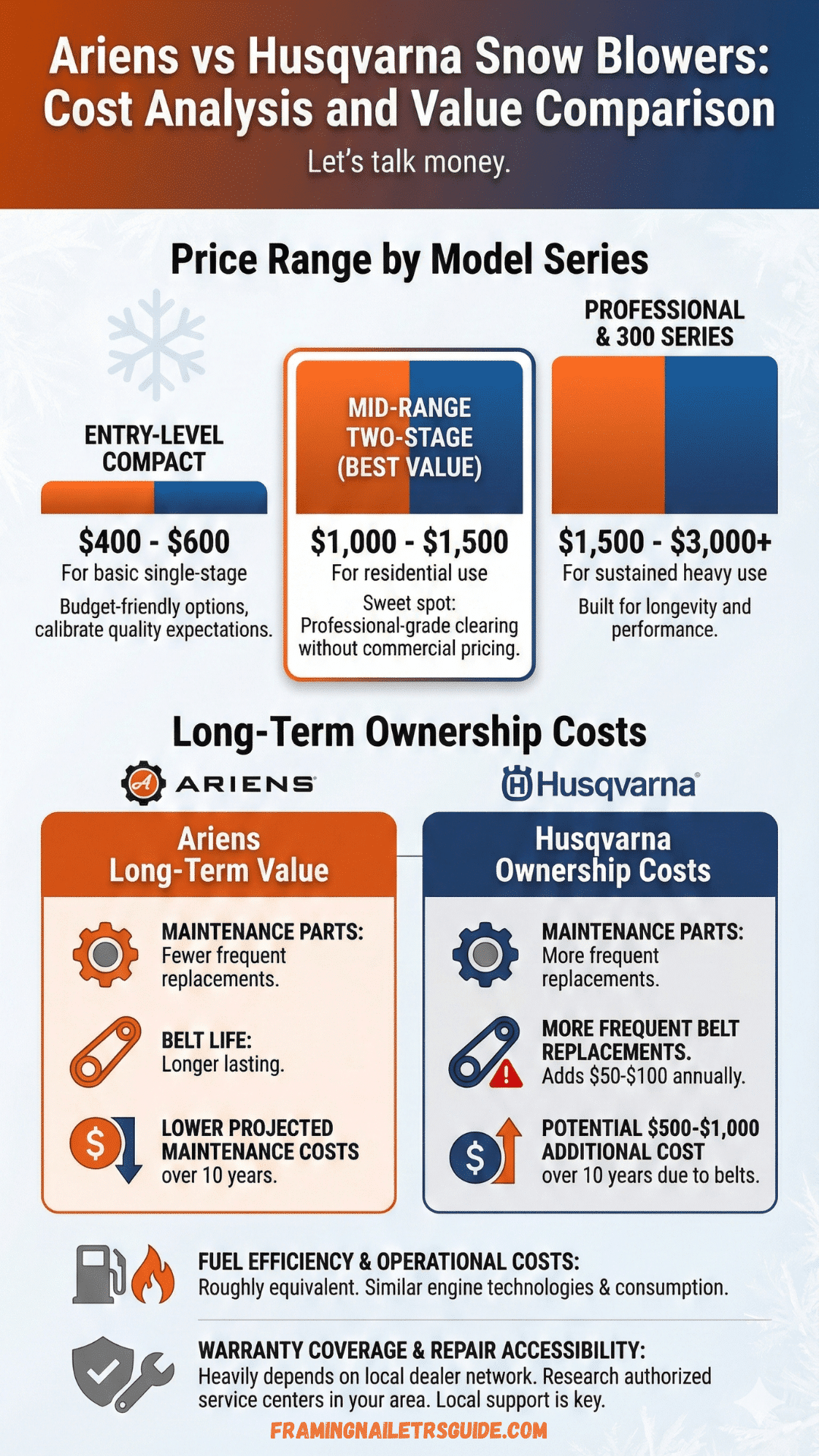
Entry-level compact models range from around $400-600 for basic single-stage units. Both brands offer budget-friendly options in this range, though quality and durability expectations should be calibrated accordingly.
Mid-range two-stage units represent the best value for residential use, typically priced between $1,000-1,500. This sweet spot delivers professional-grade clearing capability without commercial-grade pricing.
Professional and 300 Series models command premium pricing from $1,500-3,000+. These machines are built for sustained heavy use and justify their cost through longevity and performance.
Long-Term Ownership Costs
Maintenance part replacement frequency matters more than initial purchase price over a 10-year ownership period.
Husqvarna’s more frequent belt replacements add $50-100 annually compared to Ariens. Over ten years, that’s potentially $500-1,000 in additional maintenance costs.
Fuel efficiency and operational costs remain roughly equivalent. Both brands use similar engine technologies with comparable consumption rates.
Warranty coverage and repair accessibility depend heavily on your local dealer network. Research authorized service centers in your area before purchasing—a slightly better warranty means nothing if the nearest service center is 100 miles away.
Frequently Asked Questions
Which brand throws snow farther—Ariens or Husqvarna?
Ariens throws snow up to 60 feet, approximately 5 feet farther than comparable Husqvarna models, thanks to its more powerful 223cc engine. For most residential applications, this difference is negligible, but commercial users and those clearing very large areas will notice the advantage.
How often should I replace snow blower belts?
Single-stage belts wear faster and may need annual replacement, while two-stage belts can last 2-3 seasons with proper maintenance. Inspect monthly for cracks or fraying—catching wear early prevents getting stranded mid-storm.
What causes a snow blower to leave snow behind?
Common causes include worn auger belts, improper skid shoe height adjustment, or operating speed too fast for snow conditions. Slow down and make overlapping passes rather than rushing through in single passes.
Can I use regular automotive oil in my snow blower?
Always use manufacturer-specified oil types—typically 5W-30 for most conditions—and change according to manual recommendations. Automotive oil formulations work, but small engine oils include additives that protect air-cooled engines better.
Why won’t my snow blower start in extremely cold weather?
Check fuel freshness (gasoline can gel in extreme cold), verify spark plug condition, and ensure battery charge on electric-start models. Husqvarna’s electric start systems are specifically designed for extreme cold reliability, but even the best systems struggle if batteries aren’t properly maintained.
How do I prevent my discharge chute from clogging?
Clear wet snow in smaller passes, spray silicone lubricant inside the chute before use, and avoid overloading the auger system. I coat my chute with cooking spray in a pinch—works surprisingly well for a session or two.
Are heated grips worth the extra cost?
For extended operation in sub-zero temperatures, Husqvarna’s heated grips significantly improve comfort and allow longer working periods. I initially dismissed this as unnecessary luxury. After borrowing a friend’s Husqvarna with heated grips during a particularly brutal cold snap? I’m a convert.
What size snow blower do I need for a 2-car driveway?
A 24-28 inch clearing width two-stage model efficiently handles standard 2-car driveways measuring 18-20 feet wide. Match your machine to your driveway dimensions with about 20% excess capacity for efficiency.
Final Thoughts
Both Ariens and Husqvarna build capable machines that’ll serve you well with proper maintenance.
Ariens excels in raw power, durability, and maximum clearing capacity. Husqvarna wins on operator comfort and cold-weather convenience features.
Your choice ultimately comes down to what matters most in your specific situation. Heavy commercial use? Ariens. Comfort during long residential clearing sessions? Husqvarna.
Either way, you’re getting a quality machine that’ll make winter just a bit more manageable.
And honestly? That’s all any of us can ask when facing down another snowstorm.
