
Last Updated on December 15, 2025 by John Patterson
Look, I get it.
You’re shopping for a microscope, and you’re drowning in marketing nonsense.
High-end research brands next to kids’ toy microscopes. Medical-grade equipment you’ll never use mixed with budget digital units that might actually solve your problem.
Here’s what most microscope buying guides won’t tell you: the “best” microscope completely depends on what you’re actually going to do with it.
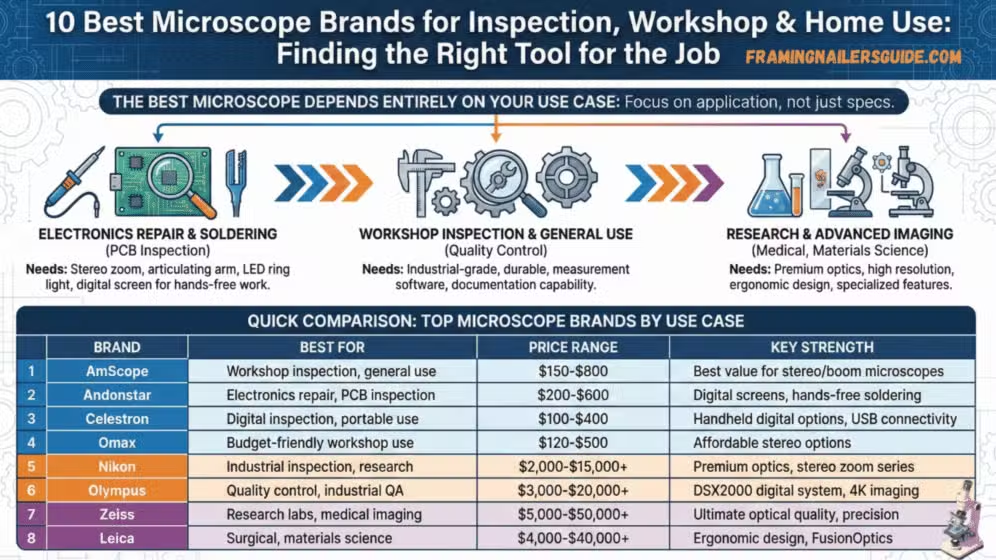
Are you inspecting PCB boards for electronics repair? You need a stereo zoom microscope with articulating arm and LED ring light—not a $15,000 Zeiss research unit.
Building circuit boards? Soldering SMD components? A digital inspection microscope with screen beats looking through eyepieces all day.
Running a quality control lab for manufacturing? Now we’re talking industrial-grade equipment with measurement software and documentation capability.
I’ve spent years working with microscopes across different applications—from hobbyist electronics repair to professional workshop inspection to high-end research environments.
And I’ll break down which brands actually matter for your specific use case, not just which ones sound impressive.
Let’s cut through the noise.
Quick Comparison: Top Microscope Picks by Use Case
| Brand | Best For | Price Range | Key Strength |
|---|---|---|---|
| Olympus | Quality control, industrial QA | $3,000-$20,000+ | DSX2000 digital system, 4K imaging |
| Zeiss | Research labs, medical imaging | $5,000-$50,000+ | Ultimate optical quality, precision |
| Nikon | DIY firewood boom | $2,000-$15,000+ | Premium optics, stereo zoom series |
| Leica | Surgical, materials science | $4,000-$40,000+ | Ergonomic design, FusionOptics |
| Andonstar | Electronics repair, PCB inspection | $200-$600 | Digital screens, hands-free soldering |
| Celestron | Digital inspection, portable use | $100-$400 | Handheld digital options, USB connectivity |
| AmScope | Workshop inspection, general use | $150-$800 | Best value for stereo/boom microscopes |
| Omax | Budget-friendly workshop use | $120-$500 | Affordable stereo options |
Best Microscope Brands for Workshop & Industrial Inspection
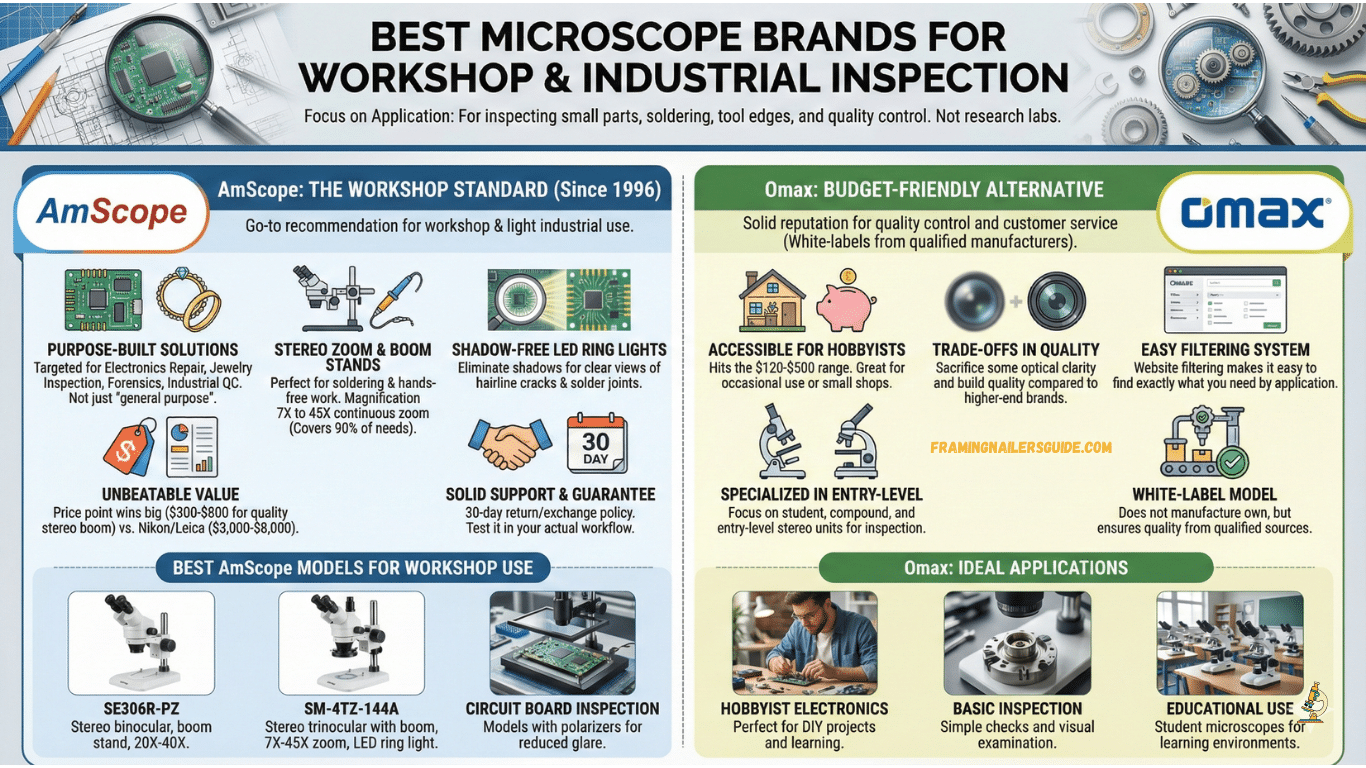
This is where most tool-focused buyers actually land. You’re not running a research lab. You need to inspect small parts, solder electronics, examine tool edges, or check quality on manufactured components.
AmScope: The Workshop Standard
AmScope has been my go-to recommendation for workshop and light industrial use since they started back in 1996. Here’s why they dominate this segment.
They make purpose-built microscopes for specific applications. Electronics repair. Jewelry inspection. Forensics. Industrial quality control. Instead of one “general purpose” microscope that’s mediocre at everything, you get targeted solutions.
Their stereo zoom microscopes—particularly the boom-stand models—are perfect for soldering, circuit board inspection, and any work where you need both hands free. Magnification typically runs 7X to 45X with continuous zoom, which covers 90% of workshop inspection needs.
LED ring lights on most models eliminate shadows and provide even illumination—critical when you’re trying to identify a hairline crack in a circuit trace or inspect a solder joint.
Price point is where AmScope wins big. A quality stereo boom microscope runs $300-$800 depending on accessories. That same capability from Nikon or Leica? You’re looking at $3,000-$8,000.
Customer support is solid. Thirty-day return/exchange policy gives you time to test it in your actual workflow before committing.
Best AmScope models for workshop use:
-
SE306R-PZ (stereo binocular, boom stand, 20X-40X)
-
SM-4TZ-144A (stereo trinocular with boom, 7X-45X zoom, LED ring light)
-
Circuit board inspection microscopes with polarizers
Omax: Budget-Friendly Alternative
Omax doesn’t manufacture their own microscopes—they white-label from qualified manufacturers. But they’ve built a solid reputation for quality control and customer service.
Their stereo microscopes hit the $120-$500 range, making them accessible for hobbyists or small shops that can’t justify AmScope pricing. You sacrifice some optical clarity and build quality, but for occasional use, they work.
Omax specializes in student microscopes, compound microscopes for basic lab work, and entry-level stereo units for inspection. Their filtering system on the website makes it easy to find exactly what you need by application.
Best Digital Inspection Microscopes (Electronics & PCB Repair)
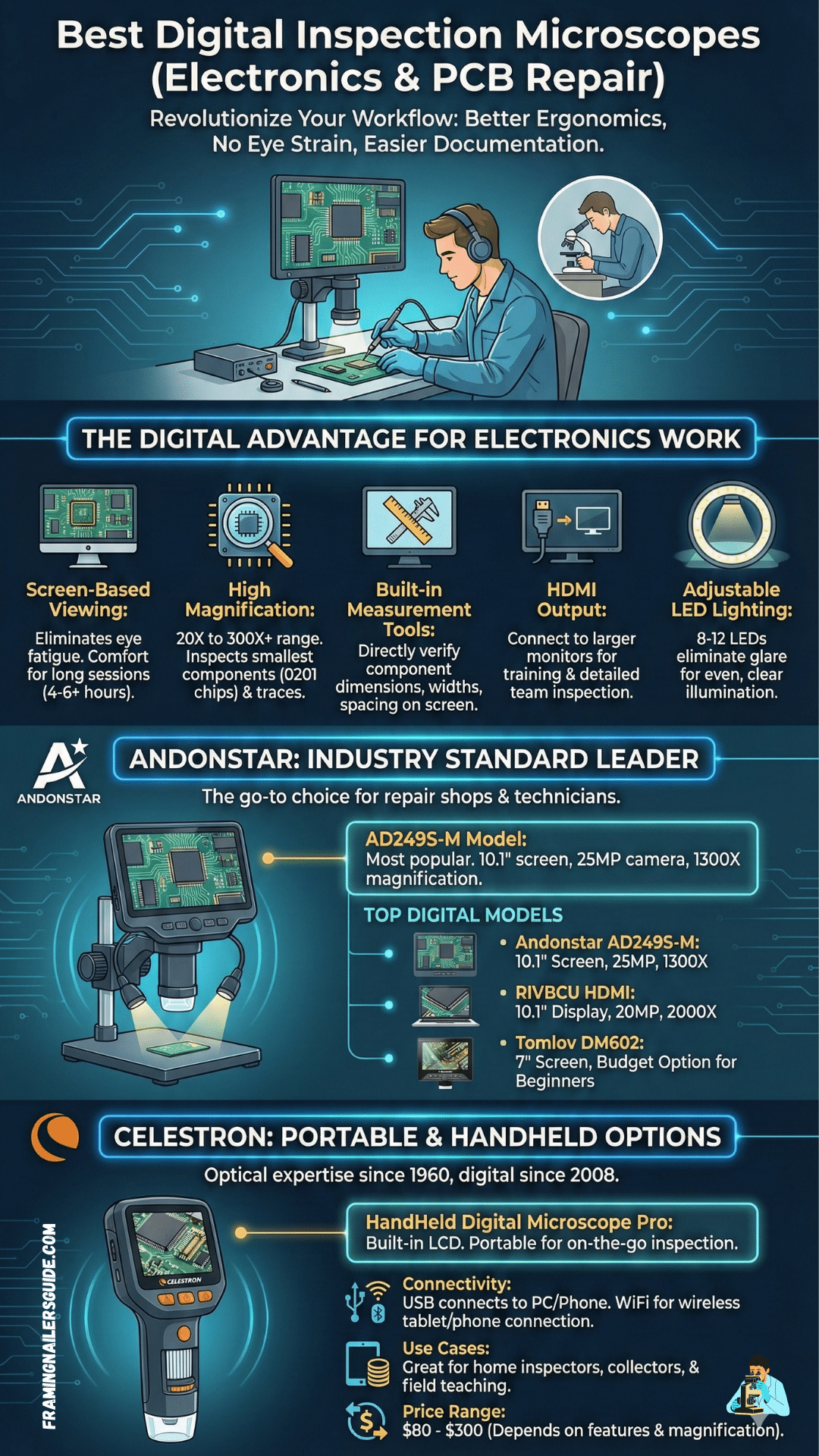
If you’re doing electronics repair, PCB rework, or SMD soldering, digital microscopes with screens have revolutionized the workflow. No more neck strain from eyepieces. Better ergonomics. Easier documentation.
Andonstar: Digital Microscope Leader
Andonstar has become the industry standard for electronics repair microscopes over the past 3-4 years. The AD249S-M model is what most phone repair shops, computer technicians, and electronics hobbyists are using now.
Why digital beats traditional for electronics work:
Screens eliminate eye fatigue. When you’re soldering for 4-6 hours straight, looking at a 7-10 inch monitor beats staring through eyepieces.
Magnification runs 20X to 300X+ depending on model—more than enough for inspecting 0201 chip components or tracing PCB damage.
Built-in measurement tools let you verify component dimensions, trace widths, and pad spacing directly on screen.
HDMI output means you can connect to larger monitors for training or detailed inspection work.
Adjustable LED lighting (8-12 LEDs typical) eliminates glare on reflective surfaces and provides even illumination across the entire field of view.
Top digital microscope models for 2025:
-
Andonstar AD249S-M (10.1″ screen, 25MP camera, 1300X magnification)
-
RIVBCU HDMI model (10.1″ display, 2000X magnification, 20MP)
-
Tomlov DM602 (budget option, 7″ screen, good for beginners)
Celestron: Digital Handheld Options
Celestron’s been making telescopes since 1960 and brought that optical expertise to digital microscopes in 2008. Their handheld digital units connect via USB to computers or smartphones, making them incredibly portable.
The HandHeld Digital Microscope Pro is popular with home inspectors, coin collectors, and anyone who needs magnification on-the-go. Built-in LCD screen eliminates the need for external devices in field situations.
WiFi models let you connect wirelessly to tablets or phones—useful when you’re inspecting hard-to-reach areas or teaching a group of students.
Price runs $80-$300 depending on features and magnification range.
Premium Brands for Professional & Research Use
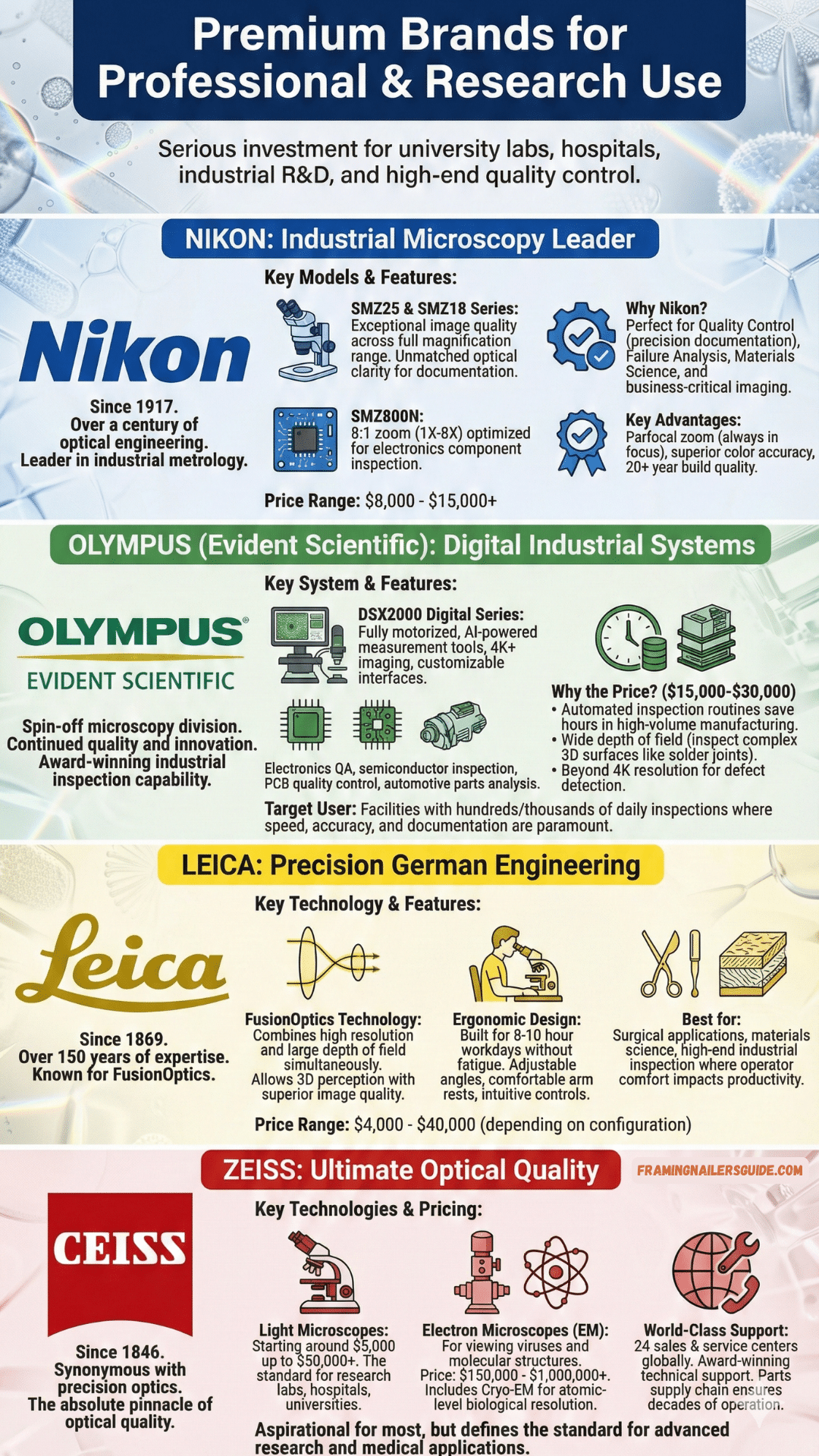
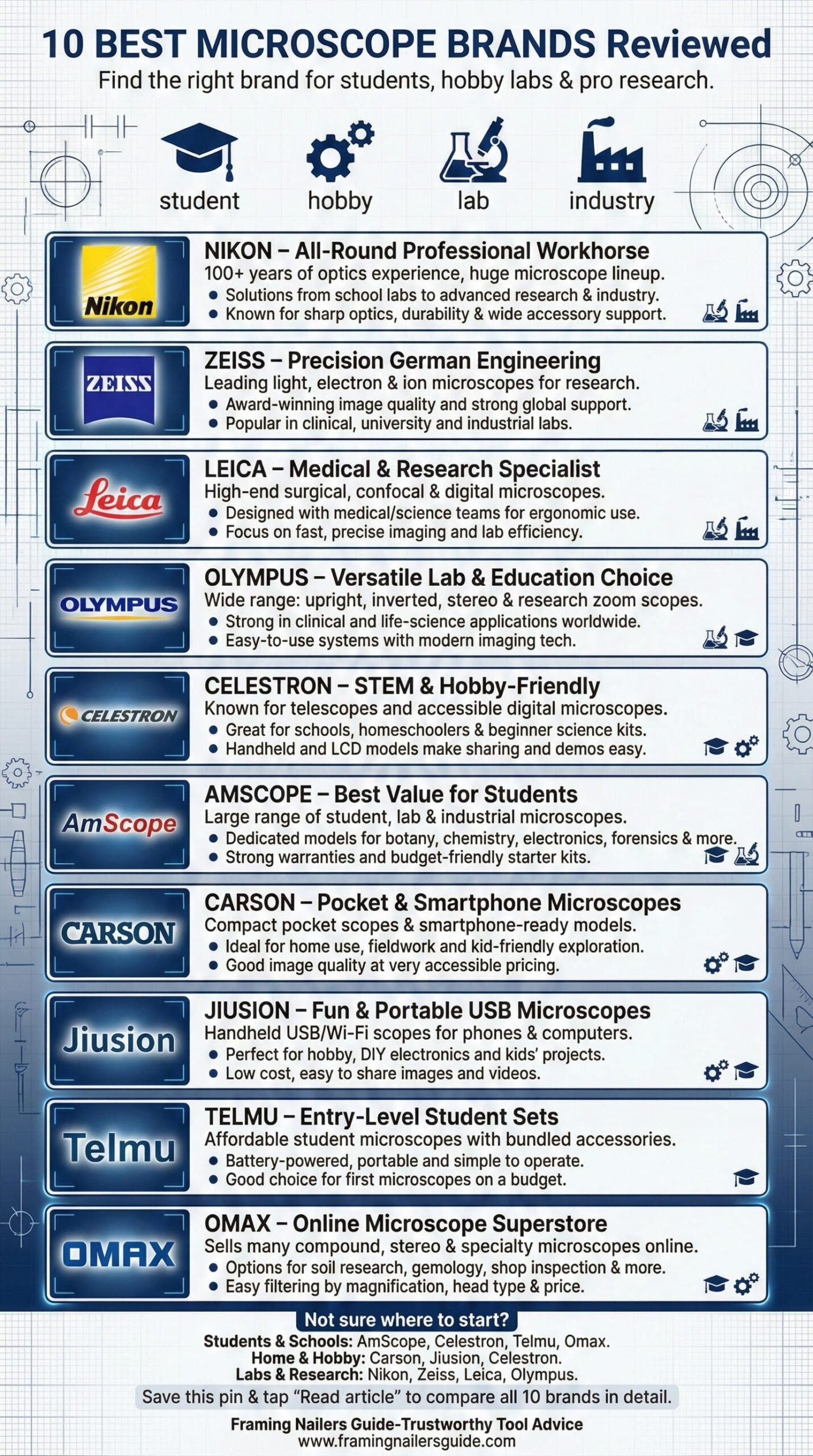
Now we move into serious money. These brands are what you find in university research labs, hospital pathology departments, industrial R&D facilities, and high-end manufacturing quality control operations.
Nikon: Industrial Microscopy Leader
Nikon’s been making microscopes since 1917—over a century of optical engineering expertise. Their industrial metrology division produces some of the finest stereo zoom microscopes available.
The SMZ25 and SMZ18 stereo microscope series deliver exceptional image quality throughout the full magnification range. These aren’t cheap ($8,000-$15,000+), but the optical clarity is unmatched for documentation and inspection work.
For electronics manufacturing and failure analysis, the SMZ800N offers 8:1 zoom ratio (1X-8X) specifically optimized for component inspection.
When Nikon makes sense:
-
Quality control in manufacturing where precision documentation is required
-
Failure analysis for determining root causes of product defects
-
Materials science research needing excellent depth of field
-
Any application where image quality directly impacts business decisions
You’re paying for parfocal zoom (stays in focus across the zoom range), superior color accuracy, and build quality that lasts 20+ years in industrial environments.
Olympus (Now Evident Scientific): Digital Industrial Systems
Olympus spun off their microscopy division into Evident Scientific, but the quality and innovation continue. Their DSX2000 digital microscope series has won multiple awards for industrial inspection capability.
This is a fully motorized digital system with AI-powered measurement tools, 4K+ imaging, and customizable interfaces. It’s designed for electronics QA, semiconductor inspection, PCB quality control, and automotive parts analysis.
What makes it worth $15,000-$30,000?
Automated inspection routines save hours per day in high-volume manufacturing. Set up measurement protocols once, then let the system document every part automatically.
Wide depth of field lets you inspect complex 3D surfaces (solder joints, bonding wires, microcracks) without constant refocusing.
Beyond 4K resolution captures details traditional microscopes miss—critical for semiconductor defect detection and microelectronics work.
This isn’t for hobbyists. It’s for facilities doing hundreds or thousands of inspections daily where speed, accuracy, and documentation are paramount.
Leica: Precision German Engineering
Leica’s been manufacturing microscopes since 1869—that’s over 150 years. They’re known for FusionOptics technology, which combines high resolution in one optical path with large depth of field in another, giving you both simultaneously.
For PCB inspection and electronics work, Leica’s stereo microscopes with FusionOptics allow 3D perception while maintaining higher resolution and larger depth of field than traditional stereo microscopes.
Ergonomic design is where Leica really shines. Their microscopes are built for 8-10 hour workdays without fatigue. Adjustable eyepiece angles, comfortable arm rests, intuitive controls—all the little details that matter when you’re using equipment all day, every day.
Price: $4,000-$40,000 depending on configuration and accessories.
Best for: Surgical applications, materials science, high-end industrial inspection where ergonomics and operator comfort directly impact productivity.
Zeiss: Ultimate Optical Quality
Carl Zeiss has been synonymous with precision optics since 1846. Their microscopes represent the absolute pinnacle of optical quality—and the price reflects it.
Light microscopes start around $5,000 and go up to $50,000+. Electron microscopes (for viewing viruses and molecular structures) run $150,000-$1,000,000+.
Zeiss cryo-electron microscopy has enabled breakthrough research in virology and molecular biology by freezing samples to preserve biological relevance while achieving atomic-level resolution.
For most readers of this article, Zeiss is aspirational rather than practical. But if you’re setting up a research lab, hospital pathology department, or university teaching facility, Zeiss equipment defines the standard.
Customer support is world-class—24 sales and service centers globally, award-winning technical support, and a parts supply chain that ensures your equipment stays operational for decades.
Budget & Student Microscope Brands

Not everyone needs industrial-grade equipment. If you’re a student, educator, hobbyist, or parent wanting to introduce kids to microscopy, these brands deliver quality at accessible prices.
Carson: Pocket Microscopes & Smartphone Options
Carson’s been in the optical industry since 1990, carving out a niche in portable and smartphone-compatible microscopes.
Their MicroMini pocket microscopes ($15-$40) fit in your palm and provide 20X-60X magnification—perfect for field identification of plants, insects, minerals, or on-the-go inspection tasks.
Smartphone microscopes with adapters let kids (and adults) capture photos and videos easily. The MS-160SP connects directly to your phone’s camera, turning it into a capable digital microscope for $30-$50.
Quality is surprisingly good for the price. Don’t expect research-grade optics, but for educational use and casual observation, Carson delivers.
Jiusion: WiFi-Connected Digital Microscopes
Jiusion makes handheld digital microscopes compatible with iOS, Android, Windows, macOS, and Linux. True cross-platform compatibility is rare and valuable. [Original content]
Most models include WiFi boxes for wireless streaming to tablets or laptops—great for classrooms or group observation. Some units are even IP67 waterproof for outdoor field work. [Original content]
Price runs $30-$150 depending on magnification and features. These are fun-project microscopes, not precision instruments. But for the cost of a decent restaurant meal, you can inspire a kid’s interest in science.
Buying Guide: Which Microscope Type Do You Actually Need?
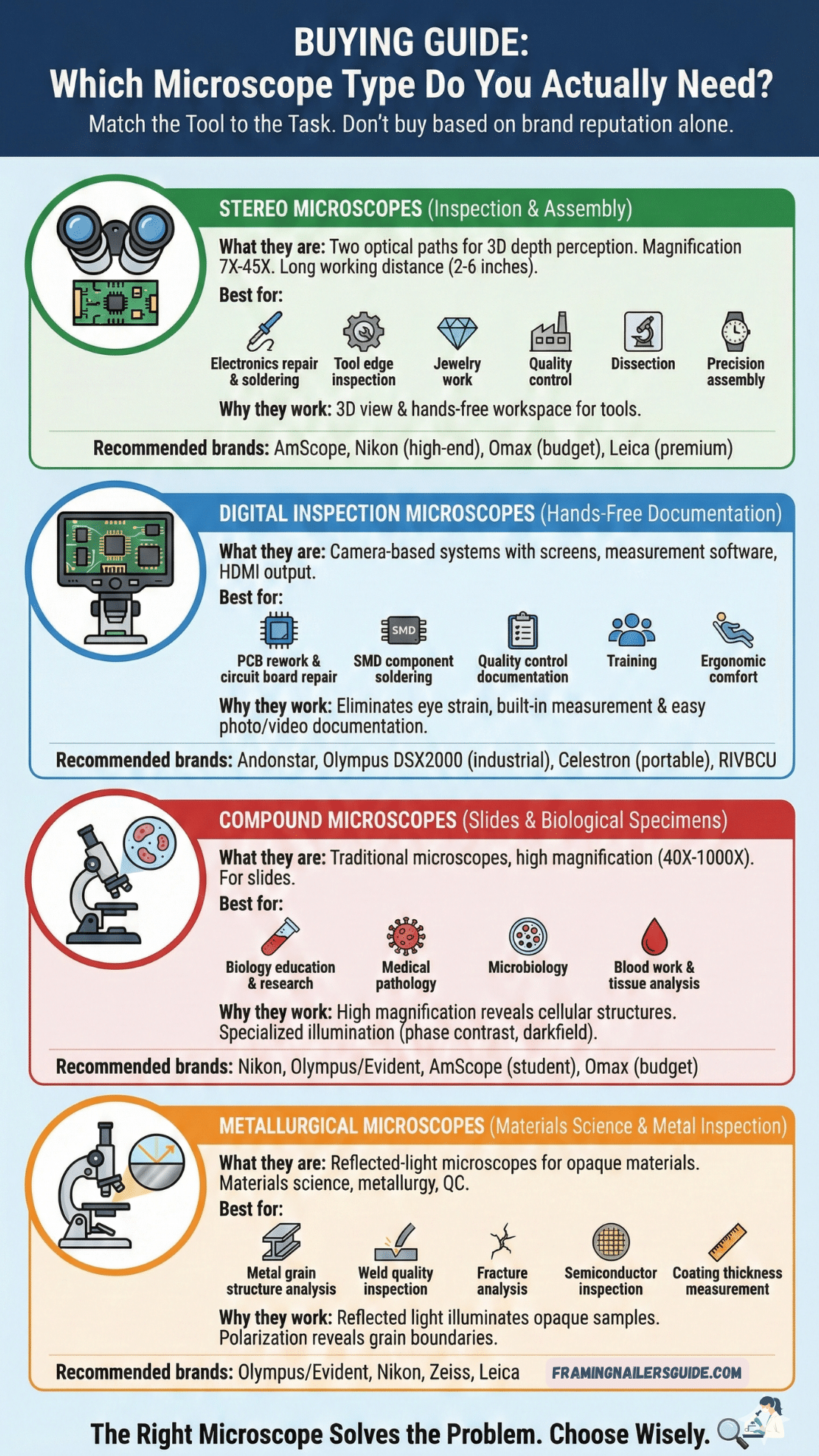
This is where most people go wrong. They buy based on brand reputation instead of matching the tool to the task.
Stereo Microscopes (Inspection & Assembly)
What they are: Two separate optical paths providing 3D depth perception. Magnification typically 7X to 45X. Long working distance (2-6 inches).
Best for:
-
Electronics repair and soldering
-
Tool edge inspection and sharpening
-
Jewelry work and gem identification
-
Quality control inspection in manufacturing
-
Dissection and biological specimen preparation
-
Watch repair and precision assembly
Why they work: You need both hands free to work under the microscope. The 3D view helps with depth perception when manipulating small parts. Longer working distance accommodates tools (soldering iron, tweezers, probes).
Recommended brands: AmScope, Nikon (high-end), Omax (budget), Leica (premium)
Digital Inspection Microscopes (Hands-Free Documentation)
What they are: Camera-based systems with screens instead of eyepieces. Often include measurement software and HDMI output.
Best for:
-
PCB rework and circuit board repair
-
SMD component soldering and inspection
-
Quality control with documentation requirements
-
Training (screen allows multiple people to view simultaneously)
-
Ergonomic comfort during extended use
Why they work: Eliminates eye strain from eyepieces. Measurement tools built into software. Easy photo/video documentation for reports or customer communication.
Recommended brands: Andonstar, Olympus DSX2000 (industrial), Celestron (portable), RIVBCU
Compound Microscopes (Slides & Biological Specimens)
What they are: Traditional microscopes with high magnification (40X-1000X). Designed for viewing prepared slides or thin specimens on glass.
Best for:
-
Biology education and research
-
Medical pathology and diagnostics
-
Microbiology and cell culture work
-
Blood work and tissue analysis
Why they work: High magnification reveals cellular structures, bacteria, parasites, and tissue detail. Parfocal objectives stay in focus when changing magnification. Specialized illumination (phase contrast, darkfield) reveals different sample features.
Recommended brands: Nikon, Olympus/Evident, AmScope (student models), Omax (budget)
Metallurgical Microscopes (Materials Science & Metal Inspection)
What they are: Reflected-light microscopes designed for inspecting opaque materials. Used in materials science, metallurgy, and industrial quality control.
Best for:
-
Metal grain structure analysis
-
Weld quality inspection
-
Fracture analysis and failure investigation
-
Semiconductor wafer inspection
-
Coating thickness measurement
Why they work: Reflected light illuminates opaque samples from above. Polarization reveals grain boundaries and stress patterns. Digital measurement tools quantify defects and dimensional features.
Recommended brands: Olympus/Evident, Nikon, Zeiss, Leica
Frequently Asked Questions
What’s the best microscope for electronics repair and PCB inspection?
For electronics repair and PCB inspection, a stereo zoom microscope with boom stand or a digital inspection microscope works best.
AmScope’s stereo models ($300-$800) offer hands-free work with 7X-45X magnification and LED ring lights for shadowless illumination.
For digital options, the Andonstar AD249S-M ($400-$600) features a 10.1″ screen, 1300X magnification, and built-in measurement tools—eliminating eye strain during long soldering sessions.
Digital vs optical microscope: which is better for workshop use?
Digital microscopes with screens are superior for extended workshop use because they eliminate neck and eye strain, allow multiple people to view simultaneously, and make documentation easy.
However, optical stereo microscopes provide true 3D depth perception crucial for precision assembly and manipulation work.
Best solution: stereo optical microscope with trinocular port for attaching a camera when documentation is needed.
How much magnification do I need for soldering SMD components?
For SMD (surface-mount device) soldering, 7X to 45X magnification covers most needs.
Smaller components like 0402 or 0201 chips benefit from 30X-50X range. Avoid exceeding 60X for hands-on work—higher magnification reduces depth of field and working distance, making tool manipulation difficult.
Digital microscopes often list much higher magnifications (300X-2000X), but these are digital zoom specifications, not optical.
Optical magnification in the 20X-80X range is what matters for practical soldering work.
What features matter most in an inspection microscope?
The most important features for an inspection microscope are: working distance (2-6 inches allows tool access under the lens), adjustable LED lighting (eliminates shadows and glare), boom stand (positions microscope over large workpieces), continuous zoom (smooth transition between magnifications without changing lenses), and 3D depth perception (stereo optical path for manipulating parts).
For digital models, add screen size (7-10 inches), HDMI output for external monitors, and built-in measurement software.
Best microscope brands for industrial quality control?
For industrial quality control and manufacturing inspection, Olympus (Evident Scientific) DSX2000 digital microscope series, Nikon SMZ stereo zoom microscopes, and Leica stereo models with FusionOptics lead the market.
These systems offer motorized inspection routines, AI-powered measurement tools, 4K+ imaging, and documentation software for QA/QC protocols.
Prices range from $8,000 (entry Nikon stereo) to $30,000+ (fully configured Olympus DSX2000 system).
For budget-conscious operations, AmScope’s industrial inspection microscopes ($500-$1,500) provide solid capability at a fraction of premium brand costs.
Can I use a biological microscope for electronics work?
No. Biological compound microscopes are designed for viewing thin specimens on glass slides with transmitted light (light shining through the sample).
Electronics components are opaque and three-dimensional, requiring reflected light from above and much lower magnification (10X-50X vs 100X-1000X).
Use a stereo microscope or digital inspection microscope for electronics—these provide 3D view, longer working distance, and appropriate magnification for circuit board work.
What’s the difference between a stereo microscope and a zoom microscope?
“Stereo microscope” and “zoom microscope” often describe the same instrument. Stereo refers to the dual optical paths providing 3D depth perception.
Zoom indicates continuously variable magnification without changing objective lenses. Most modern stereo microscopes feature zoom capability (e.g., 7X-45X continuous zoom).
Fixed-magnification stereo microscopes still exist but are less common.
When shopping, “stereo zoom microscope” gives you both 3D viewing and magnification flexibility—ideal for inspection and assembly work.
How expensive is a quality microscope for home workshop use?
Quality microscopes for home workshop use range from $200-$800 depending on features.
AmScope stereo microscopes with boom stands run $300-$500 for basic models, $500-$800 with trinocular ports and better optics.
Digital inspection microscopes like Andonstar or Tomlov cost $200-$600 with screens and LED lighting.
Budget options from Omax or Celestron start around $120-$250 but sacrifice optical quality and durability.
For occasional hobby use, $200-$400 delivers solid capability. For daily professional use, budget $500-$1,000 for equipment that will last years.
Which microscope brands are made in USA?
AmScope designs and distributes from California but manufactures internationally (primarily China).
Most major microscope brands manufacture globally—Nikon (Japan), Olympus/Evident (Japan), Zeiss (Germany), Leica (Germany/Switzerland).
Few microscopes are fully manufactured in the USA due to specialized optics manufacturing.
However, many premium brands have US assembly facilities for final configuration and quality control.
For buying American, focus on US-based companies with strong customer support (AmScope, Swift) rather than manufacturing location—service and warranty matter more for long-term satisfaction.
What microscope do professional electronics repair shops use?
Professional electronics repair shops predominantly use either stereo zoom microscopes with boom stands (AmScope, Nikon SMZ series) or digital inspection microscopes with screens (Andonstar AD249S-M, Mantis Elite).
Phone repair shops often prefer digital models with 7-10 inch screens for ergonomic comfort during all-day microsoldering.
Computer and laptop repair facilities typically use stereo boom microscopes for flexibility positioning over large motherboards.
High-volume operations invest in multiple stations with both types—stereo for hands-on work, digital for quality inspection and customer documentation.
Budget for professional setups: $800-$2,500 per workstation.
Choosing the Right Brand for Your Actual Needs
Here’s how I’d make the decision if I were buying today.
For electronics repair, PCB work, or SMD soldering: Andonstar AD249S-M or AmScope stereo boom microscope. Budget $400-$800. The screen eliminates eye fatigue, and boom stands position over any size board.
For workshop inspection, tool maintenance, or quality control: AmScope stereo zoom microscope with LED ring light. Budget $300-$600. Proven reliability, good customer support, parts availability.
For industrial manufacturing or R&D: Nikon SMZ stereo series or Olympus DSX2000 digital system depending on volume and documentation needs. Budget $8,000-$25,000. ROI justifies cost in high-volume operations.
For students or education: AmScope SE306R-PZ or Carson smartphone-compatible models. Budget $150-$400. Durable enough for classroom use, accurate enough for learning.
For hobby and casual use: Jiusion WiFi digital microscope or Celestron handheld. Budget $80-$250. Portable, fun to use, good enough for exploring coins, plants, insects, materials.
For research labs or medical facilities: Nikon, Zeiss, Olympus/Evident, or Leica depending on specific application. Budget $5,000-$50,000+. Consult directly with manufacturer reps for configuration.
The brands I’d personally avoid? Generic Amazon brands with no established support infrastructure. Toy microscopes marketed to kids but incapable of useful magnification. Overpriced “multimedia” microscopes that do everything poorly instead of one thing well.
Final Thoughts
The microscope market spans five orders of magnitude in price—from $20 pocket microscopes to $2,000,000 electron microscopes. That’s why “best brand” is meaningless without context.
AmScope dominates the workshop/inspection segment for good reason: solid quality, reasonable prices, specific solutions for specific applications.
Andonstar revolutionized electronics repair with affordable digital microscopes that actually work.
Nikon, Olympus, Zeiss, and Leica represent the premium tier—justified expense for operations where precision, documentation, and reliability directly impact business outcomes.
Match the tool to the task. A $300 AmScope stereo microscope will serve a home workshop better than a $15,000 Zeiss research microscope. And a $500 Andonstar digital unit will make an electronics tech more productive than a $5,000 Nikon stereo that causes neck strain after four hours.
Buy for your actual use case, not for the brand name.
Ready to get started? Check out these resources:
AmScope Electronics & Circuit Board Microscopes – Purpose-built stereo microscopes for PCB work
Digital Microscopes for Industrial Inspection – Olympus/Evident DSX2000 series specifications
Nikon Industrial Stereo Microscopes – SMZ series technical information
Best Microscopes for Electronic Repair 2025 – Real-world recommendations from repair professionals
